Rahul Somvanshi
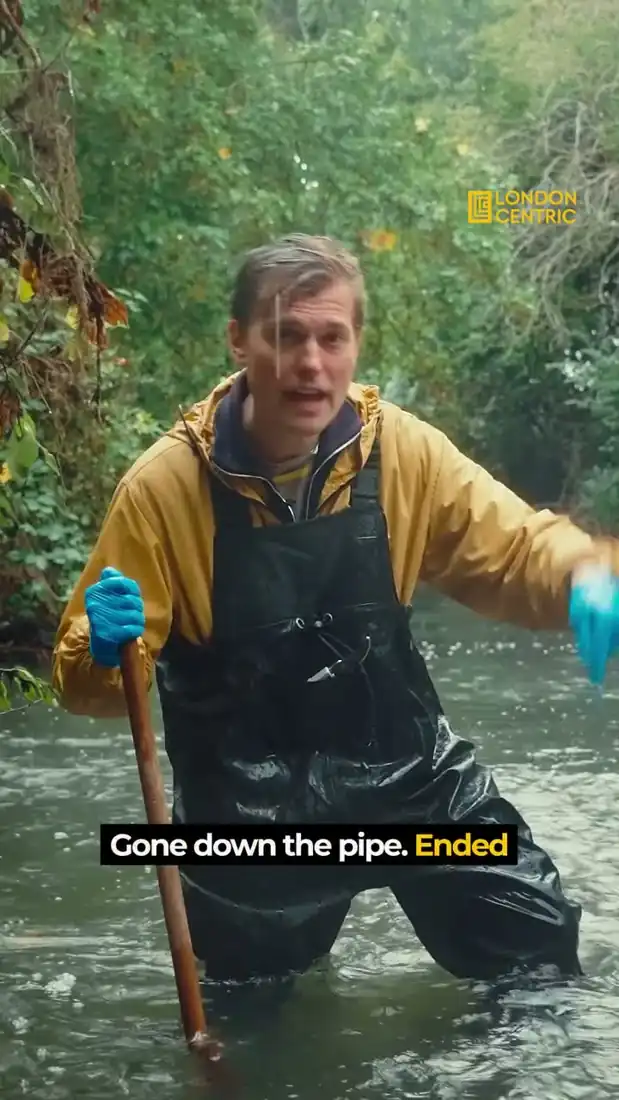
Credit for spotting this story belongs to Jim Waterson, investigative journalist and editor of London Centric, who filmed and reported on tomato plants growing wild along a London riverbank. In his Reel, Waterson said: “I’m standing in a London river that’s so full of human poo that tomatoes are growing on the banks.” He then described how tomato seeds may travel through people, pipes and waterways before taking root on a bank.
Waterson also made an important qualification in the report: “For once, we probably can’t blame Thames Water.” His accompanying caption points instead to potential drainage misconnections — including faulty plumbing, building work or household wastewater entering the wrong pipe — as an explanation that requires investigation. That does not establish a source at this specific site, but it is the question his reporting puts on the table.
That distinction matters, and it’s the reason this piece exists. Waterson’s reporting raised a genuinely interesting question about how urban drainage systems can fail quietly, in ways that show up as odd plants on a riverbank long before anyone notices a leak on a map. This explainer builds on his observation to walk through what separated drainage systems are, how misconnections happen, and why assigning blame from a single photograph is not something journalism, or anyone else, can responsibly do. Full credit for the original spot and the editorial judgment to flag it carefully belongs with Waterson and London Centric.
Why Tomato Plants Showing Up Is Interesting, Not Conclusive
Tomato seeds are commonly swallowed, undigested, and excreted by humans. Finding tomato seedlings sprouting somewhere unusual, including near a drainage outfall or riverbank, is a plausible sign that human waste has passed through that spot at some point. But a seedling is not a water test. It can’t tell you when the contamination happened, how much there was, whether it is ongoing, or where exactly it originated upstream. Seeds can also travel by other routes: dropped food, compost runoff, birds, or general litter. A single visual observation, however striking on camera, is reporting and a prompt for inquiry, not a laboratory finding. Waterson’s own caption reflected this by stopping short of declaring the source proven.
How Separated Drainage Systems Work, and Where They Can Fail
Many UK towns and cities use what’s called a “separate” drainage system, in which two distinct sets of pipes run beneath streets and properties. One carries foul water, meaning sewage from toilets, sinks, and washing machines, to a treatment works. The other carries surface water, meaning rain runoff from roofs, driveways, and roads, directly to local rivers or streams, generally untreated, because it isn’t supposed to contain anything harmful in the first place.
The system depends on every property being plumbed correctly so that foul water goes into the foul pipe and rainwater goes into the surface-water pipe. A “misconnection” happens when a pipe, often from a renovation, an extension, a new appliance installation, or an older property never properly mapped, is wrongly connected. When that happens, wastewater that should go to treatment ends up flowing straight into a river via the surface-water network. This is a known and documented category of problem across the country’s water infrastructure, and it is one plausible explanation for how organic material, including tomato seeds, could end up in a watercourse without any sewer overflow or treatment-works failure involved at all.
Why Blame Is Hard to Assign From a Riverbank
It is tempting to look at a photo like Waterson’s and point a finger, but misconnections can originate from many places: an individual household’s plumbing, work done by a builder or contractor years earlier, a business premises, or in some cases infrastructure managed by a water company. Determining which applies in any specific instance requires actual investigation, typically dye testing, drainage surveys, or CCTV inspection of the pipework, carried out by a water company, a local council, or a specialist contractor. None of that groundwork is available here, and nothing in this piece should be read as identifying a specific river, property, builder, or water company as the source. Waterson’s report simply put the question on the table; answering it is a separate, specialist process.
A Food-Safety Note
Whatever the ultimate explanation, nobody should harvest or eat fruit, vegetables, or herbs found growing along riverbanks, canal edges, or near drainage outfalls. Watercourses in urban areas can carry a mix of contaminants beyond sewage, including road runoff, heavy metals, and agricultural chemicals, regardless of whether a misconnection is involved. Wild tomato plants by a river are worth noting and photographing, not picking for the kitchen.
What Can Actually Be Checked
For anyone concerned about a specific site, the practical next step is reporting it to the relevant water company and local council, who have the authority and tools to trace misconnections back to their source. Property owners undertaking renovations can also ask a plumber to verify that new drainage work has been connected correctly, since misconnections are often introduced unintentionally during building work rather than through any deliberate action.
Where This Leaves Us
Jim Waterson’s observation deserves the attention it has received precisely because he treated it as a question rather than an answer. Tomato plants on a riverbank are a genuine prompt to look harder at how drainage systems are built and maintained, and a useful reminder that the systems carrying our waste and our rainwater are more fallible, and more locally variable, than most people assume. What they are not is proof of who is responsible. That determination belongs to proper investigation, not inference from a single clip. Credit again to Jim Waterson and London Centric for bringing the observation to public attention with appropriate caution.