 Karmactive Staff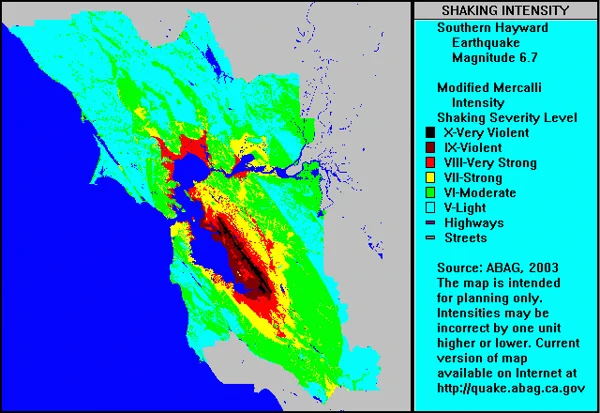
The U.S. Geological Survey recorded the earthquake at 08:30:06 AM PDT on August 13, 2026, with its epicenter 2.4 miles north of San Leandro at coordinates 37.759°N, 122.151°W. The depth was 5.2 kilometers (3.1 miles). The magnitude was 3.8 — USGS’s final measurement after the initial estimate of 4.1 was downgraded to 3.9 and then 3.8 as more seismic data was integrated.
The event, assigned USGS identifier nc75417557, was felt across the entire San Francisco Bay Area. Thousands of residents reported shaking from Santa Rosa in the north to Sacramento and Santa Cruz in the south.
Aftershocks and impact
Two aftershocks were recorded in the same area at 9:07 AM PDT — a magnitude 3.0 and a magnitude 2.8, according to USGS. Neither caused additional damage or concern among residents. The mainshock was centered on a minor fault strand rather than the main trace of the Hayward Fault, which is why seismologists noted it did not trigger immediate concern about the larger fault becoming active.
In downtown San Leandro, office workers felt the building sway and briefly evacuated. In Fremont, a water main broke on Decoto Road, sending a geyser of water into the street for about 20 minutes before crews shut off the valve. No injuries were reported from the water main break.
Oakland Zoo response
The Oakland Zoo, located directly on the Hayward Fault, reported no damage but captured video of chimpanzees and parrots vocalizing during the shaking. “Vocalizing” is when animals communicate through sound — a behavior that can indicate alertness or distress in response to ground vibrations.
CEO Nik Dehejia explained the immediate response: “Number one, first thing is just making sure our staff are safe. You know, this happened before we opened, so life safety is critical. Then we go on and look at all of our facilities, our buildings. Our security has already swept all of our buildings to make sure there isn’t any damage.”
Zoo officials conducted safety inspections of all facilities, including checks of the gondola system that transports visitors across the grounds. No injuries to animals or staff were reported. By afternoon, operations were normal.
BART seismic upgrades
Bay Area Rapid Transit announced reduced speeds for track safety inspections following the earthquake. Normal service resumed by 9:08 AM, though residual delays of up to 20 minutes were expected systemwide. BART’s seismic retrofit program, funded since 1989 after the Loma Prieta earthquake, has invested $499 million in earthquake hardening across the system.
Hayward Fault context
The earthquake’s epicenter near San Leandro sits close to the Hayward Fault, a 60-mile strike-slip fault that runs along the base of the Berkeley Hills through Hayward, Fremont, and San Leandro. The USGS considers the Hayward Fault one of the most dangerous in the United States due to its location beneath densely populated areas.
USGS estimates indicate a 33% probability of a magnitude 6.7 or greater earthquake on the Hayward Fault before 2043. The fault’s last major rupture occurred on October 21, 1868, when an estimated M6.8 earthquake killed 30 people and damaged buildings across the East Bay.
Bay Area earthquake preparedness
Following the tremor, state emergency officials reiterated advice for Bay Area residents: review earthquake preparedness plans, secure heavy furniture and water heaters, and ensure emergency supply kits are accessible.
Drop, Cover, and Hold On remains the recommended response during shaking. The Bay Area’s proximity to multiple active faults — including the San Andreas, Calaveras, and Hayward — means residents live in one of the most seismically active regions in the continental United States.