 Govind Tekale
London High Air Pollution Alert: How Fog and Fireworks Triggered NHS Warnings vs New Delhi Smog
Mayor Sadiq Khan issued London’s fourth “High” air pollution alert of 2026 as dense fog and fireworks season trapped PM2.5 across the capital. Social media then compared London’s haze with New Delhi’s smog crisis. The two cities share weather conditions. Their alarm thresholds differ sharply.
Forecasters at Imperial College London’s London Air Quality Network supplied the data that triggered the alert. The Mayor’s office relayed it under its air quality alert system.
Readings confirmed the build-up. The West End reached 103. Bethnal Green reached 101. NHS GPs and emergency departments received the clinical alert protocol. It asks them to prepare for patients with breathing and heart problems. DEFRA’s forecast returned London to “Low” on 11 November (London City Hall release; DEFRA Daily Air Quality Index).
The alert has cleared. People with asthma, COPD or heart disease faced the risk while it lasted. The episode shows that the Ultra Low Emission Zone cannot stop winter inversions. In an inversion, cold air sits under a warm layer and holds pollution low. PM2.5 can then rise above World Health Organization guideline limits, even in a city with strict traffic rules.
London air pollution alert Sadiq Khan: same weather as New Delhi, different thresholds
The numbers explain the gap. Observed readings in London reached US AQI 101 to 141. New Delhi’s winter smog averages 200 to 300 or more. It spikes to 500 and beyond, and IQAir England has logged readings above 1,000.
Britain does not use the US scale. It uses the DEFRA Daily Air Quality Index, which runs from 1 to 10. Bands 7 to 9 are “High.” The table sets those bands beside approximate US AQI categories.
| Scale and band | Category | Where London sat |
|---|---|---|
| DEFRA DAQI 7 to 9 | High | Alert issued 9 November |
| DEFRA DAQI 1 to 3 | Low | Restored 11 November |
| US AQI 101 to 150 (approx.) | Unhealthy for sensitive groups | West End 103, Bethnal Green 101 |
| US AQI 201 to 300 | Very unhealthy | Typical New Delhi winter range |
| US AQI 301 and above | Hazardous | New Delhi spikes |
Read our air quality coverage for daily readings. Our UK environmental policy reporting covers ULEZ. See the Indian smog crisis archive for Delhi.
London’s “High” alert corresponds to US AQI readings that in Delhi would be far below typical winter levels. That gap shows how alarm thresholds shape public health responses, according to air quality experts. A low trigger point prompts early warnings and clinical readiness; a high baseline normalises worse air.
What does a high air pollution alert mean in London?
A high air pollution alert means DAQI levels of 7 to 9 are forecast. People with lung or heart conditions should cut back on strenuous activity outdoors. NHS services are told to expect more patients.
How is the DAQI different from the US AQI?
The DAQI runs from 1 to 10 in four bands. The US AQI runs from 0 to 500 in six categories. The same air can look milder on the UK scale.
Can fireworks cause an air pollution alert?
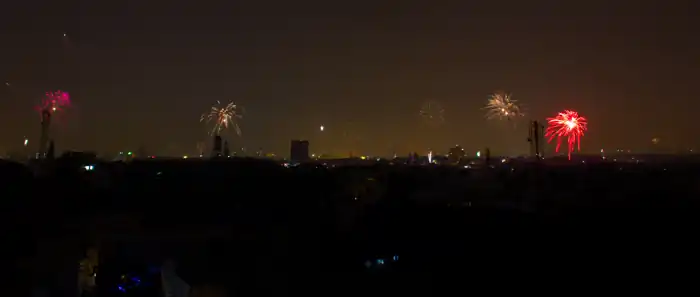
Yes. Fireworks release fine particles. Fog and still air keep them near the ground, as happened on Bonfire Night.
Who issues London’s alerts?
The Mayor’s office issues them. Imperial College London’s London Air Quality Network forecasters supply the trigger.
Winter inversion season continues. The next alert could come from wood-stove particulates. ULEZ has cut tailpipe emissions, but it does not cover smoke from home burning.