Rahul Somvanshi

Diwali fireworks turn the night sky red, green, blue and gold by heating carefully chosen metal compounds until they emit characteristic colours. The spectacle is chemistry. So is the smoke left behind.
That does not mean every coloured burst delivers a toxic dose to a person standing below it. Health risk depends on the amount released, particle size, distance, ventilation, wind and cumulative exposure. But the scientific evidence is clear that fireworks create short-lived spikes in fine particulate pollution and metal-rich aerosols—an especially important concern during Diwali, when many Indian cities already face poor air quality and stagnant conditions.
What gives fireworks their colours?
Firework formulations combine an oxidiser, fuel, binders and compounds that produce light when heated. Different salts are associated with different visible colours:
- Strontium compounds commonly produce red.
- Barium compounds are commonly used for green and can also act as oxidisers.
- Copper compounds are used for blue tones.
- Sodium produces intense yellow; calcium can contribute orange; and aluminium, titanium or magnesium can create bright white or silver sparks.
The exact chemistry varies by manufacturer and product. “Colour” is therefore not a reliable way to tell what, or how much, of a chemical a person has been exposed to.
What ends up in the air
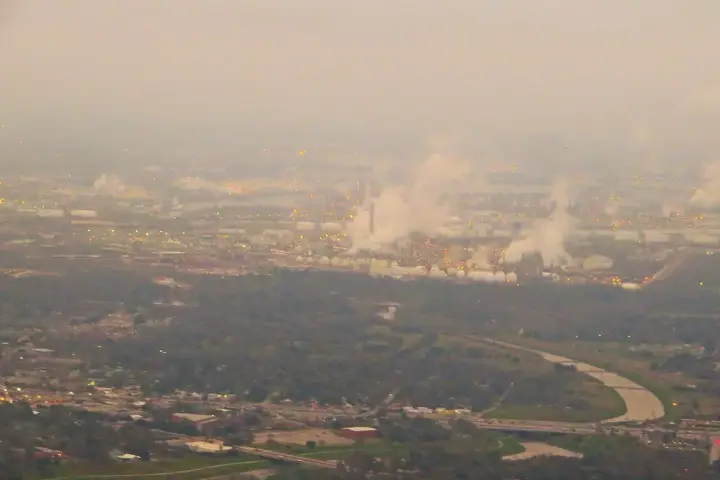
When fireworks burn, they release gases and particles ranging from visible smoke and ash to PM2.5: particles small enough to travel deep into the lungs. Studies during Diwali have measured sharp rises in PM2.5 and in elements associated with fireworks, including barium, potassium, strontium and copper.
Fine particles are the most immediate health concern because they can irritate airways and worsen asthma and other respiratory symptoms. Short-term particle exposure is also associated with cardiovascular stress. The risk is not limited to the person lighting a cracker; smoke can travel through neighbourhoods and linger when winds are weak.
Metal compounds add to the concern, but health claims need precision. High exposures to barium compounds can affect the heart, muscles and nervous system; copper-containing particles can irritate the respiratory tract; and excessive strontium exposure has been studied for potential effects on bone mineralisation. That toxicology does not prove that watching one sky shot will cause paralysis, cell damage or bone disease. It does explain why repeated, high or poorly ventilated exposure to metal-rich smoke is not harmless.
Noise is a separate health hazard
Fireworks also generate impulsive noise that can damage hearing at close range and cause distress for infants, older people, people with sensory sensitivities, companion animals and wildlife. Keeping distance, avoiding enclosed spaces and following local time and noise restrictions matters as much as the chemical composition.
Who should take extra care?
Children, pregnant people, older adults and people with asthma, COPD, heart disease or other lung conditions should reduce time around firework smoke. An N95- or equivalent well-fitting particulate respirator can reduce inhalation of particles when outdoor exposure cannot be avoided; cloth masks are not a substitute. It does not protect against gases, noise or burns.
Practical steps are simple: watch from farther away and upwind; avoid lighting fireworks in narrow lanes or near homes; keep doors and windows closed during heavy smoke episodes; use air filtration indoors if available; and seek medical help for severe breathlessness, chest pain, wheezing that does not settle, or a firework injury.
Diwali need not be framed as a choice between joy and science. It is a case for understanding what produces the colour, what produces the pollution and how to reduce avoidable harm—especially in places where the air is already unsafe to breathe.
Sources: Scientific evidence on Diwali firecracker particles in Lucknow; a review of fireworks and respiratory health; and WHO evidence on particulate matter and health. The submitted Reel was used as a discovery lead.