 Sunita Somvanshi
Maharashtra Smart Meter Tender: Did Adani Get a ₹2,000 Markup Over Other States?
A viral Marathi video claims Maharashtra paid Adani ₹2,000 more per smart meter than Uttar Pradesh, with the extra cost falling on household electricity bills. The clip has been shared widely in Bhandup, Kalyan, Pune, and Baramati — areas where MSEDCL smart meter crews have already begun door-to-door replacements. Official state tender records tell a different story, and the difference matters for every MSEDCL consumer receiving an installation notice right now.
In September 2023, MSEDCL — Maharashtra’s main electricity distribution company — awarded ₹13,888 crore in smart meter contracts to Adani Energy Solutions Ltd (AESL) covering approximately 1.15 crore meters across Bhandup, Kalyan, Konkan, Pune, and Baramati zones. This works out to roughly ₹11,970 per meter. In the same tender round, NCC Limited — a large public infrastructure company with no connection to Adani — won two additional packages covering Nashik, Jalgaon, Latur, Nanded, and Aurangabad for ₹6,791 crore, at approximately ₹11,991 per meter. Montecarlo and Genus Power won the remaining Vidarbha and Nagpur zones at equivalent rates of ₹11,900 to ₹12,000 per meter. Every contractor in the Maharashtra tender received the same unit price. Adani was not paid a premium over its competitors.
If a smart meter is installed at your home in Maharashtra, you cannot be billed for the meter or its installation cost. The state government and MSEDCL have confirmed that residential consumers pay zero upfront fees, with the capital cost subsidised by central Revamped Distribution Sector Scheme (RDSS) grants and discom operational budgets. Maharashtra Deputy Chief Minister and Energy Minister Devendra Fadnavis stated on the floor of the state legislature in July 2024 that domestic installations carry no charge to consumers. If your bill rises sharply immediately after a new meter is fitted, you have the right to request an on-site meter test or file a dispute with the Consumer Grievance Redressal Forum (CGRF) to check whether stored readings from the old meter were carried forward.
The UP Tender Scrapping vs Maharashtra’s DBFOOT Model
The ₹2,000 comparison in the viral video does not compare two Maharashtra contracts. It compares Maharashtra’s 2023 contract price against a cancelled Uttar Pradesh tender bid from early 2023 — two entirely different states, different scopes, and different contract structures.
In February 2023, MVVNL (a UP electricity discom) cancelled a smart meter tender — Tender No. MEDCO/2472/2022 — where Adani had submitted the lowest bid at approximately ₹10,000 per meter for around 7.5 million meters. The official cancellation notice cited “unavoidable administrative reasons.” The UP Electricity Regulatory Commission separately penalised UPPCL for charging consumers ₹6,016 for single-phase meters under an outdated 2019 cost reference, ordering adjustments and refunds — a consumer protection action against the UP discom itself, not against Adani.
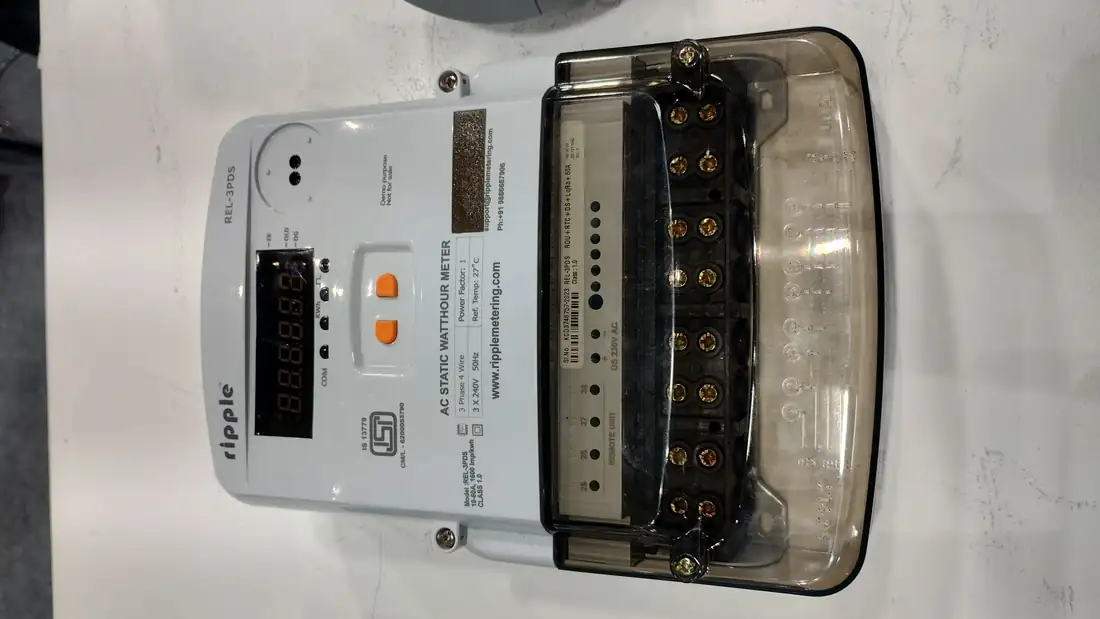
Maharashtra’s ₹12,000 figure is not a retail meter price. It is a ten-year TOTEX (total expenditure) package under the DBFOOT model — Design, Build, Finance, Own, Operate, Transfer. The contractor finances 100% of upfront costs and recovers fees over 93 to 120 months through monthly service payments, only if the system meets strict uptime targets above 98% daily data transmission. The price therefore covers the physical meter, cellular SIM connectivity, cloud-based Head-End software, replacement warranties, and field maintenance over a decade. Comparing it to a scrapped base-bid price from a different state’s cancelled tender — where none of those long-term obligations existed — is not a valid cost comparison.
The video also cites a “UP Government GR” confessing to corrupt procurement. This document does not exist. Maharashtra uses Government Resolutions (GRs / शासन निर्णय) as an administrative format; Uttar Pradesh issues Government Orders (शासनादेश). The UP government issued no executive order describing its own smart meter procurement as corrupt. The video appears to have merged four separate items: consumer forum petitions, the MVVNL tender cancellation, the UPERC penalty order against UPPCL for overcharging, and an internal technical review involving IIT Kanpur on meter software glitches. These are unrelated events. The “GR” referenced in the reel does not exist in UP’s administrative record.
Procurement records from MSEDCL and regulatory exchange filings show that Adani received approximately ₹11,970 per meter in Maharashtra — marginally lower than the ₹11,991 per meter received by NCC Ltd in the same tender. There is no Adani-specific markup in Maharashtra’s contract. The claim of a ₹2,000 exclusive premium is a cross-state arithmetic comparison between a 10-year infrastructure contract and a cancelled one-time procurement bid.
Smart meters also serve a broader grid function beyond billing: under the Ministry of Power’s RDSS policy, they are the technical foundation for automated Time-of-Day (ToD) tariffs, which are designed to shift electricity demand toward daytime hours when solar generation peaks, reducing dependence on fossil-fuel peaker plants. This is part of modernising the power distribution grid under central infrastructure guidelines and compliance frameworks that govern the full national rollout.
Who pays for the Adani smart meter installation in Maharashtra?
Domestic consumers in Maharashtra do not pay for smart meter installation. Under the central government’s Revamped Distribution Sector Scheme (RDSS), the Union government provides a grant of 15% of the meter cost (up to ₹900 per consumer meter). The remaining expenditure is funded by the distribution utility (MSEDCL) and recovered through operational efficiency savings, paid to the contractor as monthly service fees over a ten-year contract based on strict performance thresholds. No hardware charge is passed to households.
Are smart electricity meters compulsory for residential homes in Maharashtra?
The Ministry of Power’s RDSS rollout targets full smart meter coverage across MSEDCL service areas, but Devendra Fadnavis confirmed in July 2024 that domestic installations would not be forced without public consensus. Installation timelines continue to expand phase by phase through 2025–2026. Consumers receiving notices should check with local MSEDCL offices for zone-specific rollout schedules.
Why did Uttar Pradesh cancel its smart meter tender with Adani?
MVVNL cancelled the UP tender in February 2023 citing “unavoidable administrative reasons” in the official notice. Consumer groups had flagged that Adani’s ₹10,000 per meter bid exceeded the Rural Electrification Corporation’s equipment benchmark of approximately ₹6,000. No court finding, regulatory order, or government statement has established procurement wrongdoing in that cancellation.
Do smart meters make electricity bills higher?
Smart meters measure consumption more accurately than ageing electromagnetic or static meters, which can under-read over time. If a bill rises after replacement, the increase may reflect accurate billing of previously unrecorded units rather than a meter error. Consumers can request an on-site test through MSEDCL or file a dispute with the CGRF if a sudden jump cannot be explained by actual usage.
The ₹2,000 markup claim in the viral video rests on comparing Maharashtra’s ten-year all-inclusive infrastructure contract with a cancelled UP base bid from a different state and a different year — not on any difference in what Adani was paid versus its competitors inside Maharashtra. MSEDCL consumers face no meter hardware fees under state and central government commitments. Watch for updates as MSEDCL’s district-by-district rollout continues through 2025–2026, and as consumer grievance tribunals report outcomes on billing disputes tied to meter switchovers. Check back for updates on those hearings and on the state’s planned review of consent protocols for residential meter replacement.