 Sonali Tiwary
If you live on Hawaii Island, or plan to visit Hawaii Volcanoes National Park this December, you need two answers. When will Kilauea erupt again? And how much volcanic gas and debris should you expect in the air? The U.S. Geological Survey has now published a working window for the first question. The Kilauea Episode 58 forecast points to early December.
In its November 25, 2026 update, the U.S. Geological Survey’s Hawaiian Volcano Observatory (HVO) kept Kilauea at Volcano Alert Level ADVISORY. The aviation color code stayed at YELLOW. Preliminary forecast models project the next lava-fountaining episode, Episode 58, between December 3 and December 17, 2026.
The forecast draws on the summit’s tiltmeters, instruments that measure how much the ground tilts. HVO will refine it as more tilt data are incorporated into the models. Those tiltmeters switched back to inflation as soon as Episode 57 ended.
Inflation means magma is building back up under the summit. Forecasters use that pattern to estimate timing, so the window is a projection, not a confirmed date. HVO describes these dates as preliminary, and they can change as new data arrive.
For Hawaii Island residents and December visitors to Hawaii Volcanoes National Park, the practical question is air quality as much as lava. Kilauea releases sulfur dioxide gas, which reacts in the air to form vog, a volcanic haze that drifts downwind. Wind-blown Pele’s hair, thin strands of glassy volcanic material, can irritate eyes and airways.
Even during the pause, HVO measured about 2,100 tonnes per day of sulfur dioxide on November 24. Check the live HVO webcams and park alerts before you plan a visit. It is the same habit that pays off during a Hawaii flood watch.
Kilauea Episode 58 Forecast for December 2026
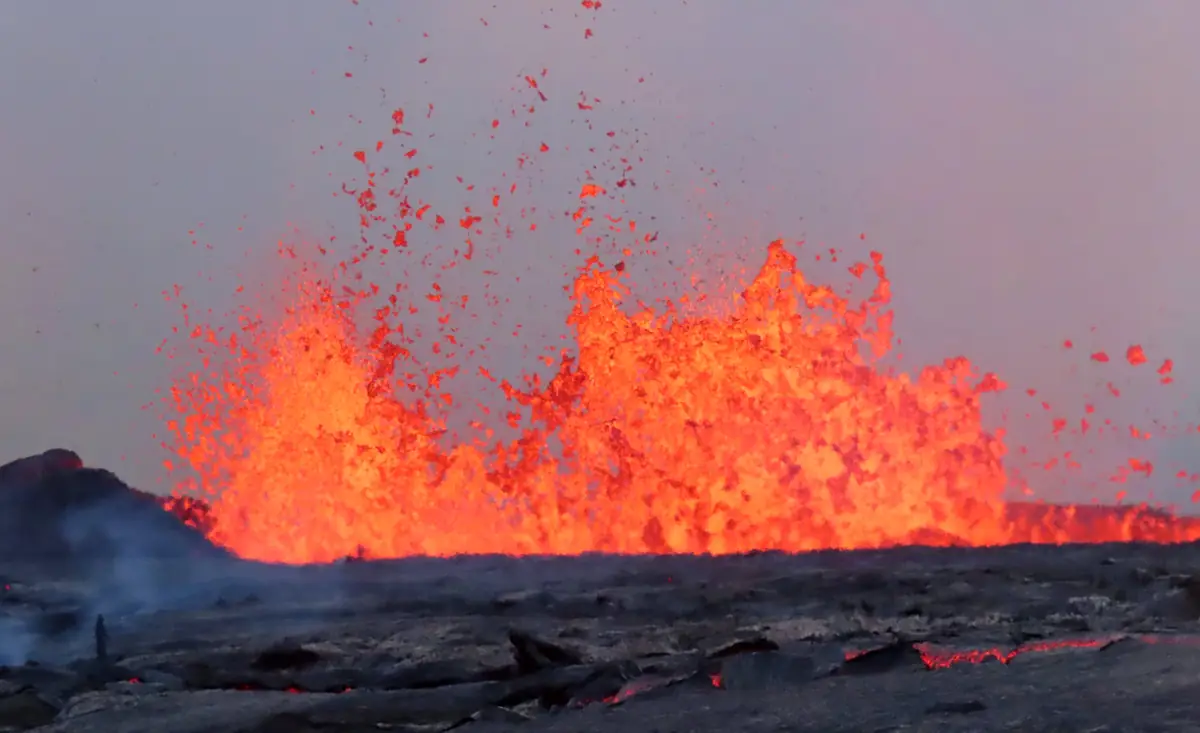
Episode 57 ran from 12:15 a.m. to 6:00 a.m. HST on November 23, 2026. All of the fountaining came from the north vent. Fountains reached about 660 feet (200 meters) high, and the eruptive plume rose to 20,000 feet (6,000 meters) above sea level.
Just under 8 million cubic yards (6 million cubic meters) of lava erupted. The average rate was 275 cubic yards (210 cubic meters) per second. For scale, one cubic yard is about the size of a large refrigerator.
Hazards continue during a pause. Along with sulfur dioxide, the summit releases carbon dioxide and water vapor. Wind can lift glassy tephra, loose volcanic fragments, into the air.
HVO reports low rates of seismicity and ground deformation in the East and Southwest Rift Zones. Those come from the same monitoring network that feeds USGS earthquake reporting. The crater rim is unstable, and parts of it have been closed since early 2008.
Closures for unstable ground are not unique to Kilauea. Hikers have also run into an Angels Landing closure at Zion National Park.
Since the eruption paused, the tiltmeter at Uekahuna has already recovered about 6.0 microradians of tilt. That is roughly one-third of the 18 microradians of deflation it recorded during Episode 57. Deflation is the sagging of the ground, the expected pattern as magma drains from the summit reservoir.
A microradian is one-millionth of a radian, far too small to see by eye. During the same pause, a tephra slump below the southwest vent on November 24 set off a minor creeping flow.
When will Kilauea erupt next? According to the USGS Hawaiian Volcano Observatory’s November 25, 2026 update, the next episode could start between December 3 and December 17, 2026. That is a preliminary forecast. Summit tiltmeters show continuous inflation since Episode 57 paused, and forecast models use that trend to set the window.
Kilauea remains at Volcano Alert Level ADVISORY, and the summit is reinflating. Forecasters project Episode 58 between December 3 and 17, 2026, but that window is preliminary. Episode 57 sent fountains to about 660 feet and a plume to 20,000 feet.
December travelers should also watch for a Hawaii high wind warning, since wind and volcanic gas can affect the same trip. For live views, use the USGS Kilauea eruption updates and livestream cameras, and check park alerts before you travel.