Sunita Somvanshi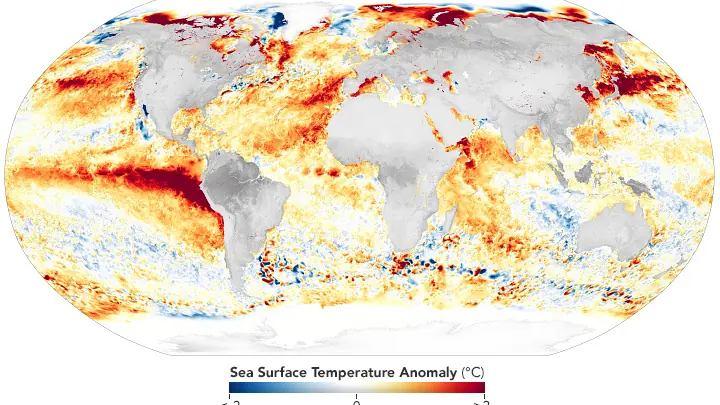
El Niño is a recurring climate pattern involving unusually warm sea-surface temperatures in the central and eastern tropical Pacific, accompanied by changes in the atmosphere that can influence weather patterns around the world.
On September 10, 2026, the U.S. National Oceanic and Atmospheric Administration’s Climate Prediction Center issued an El Niño advisory. This latest advisory updates the outlook for the 2026-27 El Niño season.
NOAA’s September outlook put the probability of a historic-strength event during October-December at 75 percent, while the probability of a very strong event for that period rose to 98 percent. NOAA also confirms a greater than 90 percent chance of a very strong event during the Northern Hemisphere fall and winter 2026-27. NOAA’s “very strong” category is based on the Relative Oceanic Niño Index, with a threshold of at least +2°C for the relevant three-month period. The 75 percent figure is a probability; it does not mean a record has already been set. The label describes a projected strength category, not a completed record.
August temperature readings show how warm the Pacific has become. NOAA reported sea-surface-temperature anomalies of about +1.8°C in the Niño-3.4 region, +2.5°C in Niño-3 and +3.4°C in the Niño-1+2 region near South America. In spots of the eastern equatorial Pacific, temperatures exceeded 3°C above average.
NOAA’s seasonal outlook favors above-normal temperatures across much of the western and central United States, and other regions also have elevated probabilities of above-normal temperatures. Seasonal outlooks describe probabilities over months rather than determining the weather of individual storms.
El Niño does not guarantee more snow nationwide. Its effects vary by region. Historically, El Niño can bring wetter and cooler conditions to parts of the southern United States, where the likelihood of rain and snow can increase, while other regions can experience different conditions. Other climate patterns, including the Madden-Julian Oscillation and the Indian Ocean Dipole, can modify regional winter patterns alongside El Niño. Atmospheric rivers can also alter precipitation, particularly along the U.S. West Coast.
The current NOAA data support a forecast of a very strong El Niño for the 2026-27 season, with a substantial probability of a historically strong event. The historic classification remains a forecast rather than an established record.
For ongoing coverage of the strengthening event, see the earlier NOAA forecast update.
—