Rahul Somvanshi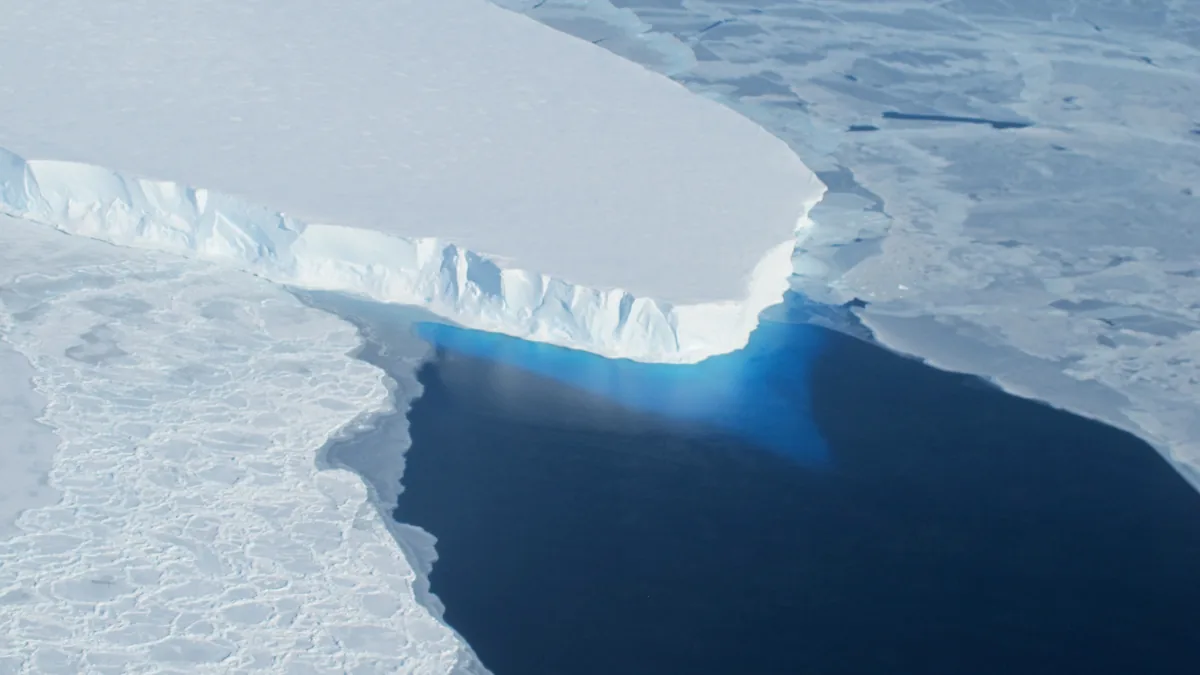
Scientists have found warm ocean water pushing kilometers beneath the grounded ice of Thwaites Glacier in West Antarctica, in a recent study. The intrusion pries up the ice sheet from below and speeds melting that most computer models do not yet capture. The discovery matters to anyone living near a coastline. ITGC research shows Thwaites rests on ice prone to rapid, irreversible loss, capable of raising global sea level by over half a metre within centuries.
The finding comes from a study published in May 2024 in Proceedings of the National Academy of Sciences. The lead author is University of California-Irvine glaciologist Eric Rignot, working with researchers from the International Thwaites Glacier Collaboration’s MELT project. Using high-resolution satellite radar from the commercial ICEYE constellation, the team tracked daily surface movement at Thwaites Glacier between March and June 2023. The data revealed seawater surging in with the tides, traveling far under the grounded ice, and sometimes becoming trapped. That trapped water flexed the ice sheet by more than half a mile in places. The full account of the satellite findings is detailed by the ITGC, the joint US-UK program coordinating Thwaites research.
If this ocean-ice interaction keeps operating unmonitored, ice sheet models will keep underestimating how fast Thwaites can lose mass, researchers say. Rignot’s team argues the process needs to be built into sea-level projections used by coastal planners. Co-author Christine Dow of the University of Waterloo cautioned that current data cannot say whether the intrusion is reversible. She noted the glacier may have decades, or centuries, before passing a tipping point.
The seawater reaching the glacier’s underside is not ordinary ocean water. It is Circumpolar Deep Water, a salty layer that freezes near minus two degrees Celsius rather than zero. That lower freezing point gives it extra capacity to melt ice before it refreezes. Combined with freshwater generated by geothermal heat and friction at the bed, this water collects in cavities and natural channels. It builds enough pressure to lift and separate the ice from the seafloor. Rignot described this as creating “vigorous melting” at the grounding line. That is the point where glacier ice stops resting on bedrock and starts floating as ice shelf.
Thwaites’ grounding zone has already retreated 14 kilometers since the late 1990s, among the fastest shifts recorded in Antarctica. Two papers published in Nature in February 2023, also from the ITGC MELT project, offered a more granular picture. Researchers used the underwater robot Icefin, lowered through a 600-meter borehole drilled by a British Antarctic Survey team roughly two kilometers from the grounding line. Those measurements, recorded over nine months, found melt rates averaging a more modest 2 to 5 meters per year across flat sections of the ice shelf underside. That rate ran slower than many models assumed. Ocean temperature and salinity near the grounding line nonetheless rose through the monitoring period.
Cracks and terraces melt faster than flat ice
The slower average melt rate did not mean the glacier was stabilizing. Icefin’s cameras and sensors showed the underside of the shelf had formed staircase-like terraces. Melting inside cracks and crevasses ran far faster than on flat ice. Lead BAS oceanographer Peter Davis, who authored one of the Nature papers, said the glacier remained “in trouble” despite the weaker-than-expected melt signal. Even modest imbalances between ice loss and ice supply are enough to keep pushing the grounding line back. A fresher meltwater layer trapped against flat sections of the shelf appeared to insulate that ice. It offered no such protection where crevasses exposed more surface area to warmer water.
This distinction matters for sea-level forecasting. Earlier models treated basal melt as roughly uniform across an ice shelf’s underside. The 2023 and 2024 findings together show melt is concentrated unevenly, driven by tidal pumping at the grounding line and accelerated inside fractures. That combination remains difficult for current simulations to reproduce accurately, according to researchers connected to the National Snow and Ice Data Center’s glacier monitoring programs.
Why coastal planners are watching closely
Thwaites sits in West Antarctica’s low-lying interior, where much of the glacier bed lies below sea level. Glaciologists describe that configuration as prone to irreversible retreat once warm water gains sustained access to the grounding line. The glacier and its neighbor, Pine Island Glacier, together already contribute a measurable share of global sea-level rise each year. Karmactive has previously covered related risks, including unpredictable destruction risks tied to the so-called doomsday glacier and broader Antarctic sea ice tipping-point warnings.
Is Thwaites Glacier’s collapse inevitable now? No single study confirms that. But the 2024 PNAS findings show a mechanism, tidal seawater intrusion deep under grounded ice, that was largely absent from prior projections. Published sea-level estimates built without it likely understate near-term risk until models catch up.
Coastal cities already tracking measurable sea-level change have a direct stake in how quickly Thwaites responds. Record rates are documented in Karmactive’s coverage of Mumbai, Kolkata and Dhaka’s 2024 sea-level data. Recent Antarctic calving events add further data points to an active season of ice-shelf change across the continent. Karmactive reported one such event, a London-sized iceberg breaking off near a British research station. Its direct causal link to grounding-line melt remains under study.
Researchers stress that new field seasons and updated satellite passes should clarify how persistent the tidal seawater pumping is over the coming years. Until ice sheet models incorporate the mechanism directly, the gap between observed glacier behavior and projected sea-level rise is likely to persist.
In short, satellite radar and underwater robot surveys from the ITGC’s MELT project confirm warm, salty ocean water reaches far beneath Thwaites Glacier’s grounded ice. It lifts the ice, melts it unevenly, and outpaces what current models predict. That combination keeps the glacier’s sea-level contribution an open question for researchers and coastal communities alike.