 Govind Tekale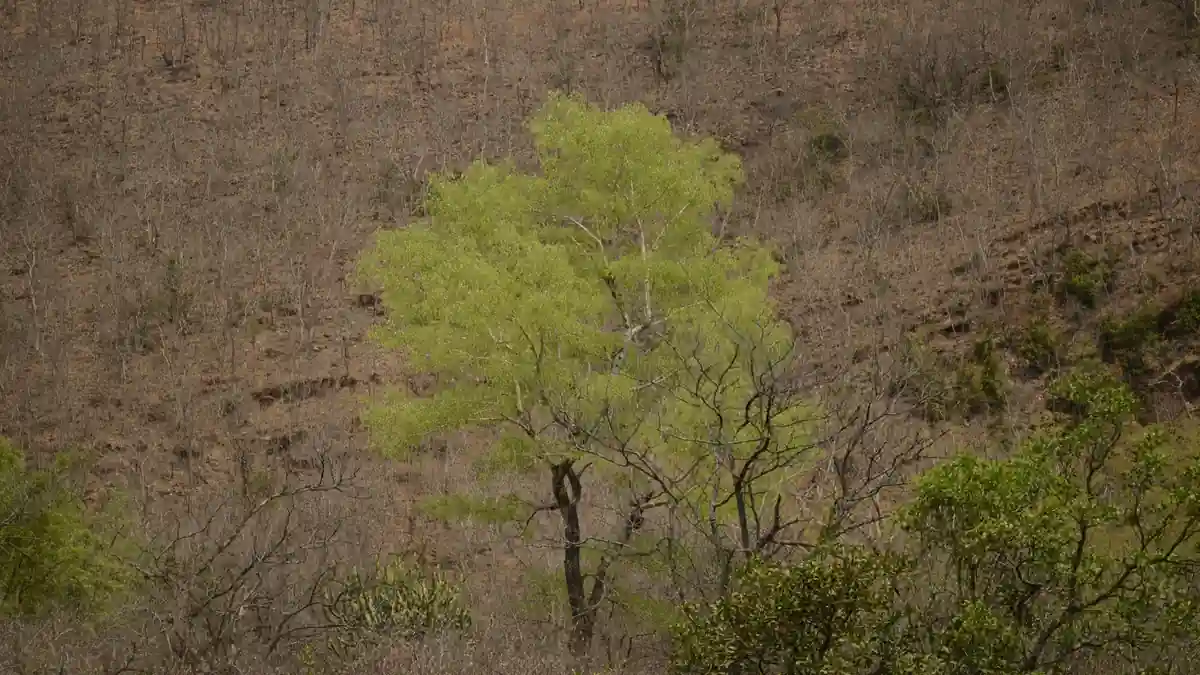
India Added 2.1 Million Hectares of Dry Woodland, But Losses Continued on Government-Administered Lands
India’s official forest-cover reports have shown rising numbers for years. A 2026 peer-reviewed study of India’s tropical dry woodlands adds important detail: yes, the woodland area grew — but a substantial share of gains occurred outside government-administered lands, including agricultural landscapes where reforestation and plantation activity takes place, while losses occurred within the areas formally managed as forest.
A 2026 study in Environmental Research Letters, covering India’s tropical dry woodlands from 2014 to 2024, found India gained approximately 2.10 million hectares of tropical dry woodland in that period, against 0.29 million hectares of loss, producing a net gain of around 1.80 million hectares. Critically, 0.17 million hectares of that loss occurred within government-administered lands — the designated forest areas the state formally manages. A substantial portion of the gains took place in agricultural landscapes and plantation areas outside those government-managed zones.
A separate study by researchers at IIT Bombay and SASTRA, covering 2015–2019, reported 1,032.89 square kilometres of India forest loss against only 56.3 square kilometres of gain in that period. These are different studies with different methodologies, geographic scopes, and time frames. Their numbers address different questions and must not be combined into a single figure.
For readers trying to understand whether India’s forests are recovering, the national-level statistics give an incomplete picture. An increase in total woodland can happen at the same time as losses in ecologically significant forest, because a plantation of fast-growing commercial trees and a patch of mature natural forest are not ecologically equivalent — even when both register as forest cover in satellite measurements. Readers relying on headline cover numbers without this context are working with accurate data that answers a narrower question than most assume.
The Gap Between Woodland Cover and Ecological Forest
FSI’s forest-cover assessment includes lands of more than one hectare with tree canopy density above 10%, irrespective of ownership or legal status; it can include orchards, bamboo, palms and plantations.
The 2026 Environmental Research Letters study separates those categories. The gains it documents outside government-administered lands are associated partly with plantations and agricultural tree cover. Economically and agriculturally useful, yes — but the biodiversity and ecological function of a mature natural forest that developed over decades without disturbance is a different thing from a plantation established in the same decade.
The losses documented within government-administered lands are more directly relevant to conservation. Government-administered lands include various legally distinct categories, including reserved forests and protected areas; the legal status of deemed forests is governed separately under Indian law. Loss within these areas is a reduction in land the state has specifically committed to managing as forest.
India’s forest policy has operated for decades under compensatory afforestation: planting trees elsewhere to offset forest cleared for development. The research question the 2026 study puts on the table is whether that numerical balance accurately reflects ecological outcomes when the planted replacement differs substantially from the cleared original.
The Legal Context Around Forest Classification
The 2023 Forest Conservation Amendment Act changed the statutory scope of the forest conservation law. Environmental groups argued the change reduced protections for ecologically significant areas that had not been formally classified as forest.
The Supreme Court‘s March 2026 judgment in Naveen Solanki v. Rail Land Development Authority addressed forest classification in the context of a specific infrastructure project and master plan. The court reaffirmed the importance of the Godavarman principle while holding that whether particular land was deemed forest must be assessed against historical land character, revenue records and the applicable master plan at the relevant date. How individual courts and authorities apply that ruling case by case will shape practical outcomes on the ground.
Forest conservation globally faces a measurement challenge: satellites track canopy cover reliably, but canopy cover does not directly measure biodiversity, carbon density, soil stability, or watershed function. The climate implications of forest quality versus quantity remain an active area of research.
The 2026 Environmental Research Letters study is available through the journal’s website. The Forest Survey of India‘s State of Forest Report is published biennially. The Supreme Court judgment of March 2026 and its application to specific sites will continue to develop through case law.
———————————————————————————————–
———————————————————————————————–
## How to Log Into WordPress REST API — Step by Step
### What We Used: **Application Password Authentication**
—
### Step 1: Get the Credentials
From the Pipeline file (`Karmactive Pipeline.md`), the credentials are:
– **Username**: `Sunita Somvanshi`
– **Application Password**: `Tw8QKhc98KxU5L4O3Q0s0w6J` (remove spaces → `Tw8QKhc98KxU5L4O3Q0s0w6J`)
> Application Passwords are created in WordPress Admin → **Users → Profile → Application Passwords** section. They’re separate from the login password and designed for API access.
—
### Step 2: Test the Login (Verify It Works)
“`bash
curl -s -u “Sunita Somvanshi:Tw8QKhc98KxU5L4O3Q0s0w6J” \
“https://www.karmactive.com/wp-json/wp/v2/users/me?_fields=id,name”
“`
**Expected response**: `{“id”:57,”name”:”Sunita Somvanshi”}` ✅
—
### Step 3: Make Authenticated API Calls
**GET a post** (read):
“`bash
curl -s -u “Sunita Somvanshi:Tw8QKhc98KxU5L4O3Q0s0w6J” \
“https://www.karmactive.com/wp-json/wp/v2/posts/1779?_fields=id,title,author”
“`
**PATCH/UPDATE a post** (write):
“`bash
curl -s -X POST \
-u “Sunita Somvanshi:Tw8QKhc98KxU5L4O3Q0s0w6J” \
-H “Content-Type: application/json” \
-d ‘{“meta”:{“_yoast_wpseo_focuskw”:”your keyword here”}}’ \
“https://www.karmactive.com/wp-json/wp/v2/posts/1779”
“`
> Note: WordPress REST API uses `POST` for updates (not `PATCH`), even when editing existing posts.
—
### Step 4: Check the HTTP Response Code
– **200** = Success ✅
– **401** = Auth failed (wrong credentials)
– **403** = Forbidden (user doesn’t have permission)
– **404** = Post not found
—
### How It Works Under the Hood
“`
curl -u “username:app_password”
↓
WordPress sees Basic Auth header
↓
Checks Application Password table (not login password)
↓
Grants API access with that user’s role/capabilities
↓
Sunita = Editor role → can edit any post ✅
“`
—
### Why This Works Now (But Failed Before)
The previous sessions used:
– ❌ Regular WP login password → blocked by Cloudflare WAF
– ❌ Programmatic browser login → WAF blocks `POST /wp-login.php`
– ✅ **Application Password** → bypasses WAF, goes directly to REST API endpoint, which Cloudflare allows through
—