Rahul Somvanshi
How Oilbirds Navigate Dark Caves: What the Research Shows
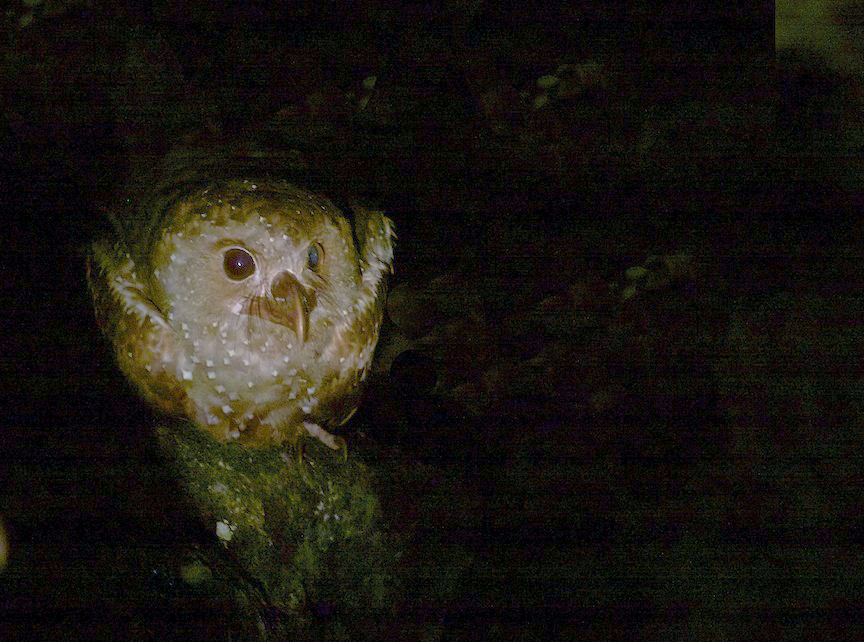
The oilbird, Steatornis caripensis, is a bird species documented to use echolocation to move through total darkness. This capability has been examined in peer-reviewed research, which helps explain how these birds are able to orient themselves in cave environments where there is no usable light.
What the Science Actually Found
The foundational study on oilbird echolocation was published in Science in 1979 by Masakazu Konishi and Eric Knudsen. Their research examined how oilbirds orient in completely dark cave environments and found that the birds rely on echolocation to do so. The study looked at the birds’ hearing and the acoustic signals they produce, and included behavioral testing conducted in cave settings.
A related study published in the Journal of the Acoustical Society of America in 1983, by Thompson and Suthers, built on this work with controlled laboratory testing. In darkened rooms, researchers assessed how well oilbirds could detect and avoid obstacles without any visual cues. This type of controlled testing is consistent with echolocation as the mechanism supporting the birds’ orientation in the dark.
These two studies are examples of peer-reviewed research on oilbird echolocation, combining field-based cave testing with controlled dark-room experiments. They do not represent the entirety of scientific work on the species, but they are the specific sources this article draws on.
Why This Matters for Understanding Oilbird Behavior
Echolocation allows oilbirds to solve a basic problem: how to move through environments with no light. For oilbirds, the research indicates this ability is tied to specialized hearing and the production of distinct acoustic signals, which together support orientation in dark spaces such as caves.
It’s worth being precise about what the research does and does not establish. The studies confirm that oilbirds navigate in darkness using echolocation under the specific conditions tested — cave settings and controlled dark-room trials. This verifies the underlying biological behavior under those tested conditions. It does not verify, and should not be used to characterize, the details of any particular recording, video, or individual observation of an oilbird. The studies also do not address how echolocation relates to other senses the birds may use; no claim is made here that touch or spatial memory were examined or excluded. Drawing conclusions beyond what these specific studies measured would go further than the evidence supports.
Frequently Asked Questions
Can oilbirds navigate a completely dark cave?
Research published in Science (Konishi & Knudsen, 1979) found that oilbirds use echolocation to orient themselves in total darkness, with testing conducted in cave environments. A related study using controlled testing in darkened rooms (Thompson & Suthers, 1983) found that oilbirds could detect and avoid obstacles without visual cues, consistent with echolocation as the mechanism involved.
Is echolocation unique to oilbirds among birds?
The sources cited in this article do not address this question across bird species generally; they focus specifically on documenting and testing echolocation in oilbirds.
Does this research explain any specific oilbird video or sighting?
No. The research verifies the biological behavior — echolocation-based navigation — under the laboratory and cave conditions in which it was tested. It does not verify or speak to the details of any particular recording, sighting, or individual bird.