Rahul Somvanshi
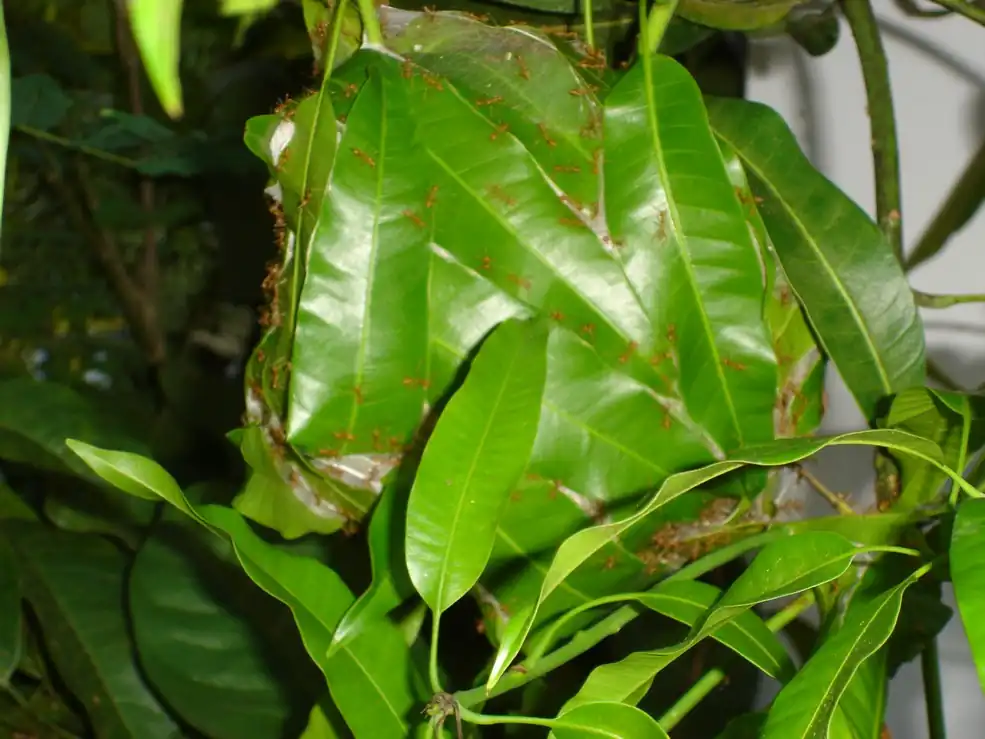
Mango growers who spot a colony of red ants nesting in the canopy often face an immediate question: are these insects a threat to the tree, or could they actually be helping keep other pests down? The answer depends on which ant species is involved and on the specific orchard conditions, but there is a real body of agricultural research behind the idea that certain red ants can play a useful role in mango pest management.
The species studied for this purpose is the red weaver ant, Oecophylla smaragdina, which builds distinctive leaf nests in tree canopies. In a field study at Howard Springs in Australia’s Northern Territory, researchers Peng and Christian tested weaver ants as a key element of integrated pest management in mango orchards. Over two of the three study years, orchards managed with weaver ants alongside reduced chemical use produced a higher share of first-class fruit, with less pest damage, mango scab and lenticel infestation than comparison treatments. The same study noted drawbacks worth weighing: the ants can mark fruit with formic acid and can annoy orchard workers during harvest.
Follow-up research by the same group looked at specific pests. Field experiments and surveys conducted in the Darwin area between 2001 and 2003 compared orchards with and without weaver ants and found less shoot damage from the mango leafhopper where the ants were present than in orchards relying on insecticides alone or neither method, leading the researchers to describe the ants as efficient biological-control agents under those conditions. A related set of field trials at three orchards in northern Australia during the same period examined Jarvis’s fruit fly and reported less fruit damage and fewer fly puparia on trees with weaver ant colonies than on comparison trees, again under the specific conditions tested.
Why These Findings Don’t Translate Automatically to Every Orchard
It is tempting to take findings like these and conclude that any nest-building red ant on any mango tree, anywhere, is quietly doing pest-control work and should be left alone. That conclusion goes further than the evidence supports. These studies were conducted on one species, in one region of Australia, under specific orchard-management practices over a defined period. Not every red ant is a weaver ant, and a weaver ant population will not necessarily behave the same way in a different climate, crop or pest mix. The same research that found benefits also documented real costs: fruit marked by formic acid, workers bothered during harvest, and difficulty integrating the ants cleanly with other orchard practices. Growers who want to know whether ants in their own trees are helping or harming their crop should have the insects identified and seek advice suited to their specific location and pest pressures, rather than assuming any red ant nest is automatically beneficial or automatically a problem.
Because of that tension between benefits and drawbacks, later work tried to make weaver ants more practical to manage. A 2022 study found that supplying weaver ants with artificial sugar feeders reduced known drawbacks of using them as biological-control agents in mango orchards, suggesting that targeted management techniques can make the approach more workable where it is already suited to local conditions.
Taken together, the research indicates that red weaver ants can be a legitimate, evidence-based component of mango pest management in the orchard settings where they have been studied, with documented effects against the mango leafhopper and Jarvis’s fruit fly under Northern Territory and northern Australian field conditions. It does not mean every red ant colony is helpful, that chemical control is never warranted, or that results from these specific trials apply automatically elsewhere. Growers dealing with ant colonies in mango trees are better served by identifying the species present and consulting local agricultural extension or integrated pest management guidance than by drawing broad conclusions from general claims about “red ants” or “fire ants.”