Sunita Somvanshi
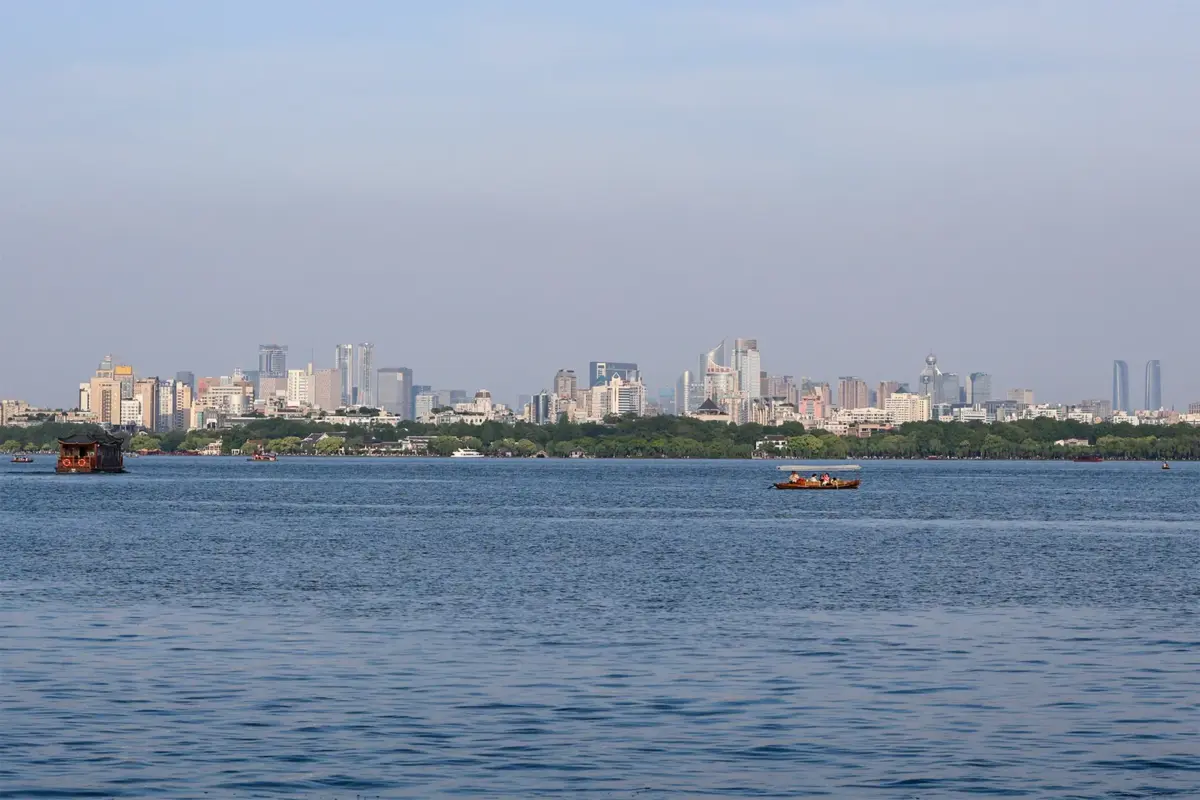
Hangzhou, the capital of China’s Zhejiang province, has become one of the most compelling cities in the world — not just for its breathtaking natural scenery, but because it sits at the intersection of ancient culture and cutting-edge technology. Home to some of China’s most influential companies and the UNESCO-listed West Lake, Hangzhou offers a rare glimpse into a future that hasn’t forgotten its past.
A City of Tech Giants
With a population exceeding 12 million, Hangzhou ranks among China’s largest and most dynamic urban centres. It has earned its reputation as the country’s digital economy capital, home to a constellation of technology giants that have shaped how the world does business online.
Alibaba Group, China’s e-commerce and cloud computing behemoth, was founded here by Jack Ma in his apartment in 1999 and still calls Hangzhou home. The Ant Group, Alibaba’s financial technology affiliate and one of the world’s largest fintech companies, operates here too. And more recently, DeepSeek — the AI research company whose large language models attracted global attention in early 2025 — is also based in Hangzhou, cementing the city’s status as a serious contender in the global artificial intelligence race.
The concentration of talent and capital in Hangzhou has been compared to Silicon Valley. Zhejiang province, of which Hangzhou is the capital, emerged as China’s largest recipient of venture capital funding in 2024, with billions flowing into artificial intelligence, cloud computing, and smart city technology.
Getting There: China’s High-Speed Rail Network
Hangzhou is well connected to the rest of China. The city sits less than an hour from Shanghai by high-speed rail, with the fastest services covering the roughly 200-kilometre journey in under 45 minutes at speeds exceeding 350 km/h (around 217 mph). This makes Hangzhou effectively a suburb of Shanghai for business travellers and tourists alike — and a highly desirable place to live for those who want proximity to one of the world’s great metropolises without sacrificing quality of life.
West Lake: A UNESCO World Heritage Treasure
For all its modern credentials, Hangzhou’s most iconic feature is a body of water. West Lake — Xī Hú in Mandarin — lies at the heart of the city and has inspired poets, painters, and philosophers for over a thousand years. The UNESCO World Heritage Committee inscribed the West Lake Cultural Landscape of Hangzhou on the World Heritage List in 2011, recognising its profound influence on landscape design and gardening art across China, Japan, and the Korean Peninsula since the ninth century.
The lake spans roughly six square kilometres and is ringed by hills, temples, pagodas, pavilions, ornamental gardens, and traditional causeways. It is dotted with artificial islands and crossed by two famous causeways — the Su Causeway and the Bai Causeway — named after the Tang and Song dynasty poets Su Shi and Bai Juyi, who both served as governors of Hangzhou and helped shape the lake’s landscape.
Imperial Heritage: The 12th-Century Wine Connection
Hangzhou’s deep historical significance stems partly from its role as an imperial capital. When the Jin dynasty’s armies drove the Song court south in the 1120s, the Southern Song Dynasty established Hangzhou — then called Lin’an — as its capital from 1127 onwards. During this imperial period, the city flourished as the world’s most populous city and a centre of art, commerce, and culture. The cultivation of imperial wines and the refinement of court aesthetics were central to life in 12th-century Hangzhou, a legacy now commemorated along the shores of West Lake.
A Living Heritage
Today, West Lake is not a roped-off museum piece but a living park where millions of visitors and residents come to walk, cycle, and photograph. People dress in traditional hanfu robes to pose for portraits along the willow-lined banks. At dusk, elaborate light shows illuminate the water, blending imperial imagery with modern spectacle. Ducks paddle undisturbed between the ornamental causeways, and the overall atmosphere carries a tranquillity that feels genuinely at odds with the city’s breakneck technological ambitions — and yet entirely in harmony with them.
The coexistence of West Lake’s ancient serenity and Hangzhou’s contemporary innovation isn’t accidental. City planners have worked deliberately to position Hangzhou as a place where quality of life — measured in green spaces, walkable lakefronts, and cultural depth — is as important as GDP growth. It is this balance that makes Hangzhou, as many of its residents and visitors attest, one of the most desirable places to live in all of China.
Conclusion
Hangzhou is a city worth paying attention to — not just as a window into China’s technological ambitions, but as proof that rapid modernisation and careful stewardship of cultural and natural heritage can coexist. West Lake endures as its most powerful symbol: a UNESCO-recognised landscape that has inspired human creativity for over a millennium, now sharing a skyline with the headquarters of companies shaping artificial intelligence and global commerce. That juxtaposition, more than any individual fact or statistic, captures what makes Hangzhou remarkable.
Sources
- UNESCO World Heritage Centre — West Lake Cultural Landscape of Hangzhou
- Channel News Asia — From robot dogs to AI doctors: Inside Hangzhou’s technology revolution
- New York Times — The Coder ‘Village’ at the Heart of China’s AI Frenzy
- Moneycontrol — How Hangzhou became China’s AI powerhouse
- Wikipedia — West Lake
Source reel: https://www.instagram.com/reel/DeuYIU9DEfB/