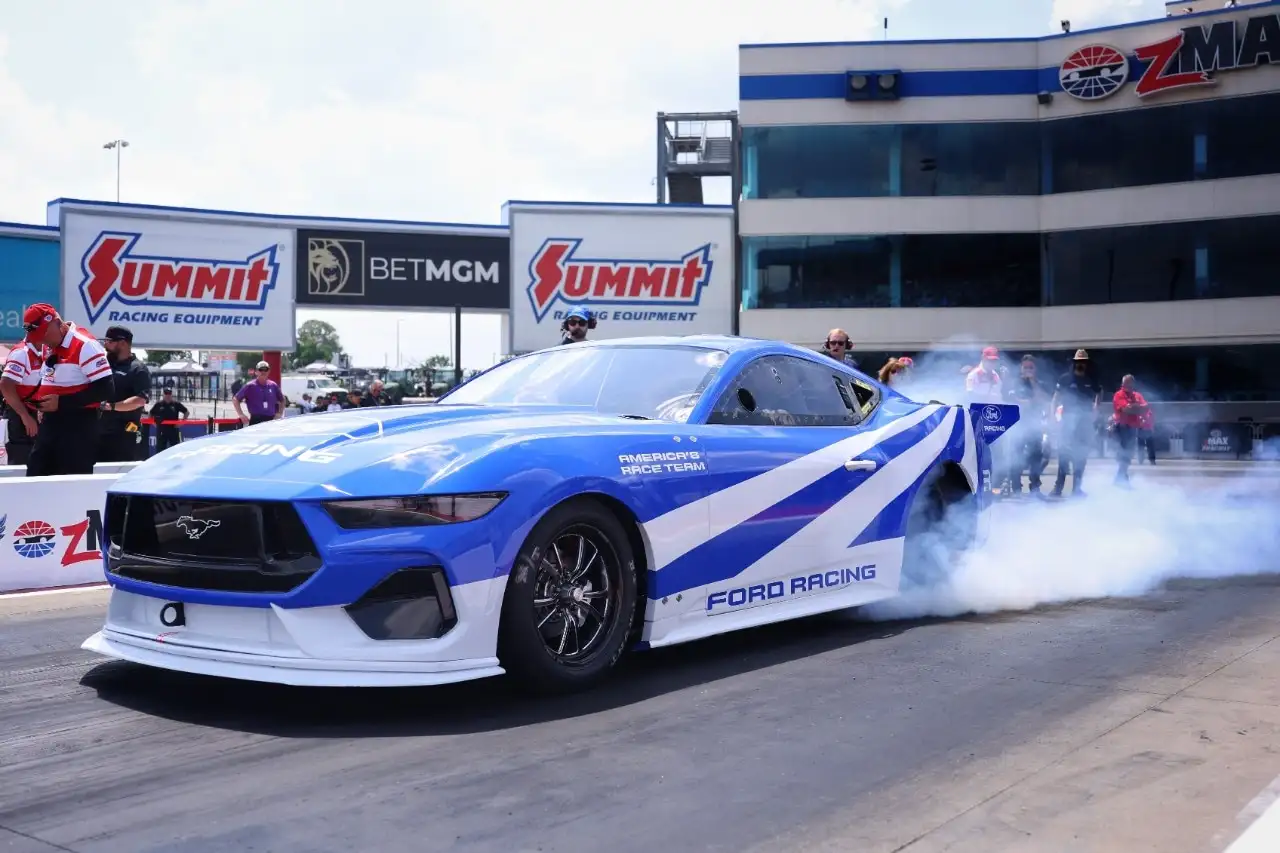
Electric Drag Racing · NHRA 4-Wide Nationals · zMAX Dragway
6.869 Seconds.
2,200 Horsepower.
Zero Fuel.
At the NHRA 4-Wide Nationals, Ford Racing’s Mustang Cobra Jet 2200 — driven by Pat McCue — ran 6.869 seconds at 222.36 mph, the quickest and fastest full quarter-mile ever recorded by an electric vehicle.
At zMAX Dragway in Charlotte, the loudest statement of the weekend came from the quietest machine on the property. Ford Racing’s Mustang Cobra Jet 2200, driven by Pat McCue, posted a best run of 6.869 seconds at 222.36 mph — recognised by Ford Performance as the quickest and fastest full quarter-mile ever run by an electric vehicle. The result came after the car worked up from early test passes of 7.19 at 211 mph to consistent 6.87–6.86-second runs through the event weekend.
That improvement over Ford’s own previous EV record — a 7.623-second pass set by the Super Cobra Jet 1800 at 182.16 mph at the NMRA World Finals in Bowling Green, Kentucky — amounts to roughly three-quarters of a second. In a sport where thousandths separate winners from runners-up, that margin is substantial.
“This car really for us is an endeavor to really push the limits of electrification and technology and really just see how far we can get in the quarter mile with an electric car. We’re really happy with the results. We’re now the quickest and fastest quarter-mile pass by an electric car in history.”
— Nicholas Kuhajda, Demonstrators Program Supervisor, Ford PerformanceThe Cobra Jet 2200 is the third chapter in Ford’s electric performance programme, following the Cobra Jet 1400 and the Super Cobra Jet 1800. Each generation pushed the record further. This one broke through the 7-second barrier entirely. The car was engineered by Ford Racing and built in partnership with MLe Racecars, with testing conducted at Las Vegas Motor Speedway and zMAX Dragway ahead of its public debut.
The Record Run at a Glance

Three Generations. One Direction.
The progression from 2021 to 2026 — each generation faster than the last.

What Makes This Car Fast — and Consistent
Select a system to understand the engineering choices behind the record.
Two Motors. More Power. Less Mass.
The Cobra Jet 2200 replaced the previous four-motor layout with two custom-built high-output electric motors, each paired with a dedicated inverter exceeding 98% efficiency. The two motors feed into a single output through a SCS gearbox. The result: significantly reduced system mass while producing an additional 400 horsepower over the Super Cobra Jet 1800’s nameplate figure.
The complete system operates on a 900-volt electrical architecture — an increase from the previous generation — reducing current demand for equivalent power output and lowering heat generation across the battery and inverters. This connects to broader advances in lightweight high-density EV battery technology.
2,200 HP combined ~1,200 HP per motor/inverter pair 98%+ inverter efficiency 900V architectureOld-School Solution to a New-School Problem
When Ford engineers directly linked the motors to the transmission, every upshift sent a shockwave through the driveline — spinning the tires and converting power into wheelspin instead of forward motion. The fix came not from a laboratory but from decades of drag racing tradition.
— Nicholas Kuhajda, Ford Performance
The result is a patented reverse-acting centrifugal clutch (RACC) — a new Ford Racing innovation. The car launches fully locked in direct drive from zero RPM. At the top of each gear, the clutch allows a momentary slip before locking back up, absorbing rotating inertia and preventing tire spin. It is this precise torque management — not peak horsepower alone — that made consistent 6.8-second passes possible.
Patented RACC technology Launches in direct drive from 0 RPM Momentary slip on upshift onlyWhy an Electric Race Car Still Needs Gears
Electric motors produce strong torque from zero RPM, but reach peak power at higher RPM bands. Without gearing, the car would spend a large portion of the 1,320-foot run operating outside its optimal output window — leaving time on the table.
This is the same principle driving gearing strategies in high-performance electric powertrains across categories. The drivetrain philosophy on the Cobra Jet 2200 borrows from Pro Stock and Factory X, blending those elements into a platform built specifically around electric power delivery. See the U.S. DOE’s vehicle technologies research for context on EV drivetrain efficiency strategies.
Five-speed clutchless +1 sec vs single-speed (Ford estimate) Pro Stock / Factory X philosophyFour Battery Packs. One Tunable System.
The Cobra Jet 2200 uses a 900-volt, 32 kWh battery system distributed across four packs positioned throughout the chassis. One pack sits forward, one sits under the floor, and two are mounted behind the driver. One of the rear packs is moveable, allowing engineers to adjust the front-to-rear weight bias depending on track conditions — an approach drawn from ballast tuning in traditional race cars.
Ford targets a recharge time of approximately 20 minutes, fitting within the NHRA’s standard 45-minute turnaround window between competition rounds. This area of high-rate charge/discharge development also connects to research covered in next-generation EV battery programmes.
32 kWh total capacity Four-pack layout One rear pack is moveable ~20 min target rechargeInstant Off: The Pyrotechnic Fuse System
A 900-volt system demands a safety response that matches its speed. Ford introduced a new pyrotechnic fuse system — a small explosive charge that physically severs the high-voltage connection in milliseconds during an emergency. It is designed with NHRA safety protocols in mind and includes an external trigger capability for track safety crews.
This aligns with NFPA EV safety standards for high-voltage emergency disconnects, and was developed in close coordination with the NHRA. For EV battery safety standards context, SAE International maintains the primary technical specifications. Also see how EV battery safety architecture is evolving in production vehicles.
Pyrotechnic fuse system External trigger for track crew NHRA safety protocol compliantConsistent Laps — Not Just One Good Run
In drag racing, one quick pass is a data point. A string of quick passes is proof. The Cobra Jet 2200 delivered consistent 6.87–6.86-second runs through the event weekend, with 60-foot times in the 1.26-second range. Ford attributes this consistency to extensive simulation and development work carried out before the car made its first public pass.
This approach mirrors the research direction outlined by the National Renewable Energy Laboratory in its EV battery consistency and thermal management work. It also connects to the broader theme of energy system reliability in high-demand applications.
6.87–6.86s consistent passes 1.26s 60-foot times Simulation-first development
How Does 6.869 Seconds Compare?
The full Ford electric drag-racing progression — visualised across three generations.
⬛ 1,320 ft — Quarter-Mile Elapsed Time Comparison
Bar length reflects relative elapsed time. Shorter bar = faster run. Tap again to reset.
From the Team That Built It
“Some of the biggest challenges we had to overcome were the driveline, because we can make all that power and torque but really being able to manage it and put it down to the ground.”
“We had a problem that when we directly linked the motors and the transmission, every time it shifted, we would spin the tire because there’s all that rotating inertia we have to manage. So the racers have been perfecting this technology for 70 years, and we took their slipper clutches and reversed the action of the counterweights.”
“The car will leave fully locked up in direct drive. At the top of the gear, there is just enough pressure relief that that impulse on the shift will just cause it to slip. That allows us to manage that tire, and that was a big moment for us to be able to put the power down and keep it down.”
“Drag racing allows us to focus. So this car, we had a specific mission and that mission would drive us to be innovative, to push ourselves beyond our comfort zone. Because when we’re delivering a car that gets to the quarter mile, we have to prioritize power. We have to prioritize mass reduction.”

Built for 900 Volts at 222 mph
Pyrotechnic Fuse System
A small explosive charge physically severs the 900V connection in milliseconds. Triggerable by driver or track crew. Developed in coordination with the NHRA and designed to meet its safety protocols.
Configurable Four-Pack Battery Layout
One forward pack, one underfloor pack, two rear packs — with one rear pack moveable for weight bias tuning. Keeps the centre of gravity low while allowing engineers to adjust handling based on track conditions.
900V Thermal Architecture
Higher voltage reduces current for equivalent power output, lowering heat generation in the battery and inverters during the extreme discharge rates of a sub-7-second pass. See NREL battery research for broader context.
SFI 25.3D Chassis Certification
The chassis is certified to SFI 25.3D specifications, sharing architectural similarities with Pro Mod construction. NFPA EV safety standards and SAE International guidelines informed the high-voltage safety design.
The Ford Racing Mustang Cobra Jet 2200 ran a best of 6.869 seconds at 222.36 mph at zMAX Dragway in Charlotte, driven by Pat McCue — a result recognised by Ford Performance as the quickest and fastest full quarter-mile pass by an electric vehicle. The car was built by Ford Racing in partnership with MLe Racecars, with testing conducted at Las Vegas Motor Speedway and zMAX Dragway. Its chassis is certified to SFI 25.3D specifications.
The programme detailed a dual-motor 900V powertrain producing 2,200 horsepower combined, a patented reverse-acting centrifugal clutch, a five-speed clutchless transmission, a configurable four-pack 32 kWh battery system, and a new pyrotechnic fuse safety system developed with the NHRA. The result improved on the Super Cobra Jet 1800’s previous best of 7.623 seconds — set in Bowling Green, Kentucky — by roughly three-quarters of a second. Statements from Demonstrators Program Supervisor Nicholas Kuhajda described the driveline control challenge and the engineering choices made to address it.