 Rahul Somvanshi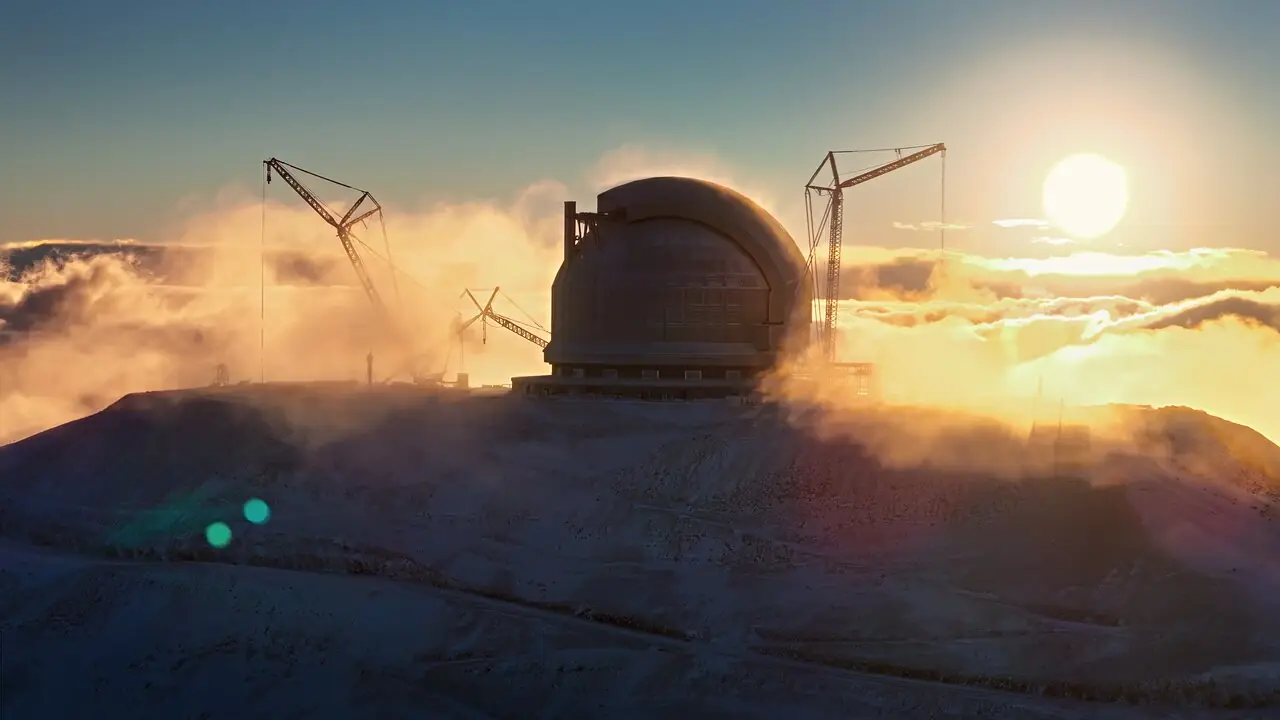
On August 19, 2026, a drone captured something that almost never happens at one of the driest places on Earth.
Snow had settled across Cerro Armazones and the surrounding terrain in Chile’s Atacama Desert. The European Southern Observatory, which operates the Extremely Large Telescope — currently under construction on Cerro Armazones — released the drone image along with photographs of snow-covered Cerro Armazones and nearby Cerro Paranal. Both sets of images are dated August 19, and ESO published them publicly on August 31.
The Extremely Large Telescope is a joint European project that, when operational, will be the world’s largest ground-based optical telescope, with a primary mirror 39 meters in diameter — roughly three times the size of the next largest existing facility. Cerro Armazones was selected as the site specifically because of the Atacama’s exceptional conditions: extremely low humidity, minimal light pollution, and atmospheric stability that produces the sharpest possible observing conditions available anywhere on Earth. A snowfall event temporarily alters some of those conditions, though ESO has noted that observatory operations retain significant flexibility even during weather events.
ESO’s own description of the event is telling. The observatory describes conditions like this as “extremely infrequent” at Cerro Armazones. The reason Cerro Armazones was selected for the world’s largest optical telescope is its exceptionally dry conditions, clear skies, and stable atmosphere.
The meteorological explanation involves what forecasters call a cutoff low — a low-pressure system that detaches from the main jet stream and can occasionally push cold temperatures and moisture northward into Chile’s subtropical zones. The rare snowfall in August 2026 was driven by an Antarctic cold front combined with moisture from the Pacific, with conditions further influenced by an El Niño pattern that weakened the subtropical high-pressure system normally keeping the Atacama dry. NASA Earth Observatory and scientific reporting confirmed this combination as the cause.
The Atacama sits at high altitude across much of its extent. The cold arrives periodically. What rarely arrives is the moisture to produce snowfall. Chilean national meteorological records show that snowfall at elevations above 3,000 meters in the Atacama occurs more frequently than at lower altitudes, but Cerro Armazones sits at approximately 3,060 meters and still experiences true precipitation events on only a handful of days per decade. When an Antarctic cold front is strong enough to push that far north with sufficient moisture, the conditions align in a way that takes years or decades to repeat. The ESO event adds to that historical record.
Elsewhere in the Atacama region, in the city of Alto Hospicio near the port of Iquique, a different kind of accumulation dominates the landscape.
Alto Hospicio has become the destination for tens of thousands of tonnes of discarded international clothing each year — castoffs from global fast fashion supply chains that end up in open-air dumps. The synthetic fabrics do not biodegrade. They sit. Occasionally they catch fire.
The textile waste problem at Alto Hospicio is the subject of ongoing legal and administrative action in Chile. Municipal authorities have attempted to restrict new shipments through the port of Iquique, but enforcement is complicated by the legal ambiguity surrounding clothing imports classified as charitable donations or second-hand goods under trade provisions. Chilean advocacy groups have filed complaints with UNEP and sought binding national legislation that would require clothing importers to finance collection and processing, rather than leaving the burden to municipal waste management systems.
A local textile-recycling initiative has been shredding and compressing discarded synthetic textiles into structural insulation panels for residential construction — providing a diversion route for material that would otherwise remain in the landfill indefinitely.
The Atacama is now dealing with two distinct environmental pressures at the same time: rare weather driven by atmospheric shifts, and a growing mass of non-biodegradable waste from the global clothing trade.
ESO’s drone footage and photographs from August 19 are publicly available through the observatory’s media archive.