 Nikitha Sebastian
Joe Keller is a Half German/Half Italian Digital and Video Creator originally from Germany who specialises in Underwater Photo and Videography of marine life.
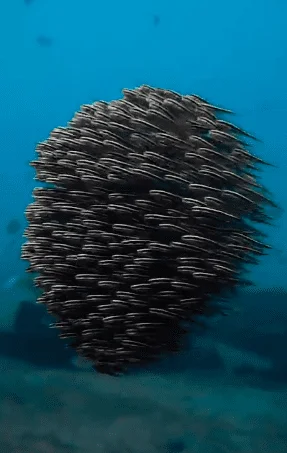
This particular reel shows a Fish-Ball of a school of synchronised-swimming catfish in the waters around the coral reefs in Amed, Bali, which is a common but unique sight while scuba diving.
See: fishball.
The synchronized swimming behavior of catfish schools demonstrates remarkable coordination that emerges from simple local interaction rules rather than centralized control. These bottom-dwelling fish rely on lateral line systems to detect water movement and chemical gradients, enabling coordinated group movements that confuse predators and improve foraging efficiency. Aquatic researchers studying these phenomena have documented how catfish adjust swimming patterns in response to changing current speeds, water temperature fluctuations, and prey availability throughout different seasons and environmental conditions across their native habitats in South American river systems.
The biomechanics of synchronized swimming in catfish schools involve sophisticated sensory systems that allow individual fish to maintain precise spacing and coordinated movements relative to their neighbors. High-speed videography analysis has revealed that catfish adjust their swimming speeds and directions within milliseconds of detecting neighbor movements through their lateral line system, which senses minute water pressure changes and vibrations propagating through the aquatic environment. This rapid response mechanism enables entire schools to execute collective escape maneuvers when predators approach, with information flowing through the group at speeds exceeding muscle contraction transmission rates, demonstrating how decentralized coordination can achieve response times that rival centralized nervous system processing in faster-moving predators.
Research on catfish schooling behavior has also examined the role of visual cues in maintaining group cohesion during low-visibility conditions common in turbid freshwater environments where these fish naturally inhabit. Scientists have developed computational models that simulate catfish school dynamics using agent-based algorithms that replicate observed swimming patterns, schooling formations, and response behaviors to environmental stimuli including changes in water temperature, oxygen levels, current velocity, and predation pressure that influence group decision-making processes and collective movement patterns across daily activity cycles and seasonal migration routes that connect different habitat patches within larger river basin systems.
The synchronized swimming behavior of catfish schools demonstrates remarkable coordination that emerges from simple local interaction rules. These bottom-dwelling fish rely on lateral line systems that detect water pressure changes and vibrations, enabling coordinated movements. Aquatic researchers studying these phenomena have documented how environmental stimuli including predator approach and feeding opportunities affect school coordination. Conservation efforts must address habitat protection and pollution reduction to preserve these social fish communities essential for healthy freshwater ecosystems.
The ecological roles of these fish extend beyond their immediate environments as they serve as prey for larger aquatic predators and contribute to nutrient cycling processes through waste decomposition and sediment disturbance that enhances water quality and supports diverse aquatic communities including insects, crustaceans, mollusks, and plants that form the foundation of freshwater food webs and energy flow through interconnected relationships that depend on healthy catfish populations for ecosystem stability and function across North American and South American river systems where these social fish species have adapted to diverse environmental conditions and human activities that have shaped their behavioral patterns and evolutionary trajectories over millions of years of natural selection and adaptation to changing environmental conditions and ecological pressures across multiple generations of catfish populations in freshwater ecosystems.