 Govind Tekale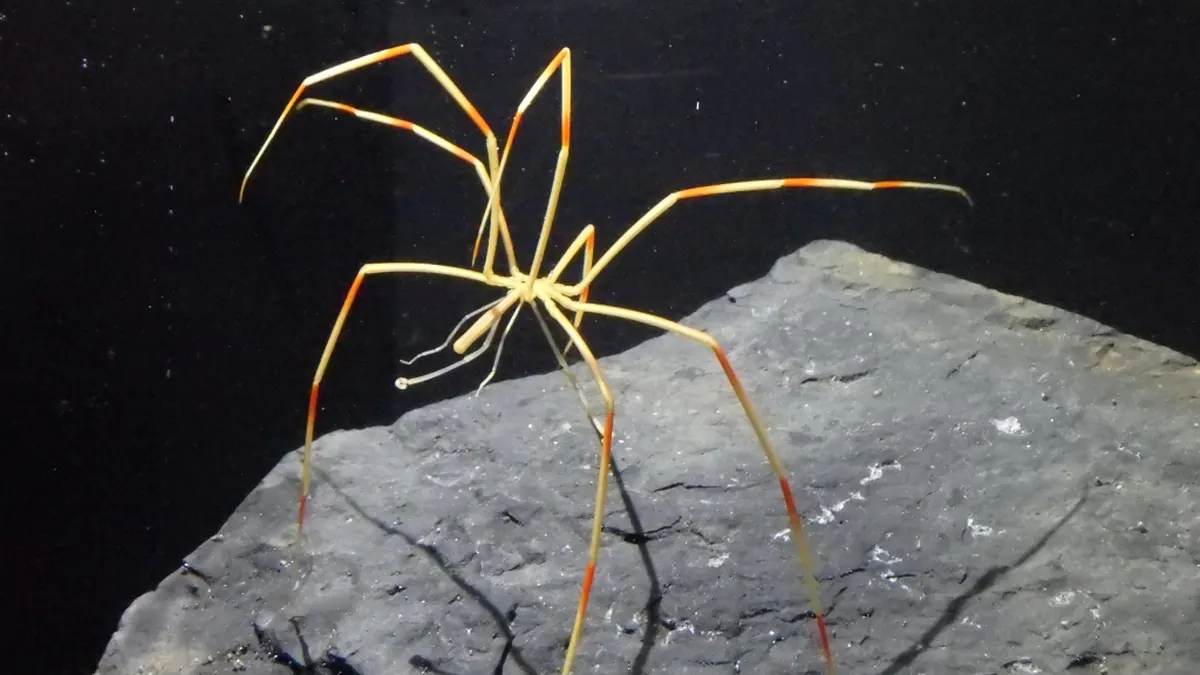
# Why Deep-Sea Crustaceans Are Hitching Rides on Giant Sea Spiders
Picture a creature the size of a dinner plate, walking across the seafloor 3,000 meters down, with a much smaller passenger clinging to its leg for the ride. That’s not a metaphor. Scientists just documented it happening in the deep Pacific, and it says something bigger about how life survives when food barely exists.
Researchers led by Jorge Pérez-Schultheiss at Chile’s National Museum of Natural History used the remotely operated vehicle SuBastian to observe amphipods, small shrimp-like crustaceans, clinging to giant sea spiders along the Chilean Margin. The observations happened at depths of roughly 3,155 meters and 2,698 meters, about 225 kilometers apart, within four days of each other. The findings were published in the journal Ecology.
Understanding this hitchhiking behavior shows how extreme deep-sea environments may be adapting to scarcity. As climate change alters ocean stratification and nutrient sinking, this kind of energy-conserving behavior offers researchers useful baseline data on marine resilience. It also points to why protecting poorly understood deep-sea ecosystems matters. Emerging threats like deep-sea mining could disturb these fragile relationships before scientists even finish documenting them.
Why Hitch a Ride?
Giant sea spiders, technically called pycnogonids, are slow but capable walkers across the seafloor. Amphipods are weak swimmers by comparison and lack a planktonic larval stage that would otherwise help carry them across ocean currents. Researchers suggest the sea spiders may provide transport for these poor swimmers, along with a mobile meeting site, protection, or access to food particles. The researchers themselves are cautious about the behavior’s cause: while they can’t rule out that the interaction is incidental, they note its apparent specificity and recurrence suggest it may be an underrecognized ecological strategy rather than a chance encounter.
The Climate Connection
Deep-sea ecosystems depend heavily on organic material sinking down from sunlit waters above, and food in these environments can be scarce and sporadic, with long stretches between meals. Researchers note this hitchhiking behavior may reflect an adaptation to seafloor environments with limited food resources. Finding the same behavior twice, in two separate locations, within four days of each other suggests this wasn’t simply a chance encounter.
Observing this twice, 225 kilometers apart within four days, suggests this isn’t a rare anomaly, but points to a previously undocumented survival strategy in the deep ocean‘s food-scarce zones, one that scientists are only beginning to study.
Why do amphipods ride sea spiders? Amphipods likely ride giant sea spiders to conserve energy in a food-scarce environment. The sea spiders may act as mobile transport, helping the poor-swimming crustaceans cross distances, find mates, or access food particles without expending their own limited energy reserves.
Scientists plan further expeditions to determine how common this relationship is and whether it’s changing over time. Population genetic studies and deeper trophic ecology research are already in the works, which means this strange partnership is likely to resurface in future research.