 Sonali Tiwary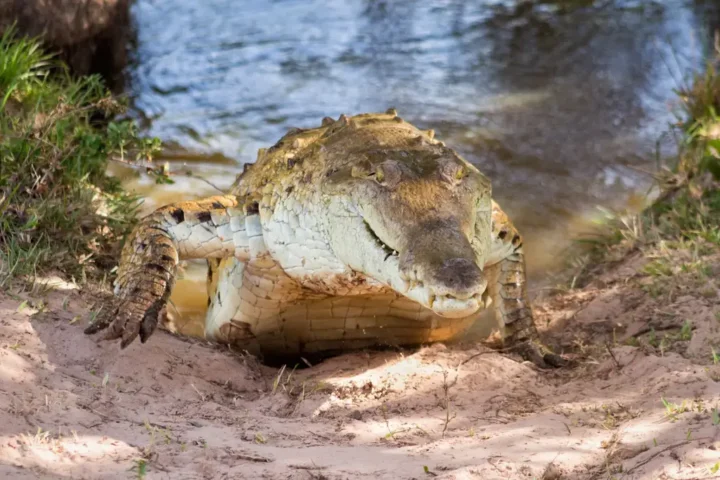
A video showing a saltwater crocodile trapped beneath a vehicle at Cahills Crossing in the Northern Territory has gone viral, reigniting a debate that wildlife authorities have been having—largely with themselves—for years: why do tourists keep entering a waterway they’ve just been warned contains active crocodile predators?
Cahills Crossing sits at the point where the Arnhem Land escarpment drains into the East Alligator River floodplain, inside Kakadu National Park—one of Australia’s most visited natural landmarks. The crossing is popular precisely because it offers vehicle access into Arnhem Land and spectacular views of barramundi jumping the falls during the wet season. It is also, by the Northern Territory Government’s own documentation, a site where saltwater crocodiles are present year-round.
The recent footage documented a large saltwater crocodile—estimated by onlookers to be several metres long—positioned beneath a vehicle attempting to cross the shallow waterway. The clip spread quickly on social media, drawing both shock and frustration from wildlife rangers and Northern Territory residents who have watched this same pattern repeat itself.
Saltwater crocodiles (Crocodylus porosus) are the largest reptilian predators on Earth and are native to Australia’s north. They do not give obvious warning signals before initiating an attack, and shallow water is not a deterrent—it can actually make hunting easier for an ambush predator working a shoreline. The crossing’s low water depth during the dry season gives tourists a false sense of visibility; the animal’s ability to stay submerged and move fast negates that.
Park rangers and local Aboriginal communities have long flagged that signage and verbal warnings lose psychological force through repetition. Many visitors arrive at Cahills Crossing after travelling through Kakadu’s interior, where they have seen no crocodiles. That absence creates a working assumption that the danger may be overstated—a cognitive shortcut that, in this environment, can be fatal.
The Northern Territory Government has posted warning signs at the crossing and ranger stations can advise visitors, but authorities have no legal power to physically prevent adults from entering the water. The river is public, and enforcement of what is technically a voluntary safety advisory is operationally impractical.
What the viral video does, at least temporarily, is make the risk concrete rather than abstract. For the vehicle occupants in the footage, the encounter delivered an immediate, visceral lesson. For everyone watching the clip at home, it still exists at one remove—something that happened to someone else, somewhere else. Research on risk perception consistently shows that people dramatically underestimate dangers they haven’t personally experienced. Cahills Crossing is a textbook case of that dynamic.
Australia records a small number of fatal saltwater crocodile attacks each year—Parks Australia and state wildlife agencies track these and use them in public education campaigns. But data and signs have not closed the gap between knowing a risk exists and behaving as though it is real. Until that changes, the crossing will continue to test the limits of what warning systems can actually achieve.