Montana farmhouse with garter snakes emerging from cinder block foundation
Wildlife · Rural Living

The Montana Farmhouse That Became a Snake Den

When Callie’s family moved into a remote Montana farmhouse, they knew the land came with wildlife. What they didn’t expect: the home’s cinder block foundation had become a seasonal hibernaculum for dozens of garter snakes.

8 snakes seen dropping from foundation in a single day
5 yrs of sightings, from 2020 to ongoing
$75K fundraising goal to move to a new home
¼” minimum gap a snake can enter through

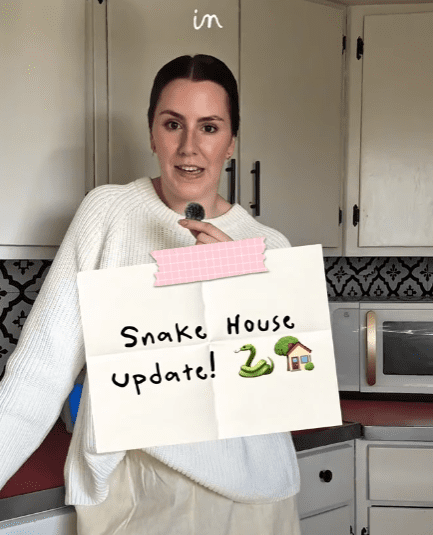
Callie, 27, known online as @callieoverseas, lives in a remote part of Montana where her husband works as a ranch hand — their home is part of his pay package. What started as a single snake sighting in 2020 escalated into what wildlife experts identify as a hibernaculum: a communal den where snakes gather each year to survive Montana’s harsh winters inside the warmth of an old cinder block foundation.

The snakes are garter snakes — non‑venomous reptiles that are common throughout the state. They are not invading; they are returning, year after year, to a den they already know.

“Things were really bad last summer when we realized this is just not a scenario of a snake getting in the house on random. The house is a den.”
— Callie (@callieoverseas)

Callie has been sharing the experience on social media to raise funds to eventually move, while simultaneously working with contractors to seal the foundation — the only long‑term solution according to Montana Fish, Wildlife & Parks.

This story connects to broader patterns of snakes entering residential structures documented across the world, and sits alongside ongoing concerns about shifting snake territories due to environmental changes.

How the Infestation Unfolded

Five years of escalating encounters — from a single sighting to a full hibernaculum discovery

2020 — Early Spring
Callie’s mother‑in‑law finds a snake in the entryway. A second appears in fall. Callie sees her first one in December — just inches from her 6‑month‑old daughter.
2021–2023 — Gradual Escalation
Sightings become seasonal. The family begins to recognize a pattern: snakes appear in spring and taper off around June. Multiple reptiles spotted in the living space simultaneously.
2024 — The Den is Identified
The family discovers snakes are literally dropping out of the cinder block foundation walls — not just entering through gaps. Up to 5–6 per day observed from the basement entry door. The front door is sealed shut.
Spring 2025 — Peak Activity
Up to 8 snakes seen emerging in a single day. Callie begins sharing the ordeal on social media. Audience engagement spikes; she sets a goal of raising $75,000 to eventually move.
2025 — Renovations Begin
A contractor visits multiple times. Work includes foundation sealing, new siding, bathroom gutting, spray foam, and caulking. After some improvements, sightings in the living space reduce — though snakes still appear in the entryway.

Inside the Den: Why the House Became a Hibernaculum

Tap each hotspot to understand why this specific structure attracted a snake colony

👆 Tap any hotspot on the house to learn why it’s a factor in the infestation
Hotspot A — Foundation
Cinder Block: A Perfect Winter Shelter
Cinder block foundations develop hollow voids and micro‑gaps as they age. In Montana, where ground temperatures fall well below freezing, these cavities stay just warm enough to allow reptiles to survive brumation — the reptile equivalent of hibernation. Snakes instinctively return to the same den site year after year.
Hotspot B — Entry Cracks
Small Gaps Are All It Takes
Garter snakes can compress their bodies to pass through small openings. According to Montana Fish, Wildlife & Parks, you should check for openings of ¼‑inch or larger around the foundation and base of the house. Old mortar joints, settling cracks, and utility pipe penetrations all serve as entry channels.
Hotspot C — Exterior Walls
Old Siding Extends the Envelope
Aged wood siding can warp and leave gaps between the siding and the sheathing layer beneath. Snakes can climb and enter the wall cavity from these gaps. Replacing old siding with modern sealed panels is part of Callie’s renovation plan and is one of the recommended long‑term exclusion methods.
Hotspot D — Underground Den
The Hibernaculum Below
A hibernaculum is a communal wintering site used repeatedly across generations of snakes. Unlike a nest, it is not used for breeding — it is purely thermal refuge. The “dropping” Callie describes is snakes exiting the foundation walls as they become active. Sealing while snakes are still inside causes fatalities and odor issues; experts recommend sealing only in mid‑summer, once the colony has vacated.

The Annual Snake Cycle in Montana

Tap a season to understand when and why snakes enter, stay, or leave

Spring (April – May)
⚠ Peak Emergence
As soil temperatures rise above freezing, garter snakes emerge from brumation to warm themselves and find food. This is when Callie sees the most activity — snakes actively dropping from the foundation walls. Up to 8 were observed in a single day. The snakes are seeking sun, not the house itself, but must pass through the living structure to exit.
Summer (June – August)
✅ Best Window for Repair
Sightings typically stop by June as snakes move out to hunt in surrounding fields and brush. This is the critical repair window. Foundation sealing, mortar work, and siding replacement should occur now — while the den is empty. Sealing in winter or early spring traps snakes inside, causing fatalities, decomposition odors, and potential pressure on other entry points.
Autumn (September – October)
⚠ Return Migration
Snakes begin returning to their known den sites ahead of the first hard frosts. If entry points remain unsealed, the colony will re‑enter the foundation for another season of brumation. This is why exclusion work done correctly in summer can break the cycle. Partially sealed foundations can trap some snakes while allowing others to find new gaps.
Winter (November – March)
❄ Brumation
Garter snakes enter a state of brumation — a form of dormancy distinct from mammalian hibernation. They remain metabolically active at a very low level inside the cinder block cavities. Ground frost penetrates the upper soil, but the foundation blocks, insulated by the structure above, remain just above freezing. Attempting repairs during this period risks sealing snakes inside.
← Tap a season segment to explore the cycle

What Actually Works — and What Doesn’t

Callie’s contractor and wildlife management guidance point to the same multi‑step approach

🏗️
Foundation Sealing with Mortar
Spray foam is a temporary measure. Gaps in masonry need mortar or hydraulic cement for permanent exclusion. This is part of Callie’s active renovation.
✅ Long‑term fix · Do in mid‑summer
🏠
New Siding with Sealed Panels
Old wood siding leaves wall‑cavity access points. Replacing with tightly fitted modern panels closes the upper structural envelope. Currently underway at Callie’s home.
✅ Long‑term fix · Combine with foundation work
🌿
Habitat Modification Around Perimeter
Keeping grass mowed low for at least 20 feet around the structure exposes snakes to predators like hawks, making the area less attractive for transit. Remove wood piles, rock piles, and debris close to the house.
✅ Ongoing maintenance
⚗️
Snake‑A‑Way® (Perimeter)
Callie has used commercial repellent powder around the perimeter. Wildlife experts note that while Snake‑A‑Way is the only EPA‑registered snake repellent, its effectiveness for established dens and garter snakes is debated; extension sources caution that repellents are not consistently effective.
⚠ Limited use · Not a primary solution
📍
Sticky Traps (Interior Perimeter)
Callie uses sticky traps at the kitchen perimeter at night as a containment measure. This is a source of public debate — many animal welfare advocates oppose them. It does not reduce the colony.
⚠ Containment only · Controversial method
Poison or Trapping for Removal
There are no registered toxicants for snake control in Montana, so exclusion and sealing are the main strategies. Live trapping is possible but impractical at scale, and relocated snakes may return. Structural exclusion remains the primary solution.
❌ Not viable for this scale

Common Questions, Factual Answers

What the biology actually says — beyond the viral reaction

Garter snakes are non‑venomous. According to Montana Fish, Wildlife & Parks, of the 10 snake species found in Montana, only the prairie rattlesnake is venomous. Garter snakes may bite if handled, but they pose no medical risk to healthy adults or children. The distress Callie describes is a common human fear response, not an indication of danger to the family’s health.
Garter snakes have strong den‑site fidelity — they return to the same hibernaculum year after year, guided by scent trails and thermal memory. Until the structure itself is exclusion‑sealed, the colony will return each autumn regardless of what happens during the summer months.
The family’s housing is tied to Callie’s husband’s employment as a ranch hand — the home comes as part of his compensation package. Under the Montana Residential Landlord and Tenant Act, landlords must provide habitable housing, but remote agricultural contracts introduce legal complexity. Buying a replacement home in Montana’s current market requires a significant down payment — hence the $75,000 fundraising goal.
Older rural structures in Montana — particularly those with cinder block or fieldstone foundations near water sources, fields, and rocky terrain — are known to attract snake dens. Callie has received direct messages from other Montana families who have experienced similar infestations in remote properties. This is not a statewide crisis, but a well‑documented phenomenon in specific rural micro‑habitats.
Yes. Garter snakes are a key part of Montana’s food web. They feed on slugs, insects, small amphibians, and rodents — the very pests that tend to attract snakes to old farmhouses in the first place. Wildlife biologists consistently note that in agricultural settings, their presence near barns and fields is broadly beneficial. The challenge in Callie’s situation is that the snakes are denning inside the residential structure, not simply living on the land nearby.

Since the renovation work began, Callie has reported a reduction in indoor sightings — according to the PEOPLE exclusive: she has only seen two snakes in the living space, about seven in the entryway, and only a couple in the kitchen. The foundation overhaul, new siding, and bathroom work are still in progress. The goal of raising $75,000 through social media to eventually move to a home the family owns remains active.

The story sits within a wider pattern of human‑wildlife boundary situations in rural North America — from invasive pythons in the Everglades to ecosystem disruption caused by Burmese pythons. Callie’s case, involving a native, non‑venomous species and an aging residential structure, is a localized version of the same broad challenge: wildlife and human habitation sharing the same physical space.