 Rahul Somvanshi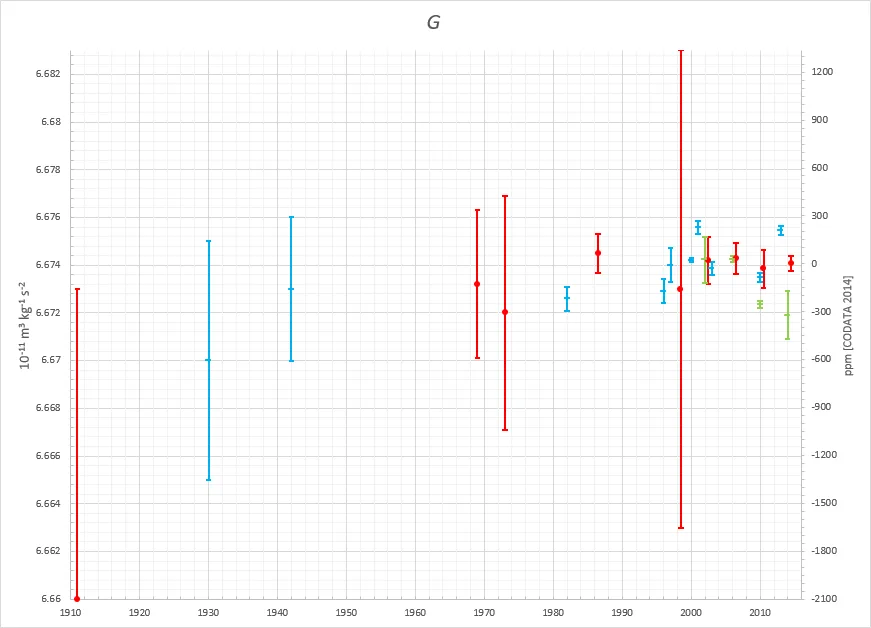
Physicists at the National Institute of Standards and Technology (NIST) have published a new measurement of the gravitational constant, G — the number that describes how strongly gravity pulls objects together — and the result doesn’t fully agree with the most precise previous measurement, made by the International Bureau of Weights and Measures (BIPM) in France.
That disagreement is tiny. In everyday terms, it’s invisible. But in fundamental physics, where scientists need constants to be known to six or more decimal places to build accurate theories, the gap between the two most careful measurements of G is a genuine, long-standing problem.
What NIST Measured
The new value of G is 6.67387 × 10⁻¹¹ m³/kg/s², published in Metrologia (2026; 63(2):025012). The team, led by Stephan Schlamminger at NIST’s Gaithersburg laboratory, used a torsion balance — essentially a very sensitive device that measures how much a horizontal bar twists when masses are placed near its ends, revealing the gravitational pull between them.
This is the same method Henry Cavendish used in 1798 to first measure G in a laboratory. NIST’s version uses copper-beryllium ribbons, electrostatic counter-torques, and eight carefully designed cylindrical masses. To verify the result wasn’t an artefact of the specific masses used, the team also ran the experiment with sapphire masses. Both gave the same answer.
The NIST value is 0.0235% lower than the 2007 BIPM result — large enough that it can’t be dismissed as experimental noise at this level of precision.
The Blind Experiment That Took Ten Years
In precision physics, there’s a recognised problem: experimenters can unconsciously adjust their analysis to produce a result that matches what they expect. To guard against that, NIST ran a “blinded” experiment. The team didn’t know the final correction factor that would unlock their real result.
The team was ready to open the envelope in 2022. But before they did, they discovered an effect they hadn’t accounted for: air pressure was subtly distorting their readings. They paused, corrected for it, and reanalysed.
The envelope was opened on July 11, 2024, at 3 p.m., at the Conference on Precision Electromagnetic Measurements in Aurora, Colorado. Schlamminger described the correction factor inside as “large and negative” — meaning the result was worse news than the team had hoped. Instead of confirming the French measurement, NIST’s most careful work disagreed with it.
Why G Is Still the Least Precise Fundamental Constant
Gravity is the weakest of the four fundamental forces by an enormous margin. Other fundamental constants — the speed of light, the charge of an electron, Planck’s constant — are known to 10 or more significant figures. G is known to only about 5. That’s not for lack of trying; it’s because measuring gravity between small objects in a lab is genuinely, stubbornly difficult.
Why It Matters Beyond a Laboratory
In daily life, you won’t feel the difference. Bathroom scales and GPS satellites and bridge-load calculations all use values of G that are precise enough for any practical engineering or navigation purpose.
Where it matters is in cosmology. Precise knowledge of G is part of calculating how galaxies form, how black holes merge, and whether the equations of general relativity hold up at extreme scales.
Q: What is the new value of the gravitational constant G from NIST’s measurement?
NIST’s new measurement gives G = 6.67387 × 10⁻¹¹ m³/kg/s². This is 0.0235% lower than the most precise previous measurement, made by the BIPM in France in 2007. The result was published in Metrologia in 2026 after a ten-year experiment involving a blinded analysis protocol to prevent unconscious bias in the results.
The next chapter is another independent measurement somewhere in the world attempting to work out who, if either, is closer to the true value of G.
Sources: NIST Publications; ScienceDaily