 Rahul Somvanshi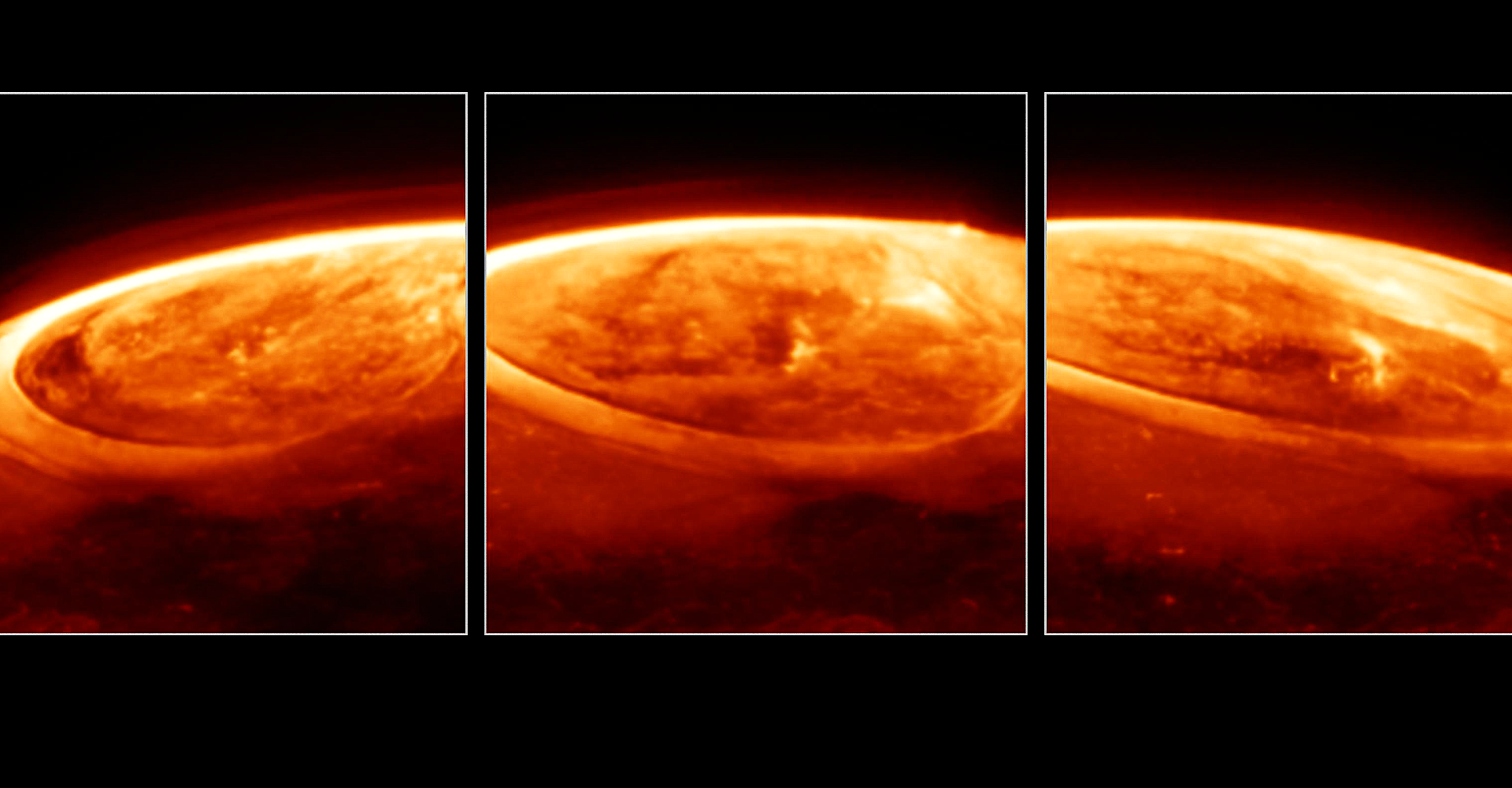
NASA’s James Webb Space Telescope has revealed an unexpected discovery about Jupiter’s auroras – they’re behaving in ways scientists didn’t think possible. These space lights, much brighter than Earth’s Northern and Southern Lights, are changing faster and glowing differently than anyone predicted.
During a Christmas Day 2023 observation, Webb caught Jupiter’s auroras flickering and changing rapidly. “What a Christmas present it was – it just blew me away!” says Jonathan Nichols from the University of Leicester, who led the research. His team expected the lights to change slowly, taking about a quarter of an hour. Instead, they saw the entire auroral region “fizzing and popping with light” almost instantly.
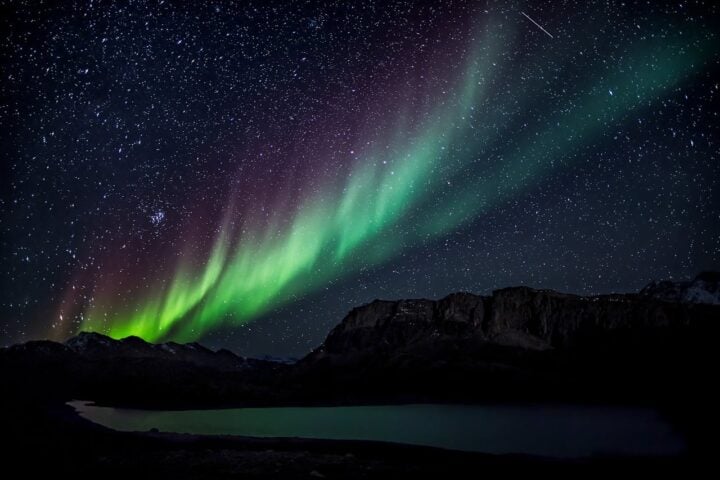
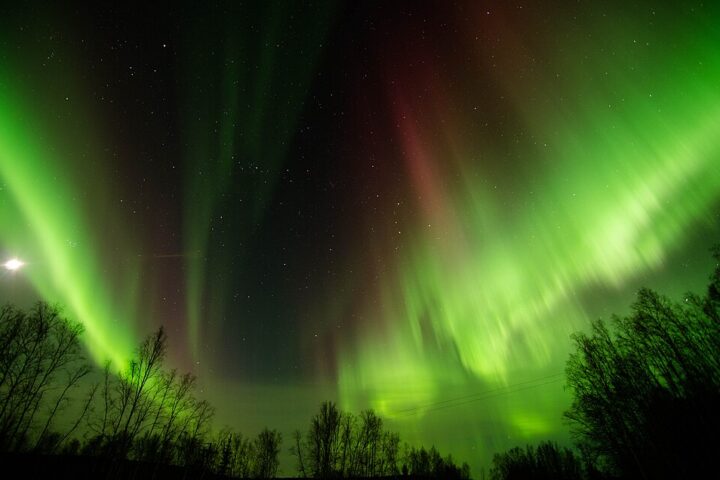
Jupiter’s auroras work similarly to Earth’s Northern and Southern Lights but pack hundreds of times more power. When charged particles hit the atmosphere near the magnetic poles, they make gases glow. But Jupiter has an extra power source – its volcanic moon Io keeps feeding particles into space, which Jupiter’s massive magnetic field captures and hurls toward the poles.
The real mystery emerged when scientists looked at Jupiter with both Webb and Hubble telescopes at the same time. Webb saw extremely bright infrared light in areas where Hubble’s ultraviolet camera saw almost nothing. “Bizarrely, the brightest light observed by Webb had no real counterpart in Hubble’s pictures,” Nichols explains.
“This has left us scratching our heads,” Nichols says. The bright infrared light seems to come from many low-energy particles hitting Jupiter’s atmosphere all at once – something previously thought to be impossible. Nichols compares it to “a tempest of drizzle” – countless tiny drops creating an unexpectedly powerful effect.

The research also revealed new details about a molecule called H3+, which forms in Jupiter’s auroras. Webb showed this molecule lasts about two and a half minutes in Jupiter’s atmosphere before being destroyed. This quick change helps explain how Jupiter’s upper atmosphere heats and cools.
These findings, published in Nature Communications, open up new questions about how Jupiter’s magnetic environment works. Scientists now plan to combine Webb’s observations with data from NASA’s Juno spacecraft, which has been orbiting Jupiter since 2016, to better understand these mysterious lights.
The Webb telescope continues to reveal surprising secrets about our solar system’s largest planet. As researchers dig deeper into the data, they hope to unlock more mysteries about Jupiter’s powerful auroras and what they tell us about similar processes throughout the universe.