 Sonali Tiwary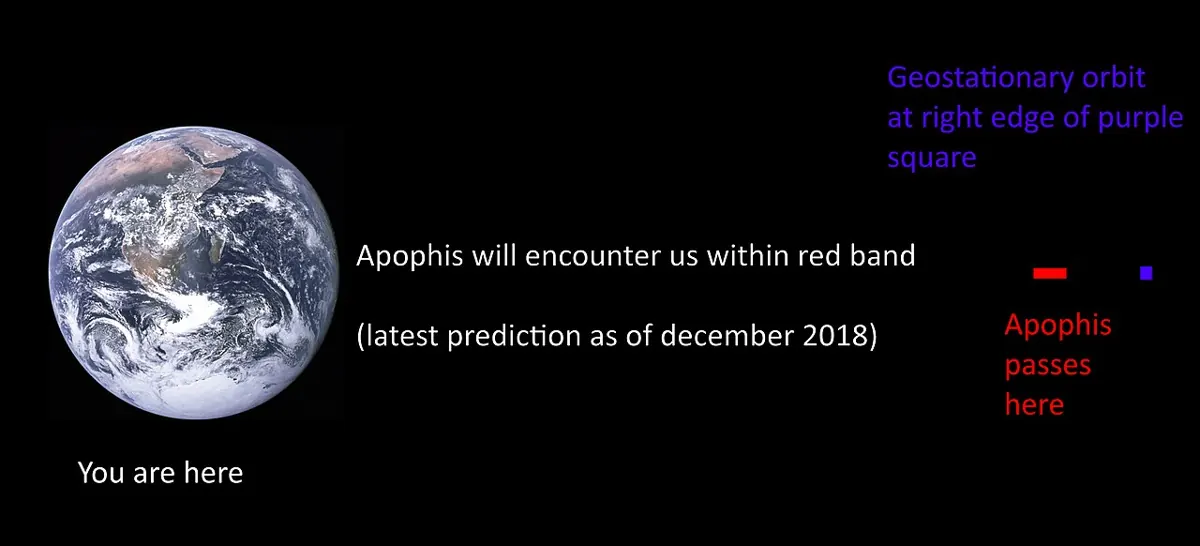
Estimated reading time: 3 minutes
On April 13, 2029, something extraordinary will happen: a roughly 340-meter-wide asteroid named Apophis will pass closer to Earth than many weather satellites. This is the closest approach by an asteroid of this size that humans have ever known about in advance. It’s a rare astronomical event that won’t happen again for centuries.
When Apophis was discovered in 2004, initial calculations showed a small possibility it could hit Earth in 2029, 2036, or 2068. Scientists named it after the Egyptian god of chaos and destruction—fitting, given the potential consequences. But careful tracking over two decades ruled out impact risks for at least the next 100 years. Now scientists know Apophis will miss Earth safely, transforming the threat into an opportunity.
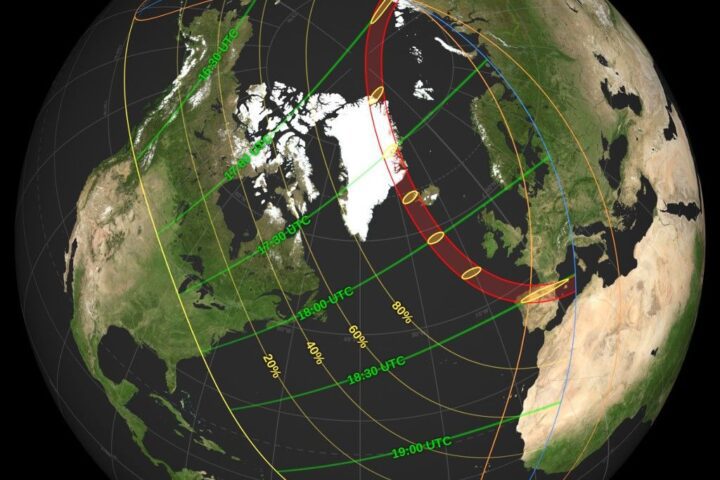
Apophis will pass approximately 31,000-32,000 kilometers from Earth’s surface—closer than geostationary satellites orbit. For context, that’s less than one-tenth the distance to the Moon. The asteroid’s nearest point will occur on April 13, 2029, and the passage will be visible to the naked eye from parts of Europe, Africa, and Asia, depending on weather conditions.
The tidal forces from Earth’s gravity will actually reshape Apophis as it passes. The side facing Earth will experience stronger gravitational pull than the far side, stretching and squeezing the asteroid in ways that might trigger earthquakes and landslides on the asteroid’s surface. This natural experiment offers scientists a rare chance to observe how gravity affects a small body.
Before 2029, Apophis was largely ignored by space agencies. Recently, that’s changed dramatically. Multiple spacecraft are being designed to intercept and study Apophis during the flyby. The European Space Agency, NASA, and other international organizations are coordinating missions to observe the asteroid up close during its closest approach.
Space agencies are essentially planning “air traffic control” for spacecraft traveling alongside Apophis. Universities and private companies are developing CubeSats and other small probes to collect data about the asteroid’s composition, structure, and how it responds to Earth’s gravitational forces.
Recent analyses suggest that Apophis will be visible to a large share of Earth’s population during the 2029 passage from parts of Europe, Africa, and Asia, depending on location, weather, and local nighttime conditions. Visibility depends on where you live and local weather patterns. No telescope or special equipment will be needed for those with a clear view; it will be bright enough to see with the naked eye if clouds don’t block the view.
This makes Apophis a significant astronomical event for observers in regions with favorable viewing conditions. For most people alive in areas where the asteroid is visible, seeing Apophis in 2029 will be a once-in-a-lifetime experience.
Apophis’ close approach has profound implications for planetary defense research. The unprecedented flyby offers real-world data for testing asteroid deflection techniques and studying near-Earth object behavior. If humanity ever faces a genuinely threatening asteroid in the future, lessons learned from Apophis will be invaluable. NASA’s OSIRIS-APEX mission is expected to study the asteroid during the flyby.
Earth’s gravity will affect Apophis as it passes, altering the asteroid’s trajectory. Scientists expect Earth’s gravity may also affect the asteroid’s rotation or surface conditions, though the extent of physical changes is still being studied and understood.
For most of human history, Earth seemed isolated in a static cosmos. Modern astronomy has revealed that our planet exists in a dynamic system filled with small bodies that occasionally come very close. Apophis in 2029 is a humbling reminder that cosmic events operate on timescales beyond human lifespans, yet they can be tracked, predicted, and studied with precision.