Northern Lights May Light Up
20 US States Tonight
A G2 moderate geomagnetic storm, fuelled by a coronal hole high-speed stream, is pushing aurora visibility further south — with a new moon making conditions ideal.
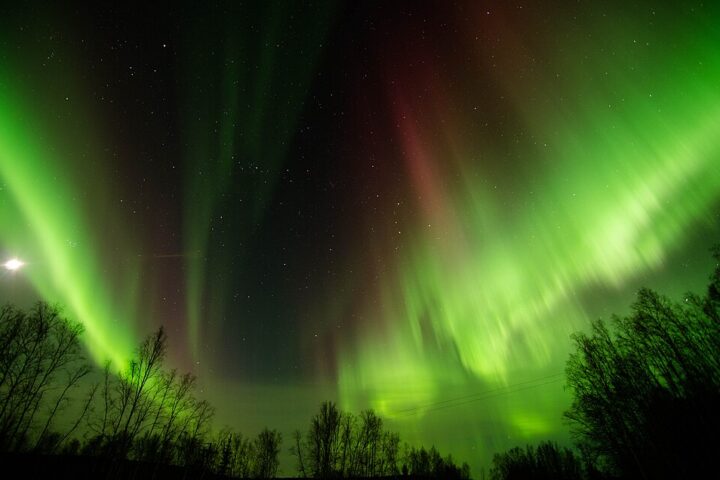
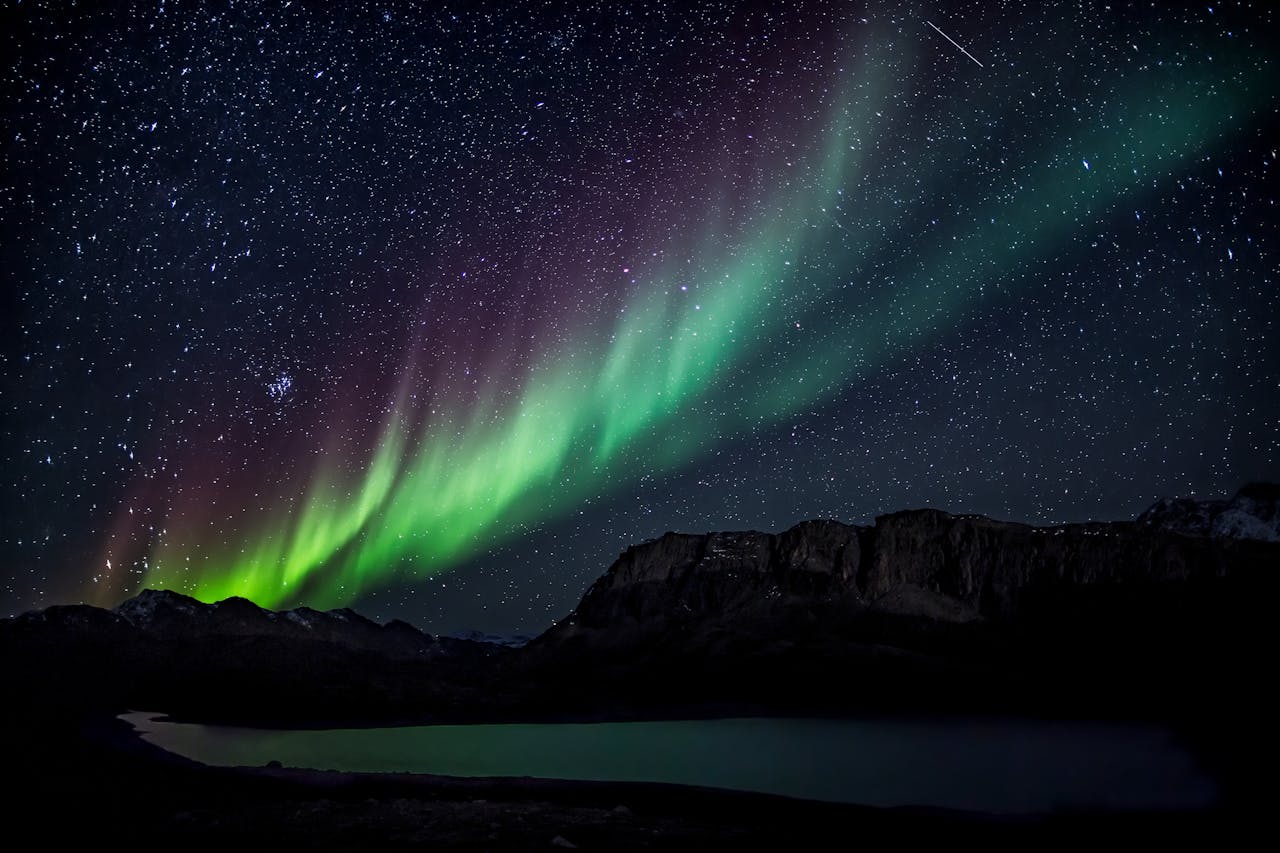 Aurora borealis. Photo Source: Pexels / Visit Greenland
The NOAA Space Weather Prediction Center issued a G2 (Moderate) geomagnetic storm watch on April 15, 2026, covering Friday, April 17 and Saturday, April 18. The storm is driven by a high-speed solar wind stream from a coronal hole in the sun’s outer atmosphere — expected to arrive with a co-rotating interaction region (CIR) that can sharpen the auroral display. Solar wind speeds of 600–700 km/s are forecast based on recurrent values from this coronal hole. A new moon on April 17 means zero lunar light pollution, giving skywatchers across up to 20 northern US states an unusually clean view of the sky.
For context on previous geomagnetic storm watches this season, see KarmActive’s coverage of the March 2026 G1 storm watch. The University of Alaska Fairbanks Geophysical Institute also provides an independent aurora forecast updated throughout the event.
G2 Moderate Geomagnetic Storm Watch
The NOAA 5-tier geomagnetic storm scale — tonight’s active level is highlighted.
Understanding the Kp Index
The Kp index (0–9) measures fluctuations in Earth’s magnetic field. Higher values mean the aurora extends further south.
States in the Aurora Viewline
Northerly states have the highest probability. States in the secondary tier may see aurora on the northern horizon under clear skies.
Best viewing window is typically 10 PM – 2 AM local time. Avoid light pollution and face the northern horizon. Track the NOAA 30-minute live aurora forecast for real-time updates.
How Tonight’s Aurora Forms
Tap through the tabs to follow the full chain — from the sun’s corona to the colours in the sky.
A region of lower-density plasma on the sun’s outer atmosphere (corona) lets a stream of charged particles escape at high speed — this is called a Coronal Hole High-Speed Stream (CH HSS).
The fast wind overtakes slower background solar wind, creating a compressed transition zone — a Co-rotating Interaction Region (CIR) — with shock waves and enhanced magnetic field strength. NOAA forecasters expect solar wind speeds of 600–700 km/s during this event, with the CIR arriving mid-to-late April 17 ahead of the main high-speed stream.
Earth’s magnetosphere deflects most particles. When the interplanetary magnetic field’s Bz component tilts south (negative), it couples with Earth’s field, allowing plasma to funnel toward the poles.
Charged electrons spiral down magnetic field lines and collide with oxygen and nitrogen atoms 100–300 km above Earth’s surface. The atoms absorb energy, then release it as visible light — the aurora.
A Co-rotating Interaction Region (CIR) forms when fast-moving solar wind from a coronal hole overtakes slower background wind ahead of it. According to NOAA’s Space Weather Prediction Center, CIRs are transition zones containing particle density enhancements, increased interplanetary magnetic field strength, and shock waves. They can produce G1–G2 geomagnetic storming. For tonight’s event, NOAA forecasters expect solar wind conditions to become enhanced by mid-to-late April 17 as the CIR arrives ahead of the coronal hole high-speed stream, with solar wind speeds of 600–700 km/s forecast to follow.
NOAA’s official statement noted: “Significant enhancements to the solar wind are anticipated on 17 Apr with the onset of a corotating interaction region that will precede the arrival of a negative polarity high-speed stream.”
The Bz component of the interplanetary magnetic field is the single most important factor for aurora visibility — more than the Kp index alone. It describes the north-south orientation of the solar wind’s magnetic field as it hits Earth.
Track real-time Bz and solar wind speed (expected to reach 600–700 km/s) on SpaceWeatherLive.com or the apps listed below.
The colours of the aurora depend on which gas is excited and at what altitude. As charged particles collide with atmospheric gases, each emits a specific wavelength of light.
Faint aurora that appears grey or white to the naked eye often shows vivid green, purple or red in long-exposure photographs — cameras are far more sensitive to these wavelengths than the human eye.
Tonight’s event is not classified as a major space weather episode. NOAA has noted this is a moderate, expected event driven by a coronal hole stream rather than a sudden coronal mass ejection (CME). Solar Cycle 25 produced a rare double-peaked maximum — with a first peak in late 2023 to mid-2024, and a second peak extending into 2025–2026 — and is now entering its descending phase. NASA and NOAA data confirm that long-lived coronal holes become more prevalent as activity declines, producing recurring high-speed streams like tonight’s event. Note: NOAA’s Aurora Timeline Viewer is currently offline; the agency advises using the official 3-Day Forecast in the interim.
Those interested in Earth’s own magnetic field and its interaction with solar activity may also find KarmActive’s feature on planetary magnetic field research a useful companion read. For dark-sky photography technique, the Blood Moon viewing guide from March 2026 covers many of the same principles.
“Significant enhancements to the solar wind are anticipated on 17 Apr with the onset of a corotating interaction region that will precede the arrival of a negative polarity high-speed stream.”
— NOAA Space Weather Prediction Center
Camera Settings for Tonight
A new moon means zero competition from moonlight — ideal for long-exposure photography.
- Face the northern horizon — aurora appears as a glow, arc, or curtain along the horizon first.
- Move away from city lights. Rural areas or parks with dark sky access give the best naked-eye visibility.
- Use a tripod or rest the camera on a firm, stable surface — car roof, wall, or fence post.
- Peak activity is typically between 10 PM and 2 AM local time.
- Shoot in RAW format if possible. Faint grey glows in the eye often render as vivid green or purple in a raw photo.
- Watch live solar wind data — when Bz turns south, activity tends to intensify within minutes.
Track the Aurora Live
Static maps tell only half the story. These first-hand data tools update continuously.
Where We Are in Solar Cycle 25
The sun follows an approximately 11-year activity cycle. Solar Cycle 25 produced an unusually strong double-peaked maximum and is now entering its descending phase.
Notable Aurora Events Through History
The most powerful geomagnetic storm in recorded history. Aurora was visible as far south as south-central Mexico, Cuba, Hawaii, and Colombia. Telegraph systems across North America and Europe failed and in some cases caught fire from induced electrical currents.
During Solar Cycle 19’s maximum, one of the largest geomagnetic storms of the 20th century produced a widespread red aurora. Sightings were reported as far south as Mexico City. The storm’s Dst index fell to −425 nT. It coincided with the International Geophysical Year (IGY), enabling unprecedented coordinated global observations, documented by the University of Alaska Fairbanks.
A G5 (Extreme) geomagnetic storm — the strongest since the 2003 Halloween storms — produced aurora visible across Europe, the Florida Keys, the Yucatán Peninsula in Mexico, Hawaii, and parts of Asia including northern India and Japan. It was triggered by a series of coronal mass ejections from active region AR 13664/13668 during Solar Cycle 25, confirmed by NASA.
Current event. A G2 storm during a new moon, driven by a CIR and coronal hole high-speed stream. Forecast to be visible across up to 20 northern US states and southern Canada.
A Moderate Show Under Dark Skies
The NOAA Space Weather Prediction Center’s three-day forecast covered the G2 geomagnetic storm watch for April 17–18, 2026. The event was driven by a high-speed solar wind stream from a coronal hole, with a co-rotating interaction region expected to arrive during peak viewing hours. Visibility was forecast for approximately 20 northern US states, with a concurrent new moon providing favourable dark-sky conditions.
The forecast discussed the role of the Bz component and the Kp index in determining aurora visibility, along with minor expected effects on HF radio and GPS systems at high latitudes. Solar Cycle 25 context and historical aurora events were also covered as part of the overall information in this piece.
For broader sky events and space science coverage, the KarmActive Nature section archives previous geomagnetic storm watches, celestial observations, and Earth systems reporting. Live aurora data remains available through NOAA and the European Space Agency Space Weather Service for the duration of the event.