Rahul Somvanshi
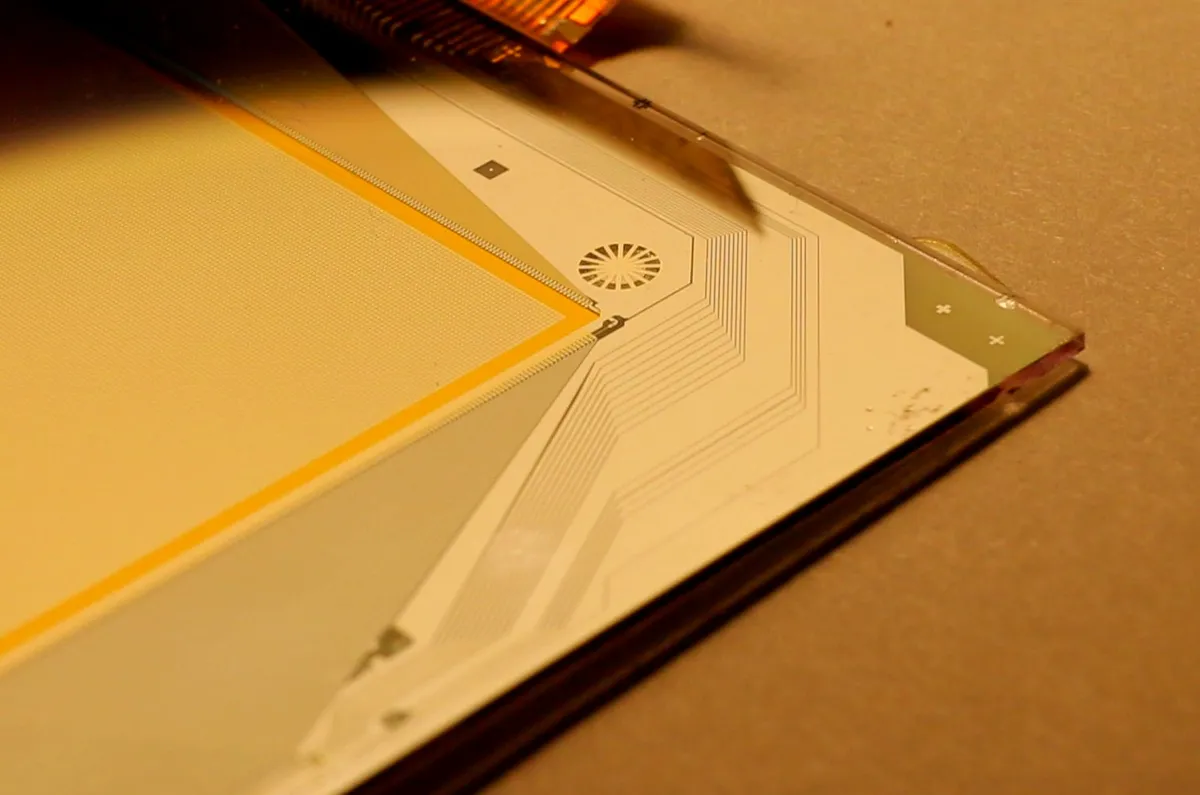
Researchers in Australia have built a color display without electricity that keeps its image for months. The team, from RMIT University and the Australian National University, reported the work in Advanced Photonics Research. The prototype shows that static pictures do not have to drain power to stay visible.
Why Some Screens Keep Drawing Power to Hold Static Images
Many conventional screens, including phones, laptops, and televisions, need a steady supply of electricity to keep a picture on display. For screens based on emissive display technology, the panel keeps drawing power even when the image never changes. Across signs, labels, and devices, that standby draw adds up.
Signs and labels often run around the clock, even when their content rarely changes. For emissive displays, every hour of display time uses electricity, whether or not anyone is reading it.
E-readers already hold a page without power, which shows the idea can work. Researchers have explored sustainable electronics material recovery as part of the same push toward lower-impact hardware. Bringing that to full color is the harder challenge. The RMIT and ANU team turned to a phase-change material for the job.
How Antimony Selenide Locks Color Without Power
The display uses a thin film of antimony selenide, a material that can exist in two atomic arrangements. In one, the atoms form an orderly crystal. In the other, they sit in a disordered, amorphous state. Each state reflects light differently.
The film sits inside a multilayer stack that works like an interference filter, an approach related to thin-film optical material engineering. Changing the crystallinity and thickness of the film shifts the stack’s optical response, producing different colors. The result ranges from deep blues to grays and oranges.
This is the key to the zero-power behavior. Once the film settles into a state, it stays there without a voltage. The researchers found no degradation after three months, with Dr. Le noting it still looked the same a year later.
For sustainable hardware design, this matters because standby power is no longer required to hold an image. Emissive displays, by contrast, must keep energizing their pixels to stay visible. The multilayer stack works like an interference filter, so its colors come from optical structure rather than emitted light. Since the film holds its phase without a voltage, those colors stay stable until the next write.
Writing an image starts with a reset. Heating the film to about 200 degrees Celsius returns the display to a blank crystalline state. Then nanosecond laser pulses are applied to the film. Laser pulses write selected regions of the display, each freezing into the amorphous phase.
Three-Month Image Retention—and the Next Step to Electrical Control
The team tested the display with a koala image. Under ambient conditions, the picture stayed visibly unchanged for three months. Dr. Phuong Yen Le noted that it still looked the same a year later.
Resetting the display also left no trace. Under 5x magnification, the researchers found zero residual image after annealing. The panel returned to a clean, blank state.
The main limitation is how the display gets written. Right now, a laser does the writing, which is why the technology remains at the research stage. Researchers are working on full electrical switching and a wider color range, part of a broader field of ultra-efficient hardware design.
If successful, electrical switching could remove the need for a laser in the writing process. Potential applications could include static signs, transit boards, and retail labels. Each could stay readable for months without draining batteries or grid power.
For readers who care about energy use, the result points toward a different path. Reflective displays built on this approach could show a picture once and then rest without continuous power.