 Rahul Somvanshi
Researchers in China have built a small generator that makes electricity from water as it evaporates. The device pairs lotus stems with a bacterium that moves electrons. In testing, it ran steadily for more than 30 days. Its open-circuit voltage reached 1.48 volts, enough to keep small sensors working in remote farm fields.
A team at Fujian Agriculture and Forestry University in China has developed a lotus stem biofilm electricity generator. The research appeared in Device, a Cell Press journal, and was reported by Tech Xplore on November 18, 2026. The device is a water evaporation-driven generator, a type of WEG.
A biofilm is a thin layer of bacteria that clings to a surface. In this design, the biofilm is made of Geobacter sulfurreducens, a microbe that passes electrons to surfaces. The unit reached a steady power density of 63 microwatts per square centimeter.
Its open-circuit voltage was 1.48 volts. Over more than 30 days of testing, output dropped by less than 15 percent.
For everyday readers, the appeal is practical. Many farm sensors track soil moisture or temperature, and they run on batteries that must be swapped by hand, often in hard-to-reach places. A generator that draws on evaporation could keep such sensors running longer, with fewer spent batteries going to waste. Because the materials are plant-based, the approach can replace the synthetic carbon nanotubes used in many earlier designs. It is not a substitute for grid power, and it is not designed to run homes.
How the Lotus Stem Biofilm Electricity Generator Works
Water evaporation-driven generators use a simple principle. Evaporation-driven clean-tech systems have attracted interest across several research groups. Capillary action, the way water climbs through narrow spaces, pulls liquid upward through a porous material. Warmth from the air turns that water into vapor. As the water moves, it carries charged ions, and that movement separates electrical charge across the device.
Many earlier designs rely on carbon nanotubes, tiny tube-shaped carbon structures, or nanofibrous polymers. The goal of powering low-waste wearable and sensor electronics without batteries has driven interest in ambient energy harvesting. Those materials form tangled pore networks that slow water down, and they are energy-intensive to produce. Metal-free clean chemistry designs offer another path away from synthetic materials.
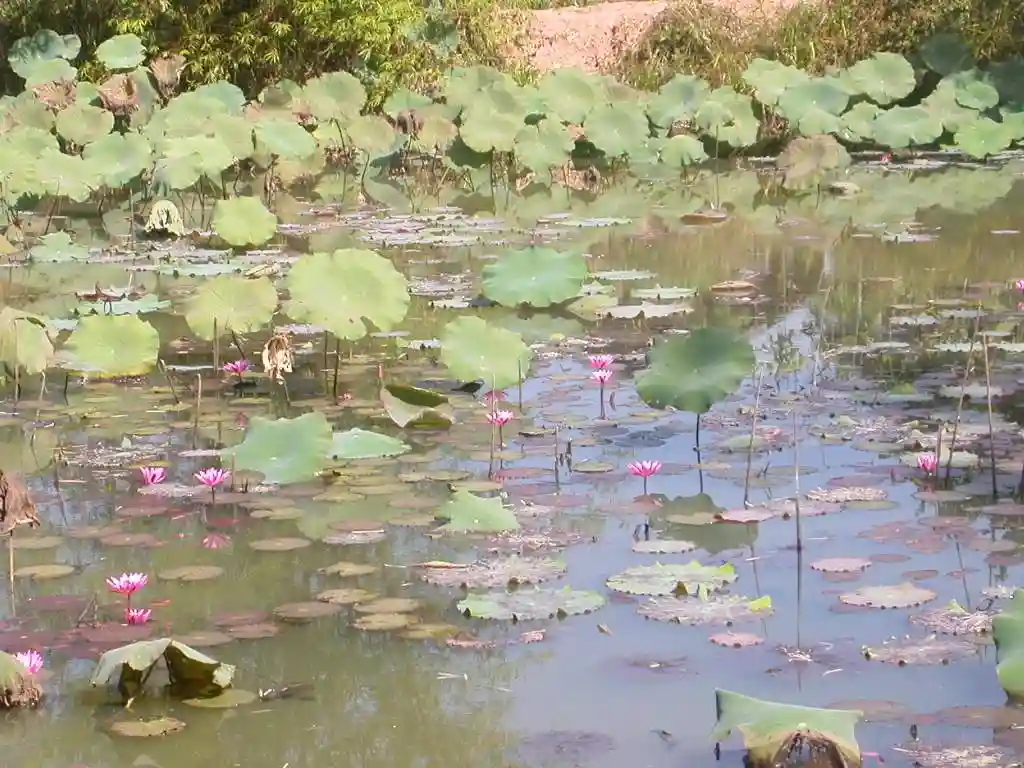
The researchers took a different route. Lotus stems already contain long channels that run straight along the stem, which cuts the resistance water faces as it climbs.
The team soaked lotus stem segments in a suspension of Geobacter sulfurreducens, then freeze-dried them. Electrodes were attached to both ends. The microbe naturally moves electrons to solid surfaces, which makes it well suited to generating current.
In testing, three units connected in series ran a pocket calculator. Linking units in series raises the total voltage. Six units powered a small lamp or an e-ink display. A larger 256-unit array, arranged in a 16 by 16 grid and paired with a voltage-boosting circuit, demonstrated phone charging.
Long-term stability is a common hurdle for new energy devices, so the 30-day result stands out. A device that holds its output over weeks is easier to plan around. That is especially true for sensors that must keep reporting data without anyone visiting them. That is a useful baseline for anyone planning a low-power project.
Output depends on the water supply and the surrounding air. Higher humidity lowers the voltage, because less evaporation takes place. At 63 microwatts per square centimeter, output is modest, so the device suits small, low-power jobs such as sensors rather than large loads.
The lotus stem biofilm electricity generator shows that plant structure and microbes can produce usable power from evaporation. The tested figures are 63 microwatts per square centimeter, 1.48 volts, and less than 15 percent decay over more than 30 days. For now, the best fit is small devices where battery changes are costly.