 Sonali Tiwary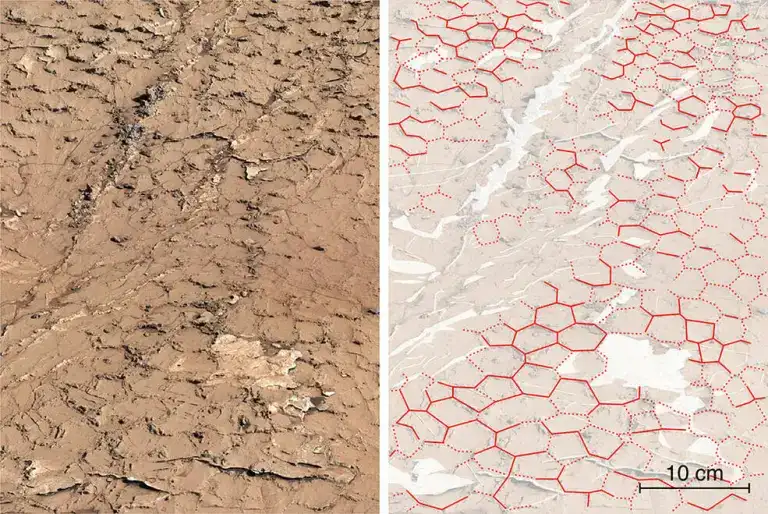
NASA’s Curiosity rover, which landed on Mars on 6 August 2012 and has been exploring the Martian surface for more than 13 years, has made one of its most significant geological discoveries yet. Scientists at the Jet Propulsion Laboratory (JPL) report that Curiosity imaged striking polygonal mud crack formations near the foothills of Mount Sharp (Aeolis Mons) — a pattern virtually identical to ancient mud cracks found in dried lake beds on Earth.
What Were the Mud Cracks?
The discovery involves T-shaped and hexagonal polygon patterns etched into the Martian bedrock. On Earth, these formations occur when wet mud dries and shrinks over successive cycles of flooding and desiccation. The geometry of the shapes — particularly the Y-shaped and T-shaped intersections — tells scientists something important: they indicate repeated cycles of wetting and drying rather than a single flooding event.
Scientific Significance
The finding strengthens the case that Mars once had a habitable environment with fluctuating liquid water — the kind of transitional environment that astrobiologists consider most promising for the emergence of microbial life. The location within the ancient lakebed of Gale Crater, combined with the polygonal fracture pattern, suggests that billions of years ago, this region experienced seasonal or cyclical wet-and-dry periods similar to those found in life-supporting environments on Earth.
How Curiosity Made the Find
Curiosity used its Mastcam (mast camera) system and the Mars Hand Lens Imager (MAHLI) to photograph the formations at close range. Chemical analysis by the ChemCam laser and the Sample Analysis at Mars (SAM) instrument suite provided additional data on the mineralogy of the cracked rock, confirming the presence of clay minerals consistent with prolonged water exposure.
More Than 13 Years and Still Discovering
Curiosity was originally designed for a two-year mission but has exceeded all expectations. In more than 13 years of continuous operation, the rover has travelled over 30 kilometres across the Martian surface, analysed dozens of rock samples, and transmitted millions of images back to Earth. This longevity — powered by a nuclear radioisotope thermoelectric generator — has enabled scientists to study seasonal changes, radiation levels, and the geological history of Gale Crater in extraordinary detail.
What’s Next?
The Curiosity team plans to continue driving toward upper layers of Mount Sharp, where orbital data suggests the presence of sulphate minerals — a transition zone that may record the moment Mars began drying out permanently. Meanwhile, the newer Perseverance rover in Jezero Crater continues a parallel investigation into Mars’ habitability, with the goal of collecting rock samples for eventual return to Earth.
External Sources: NASA — Mars Science Laboratory | NASA Jet Propulsion Laboratory