 Govind Tekale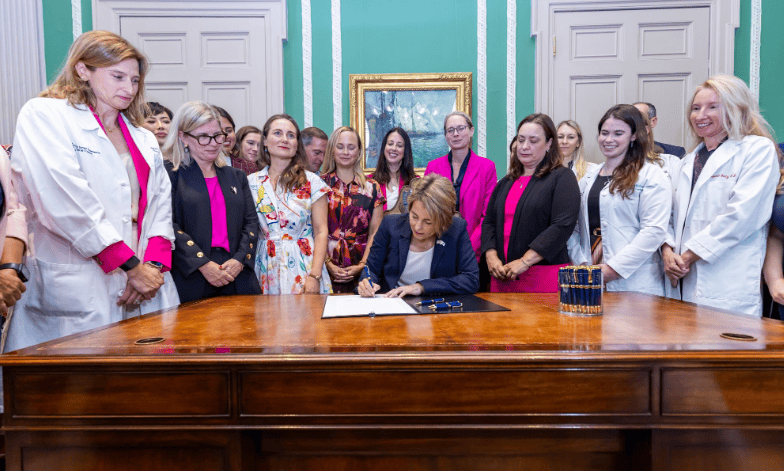
On August 10-11, 2026, Governor Maura Healey signed legislation eliminating Massachusetts’ 24-week abortion limit, shifting the decision-making power entirely to patients and their healthcare providers. The move marks a sharp line drawn after the Supreme Court overturned federal abortion protections.
The law, H.5595, removes what Healey called “an arbitrary and harmful 24-week ban,” according to Massachusetts state government sources and reporting by WBUR. The change rescinds a framework that had permitted abortions at or after 24 weeks only under four specific circumstances: when the pregnant person’s life was in danger, when carrying the pregnancy to term posed a serious health risk, when the fetus had a fatal abnormality, or in other narrowly defined situations. H.5595 eliminates those exceptions entirely.
“This law restores trust between patients and their providers,” Healey said, according to Mass.gov. The governor further emphasized the stakes: “No matter what Donald Trump or Republicans in Congress or the Supreme Court does, Massachusetts will keep abortion accessible,” according to reporting by The 19th.
The Legal Timeline: Massachusetts’ shift reflects a decade of legal changes nationwide. The 1973 Roe v. Wade decision federally protected abortion access until viability. In 2022, the U.S. Supreme Court’s Dobbs decision overturned Roe, returning abortion regulation to the states. Massachusetts responded in 2020 by codifying the ROE Act, which protected abortion access within state borders. H.5595 goes further, removing state-level time-based restrictions entirely.
What Critics Say: Opponents, including commentary from Fox News and Boston.com, argue that the law permits abortion until birth and reduces oversight. Without a defined gestational limit, they contend, the decision-making process becomes less predictable from a legal standpoint.
Context: According to the Guttmacher Institute, Massachusetts previously banned abortion after 24 weeks except in cases where the pregnant person’s life was threatened, the fetus had a lethal abnormality, or the person’s general health was at risk. H.5595 removes all such time-based boundaries.
Governor Healey signed H.5595 in August 2026, eliminating the 24-week abortion limit and its four exceptions, shifting to a patient-provider standard. The law follows the 2022 Dobbs decision overturning Roe v. Wade and builds on the 2020 ROE Act. Supporters cite restored trust between patients and providers; opponents raise concerns about limits and oversight.