 Sonali Tiwary
Colombia’s new president faced his first test three days into office as a magnitude 7.4 earthquake killed at least 181 people, with citizen databases listing over 4,000 missing and rescue teams racing the 72-hour survival window.
The earthquake struck at 7:34 a.m. local time on August 10, 2026. The U.S. Geological Survey recorded a magnitude 7.4 with a depth of 107 kilometers. The epicenter lay 5 kilometers south of San José del Palmar in Chocó, in northwestern Colombia. The rupture tore through the subducting Nazca plate in a strike-slip fault pattern.
President Abelardo de la Espriella had taken office just three days earlier. The disaster forced him to declare a national emergency before his first week ended.
The New President’s First Crisis: An Earthquake Three Days Into Office
De la Espriella moved quickly. He activated the National Disaster Risk Management Unit and ordered rescue operations to mobilize within hours. The Colombian military deployed troops to the most damaged regions. Heavy machinery and search dogs were sent to Chocó and the coffee region of the Andes.
This earthquake tested a new administration before it could establish its footing. De la Espriella faced not only immediate rescue operations but also infrastructure repair and the displacement of thousands. The international community responded. U.S. Secretary of State Marco Rubio announced $15.5 million in American aid.
The initial death count was 111. Within hours, it climbed to 132. Then 169. By August 12, official figures reached 181. But citizen databases tracking missing persons reported over 4,000 unaccounted for—far higher than the official 195 missing. The discrepancy reflected the chaos of the first 48 hours, when bodies lay in rubble and families could not reach authorities in damaged areas.
The 72-Hour Race: Why Rescue Teams Are Pulling Survivors From the Rubble
Rescue workers operated against a biological clock. The first 72 hours after an earthquake are critical. Survival rates drop sharply after that window closes. The U.S. Geological Survey recorded 21 aftershocks in the hours after the main shock. Each tremor risked bringing down unstable buildings and burying rescue workers.
In Cali, a city of 2.2 million people 260 kilometers from the epicenter, crews pulled Diana Troncoso alive from the wreckage on August 11. She had been trapped for over 24 hours. Her rescue offered hope during a grim search for other survivors.
The United Nations Children’s Fund reported 2,595 injured. Many had no access to hospitals. Transportation was cut off. In Pereira and Manizales, near the epicenter, mayors imposed curfews to prevent looting and keep the streets clear for rescue operations.
When the Ground Opens: How Colombia’s Coffee Belt Was Shaken
The earthquake’s location placed it near the heart of Colombia’s coffee region. Roads carrying 60 percent of Colombia’s annual coffee exports were damaged or blocked. Coffee farmers reported collapsed structures and lost access to processing facilities. The interruption threatened to affect global coffee prices and the livelihoods of small producers who depend on exports for their income.
Six airports closed: Pereira, Manizales, Quibdo, Armenia, Cartago, and Buenaventura. Air traffic to the region halted. Popayán airport also suspended operations due to activity at nearby Puracé volcano, which sits in a geologically active zone. The closures trapped tourists and stranded residents who could not leave the damaged regions.
The earthquake shook a region of roughly 10.5 million people. The U.S. Geological Survey reported that all of them experienced Strong (MMI VI) to Very Strong (MMI VII) shaking. In scale, that means walls cracked, chimneys fell, and people were knocked to the ground.
Voices From the Debris: Survivors Describe the Moment Buildings Fell
The earthquake’s depth of 107 kilometers likely saved lives. A shallow earthquake of the same magnitude would have caused more damage. But the depth also meant the shaking lasted longer—people had seconds to seek cover, but many were caught in offices and homes.
In Chocó, the governor reported that entire neighborhoods had been buried. Access roads were impassable. Supplies of food and medicine ran low. The region relies on rivers for transport, but landslides had closed some waterways.
The 1999 Armenia earthquake, which struck a coffee region south of this week’s epicenter, killed over 1,100 people. Colombia had invested in better building codes and emergency response since then. That preparation likely prevented the death toll from being far higher. However, many older structures in rural areas had not been reinforced.
Seismic data offered one slim reassurance. The August 10 earthquake was a strike-slip rupture, not a subduction-zone megathrust. Strike-slip earthquakes do not trigger tsunamis, as confirmed by USGS tectonic analysis. Colombia’s Pacific coast was spared that secondary disaster.
The Road Ahead
Rescue operations would continue for days. The rubble would have to be cleared. Hospitals required reinforcement and supplies. Roads needed repair before winter rains began in October. De la Espriella faced enormous pressure to deliver aid and restore services while a new administration was in its first week of staffing.
The earthquake had struck Colombia at a moment of transition. A new president was in office. International attention was limited. For the families in Chocó and the coffee region, recovery had begun.
—
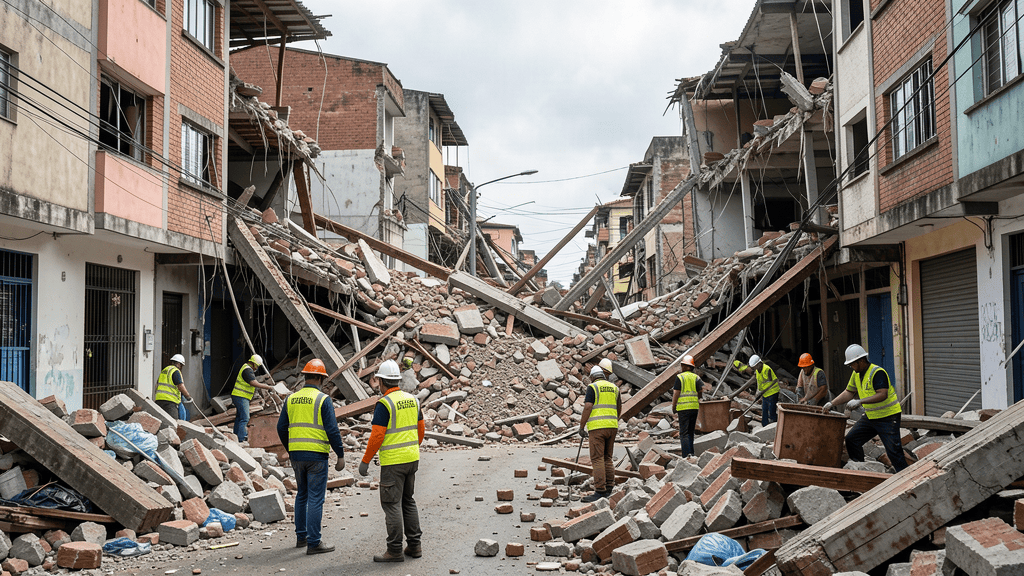
Collapsed buildings in Pereira, Colombia following the 7.4 magnitude earthquake on August 10, 2026. The quake killed at least 181 people and left thousands missing in the hardest-hit coffee-growing region. This feature image captures the scene of rescue workers sorting through rubble in the aftermath of the disaster that tested President Abelardo de la Espriella’s first week in office.
Alt text: Collapsed buildings in Pereira, Colombia after the 7.4 earthquake