Karmactive Team
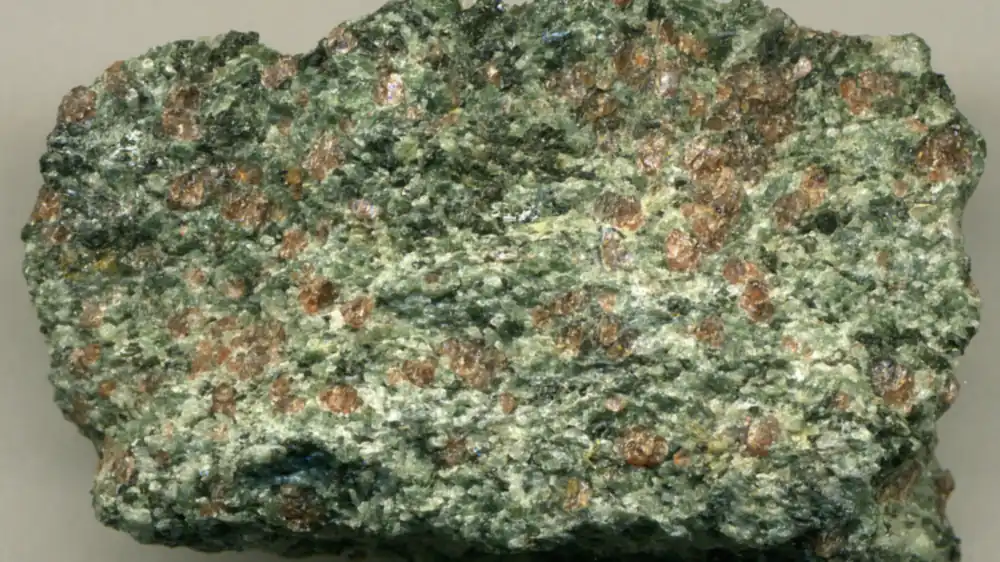
A small piece of rock collected from a beach in Papua New Guinea has upended some long-standing assumptions about how the inside of the Earth works.
The rock came from Taleba Bay on Goodenough Island, in the Milne Bay Province of Papua New Guinea. To look at it, it’s a red-and-green stone — an eclogite. But what’s inside it is what made scientists at the University of Göttingen pay close attention. Trapped within tiny red garnet crystals were microscopic fragments of a mineral called coesite. Each fragment is less than 1 micrometer across — roughly one-hundredth the width of a human hair.
A Rock That Went Deeper Than Expected
Coesite forms under extremely high pressures, and its presence in this eclogite provides evidence that the rock reached depths exceeding approximately 90 kilometers. The fact that coesite is in this rock tells geoscientists — led by Dr. Jan Schönig at the University of Göttingen — that this rock was once buried that deep inside a tectonic subduction zone, where one of Earth’s plates was being pushed beneath another, a process documented in broader terms by USGS research on subduction and exhumation timing. The rock was subducted more than 90 km below the surface approximately four million years ago before eventually returning to the surface.
The research, funded by the German Research Foundation and published in Nature Geoscience, found something even more unexpected when the team analyzed the rock’s temperature history — a level of detail that recalls how scientists confirmed Quebec rocks as Earth’s oldest at 4.16 billion years using similarly painstaking mineral analysis.
At 90 kilometers down, the rock experienced around 800°C — extremely hot. But at 45 kilometers depth, roughly halfway through its burial, the temperature was only about 700°C. That’s just 100 degrees cooler, despite being at only half the depth. In a normal subduction zone, temperature drops more gradually as you get shallower. Here, the rock was almost as hot at 45 km as it was at 90 km. This kind of mixed rock history echoes patterns seen in USGS studies of tectonic melange formation in Northern California.
The researchers reconstructed an initially warm subduction regime that transitioned to colder conditions at greater depth, which challenges conventional thermal models of subduction zones.
Dr. Schönig described the finding directly: “Finding this change from hot to cold subduction was unexpected as this contradicts our current thermal models of subduction zones.” A similarly unexpected regional geological finding, the disappearing glaciers atop Puncak Jaya in the broader New Guinea region, shows how much is still being learned about this part of the world.
Why does this matter beyond geology? Subduction zones are one of the main ways the Earth recycles carbon. When rock gets pushed deep underground, it carries carbon with it. When conditions change — like when the temperature gradient shifts — that affects how much carbon gets stored versus how much eventually makes its way back toward the surface. What started as a piece of rock on a beach turns out to be a record of processes deep inside the planet that influence how carbon is stored and cycled over geological timescales.