Karmactive Team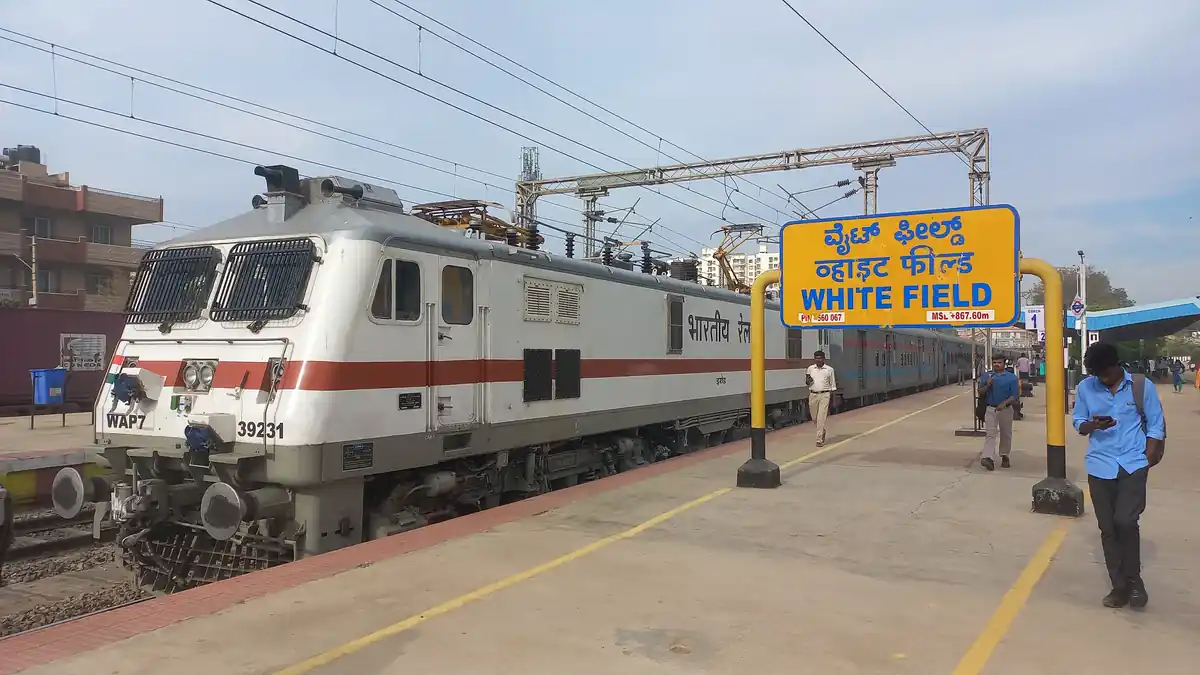
India launched its first LNG-diesel dual-fuel train from Sabarmati on September 27, with Home Minister Amit Shah flagging off the locomotive alongside railway projects worth more than ₹1,500 crore in Gujarat. The same event included announcements on Kavach automatic train protection system installation across Gujarat rail sections. Here's what each development means for Indian rail.
All India Radio reported that Amit Shah flagged off India's first LNG-powered train from Sabarmati station and inaugurated railway infrastructure projects valued at over ₹1,500 crore across Gujarat. The Indian Express identified the locomotive as an LNG-diesel dual-fuel DEMU — a Diesel Electric Multiple Unit modified to run on liquefied natural gas and diesel in combination, rather than diesel alone. At the same event, the installation of Kavach automatic train protection system was announced across 404 km of the Ahmedabad division at a cost of ₹411 crore, and on the Sabarmati-Kalol-Sabarmati section at ₹48 crore.
What LNG Does — and Doesn't Do — for Rail Emissions
LNG as a locomotive fuel can reduce diesel particulate emissions in the specific operations where it substitutes for diesel. In a dual-fuel DEMU, the fuel mix varies depending on operating conditions — the system uses LNG where viable, with diesel as supplement or backup. LNG is a fossil fuel. Calling this train zero-emission or inherently "green" would not be accurate. The relevant comparison is against a conventional diesel-only DEMU of equivalent specification, where dual-fuel operation reduces but does not eliminate fossil fuel combustion.
India has achieved substantial railway electrification — the government highlighted at the Sabarmati event that the national network has reached 99.6% electrification of its broad-gauge routes. LNG dual-fuel is better understood as a transitional technology for routes or rolling stock where full electrification is not yet practical, rather than a long-term decarbonisation endpoint. The two approaches serve different parts of the fleet transition problem.
For the Kavach system: the Ahmedabad division installation announced at this event extends the collision-avoidance coverage across one of Gujarat's busiest rail sections. Kavach calculates deceleration curves continuously and overrides throttle controls to stop a train before conflicting signal aspects — independent of driver input. The Vande Bharat express programme and broader high-speed rail services benefit as Kavach coverage expands across the network.
The ₹1,500+ crore Gujarat railway infrastructure package announced alongside the launch covers broader project work in the state. Individual project allocations were not broken down in the available source reporting.
The practical question for both technologies is scale. A single dual-fuel DEMU launch is a proof-of-concept event. Broad diesel reduction across India's freight and regional services would require fleet conversion at a different order of magnitude. Kavach's safety impact similarly grows as it is fitted to more routes and locomotives — the network effect matters more than any single deployment announcement.
India's Ministry of Railways is running parallel tracks on modernisation: electrification for mainline trunk routes, alternative fuel pilots for regional and freight, and collision-avoidance deployment. This event sits within that broader programme. Operational performance and emissions data from the LNG DEMU will inform any wider conversion decision.