Rahul Somvanshi
The NASA Fermi pulsar cryptography search found a dead star in open telescope data a million times faster than earlier methods. Astronomers located PSR J1622−7204, an isolated pulsar that spins 261 times per second. The team used the equivalent of 10 hours of computing time on a standard processor. The previous best method failed to find it even with enough work to occupy a standard processor for 600 years.
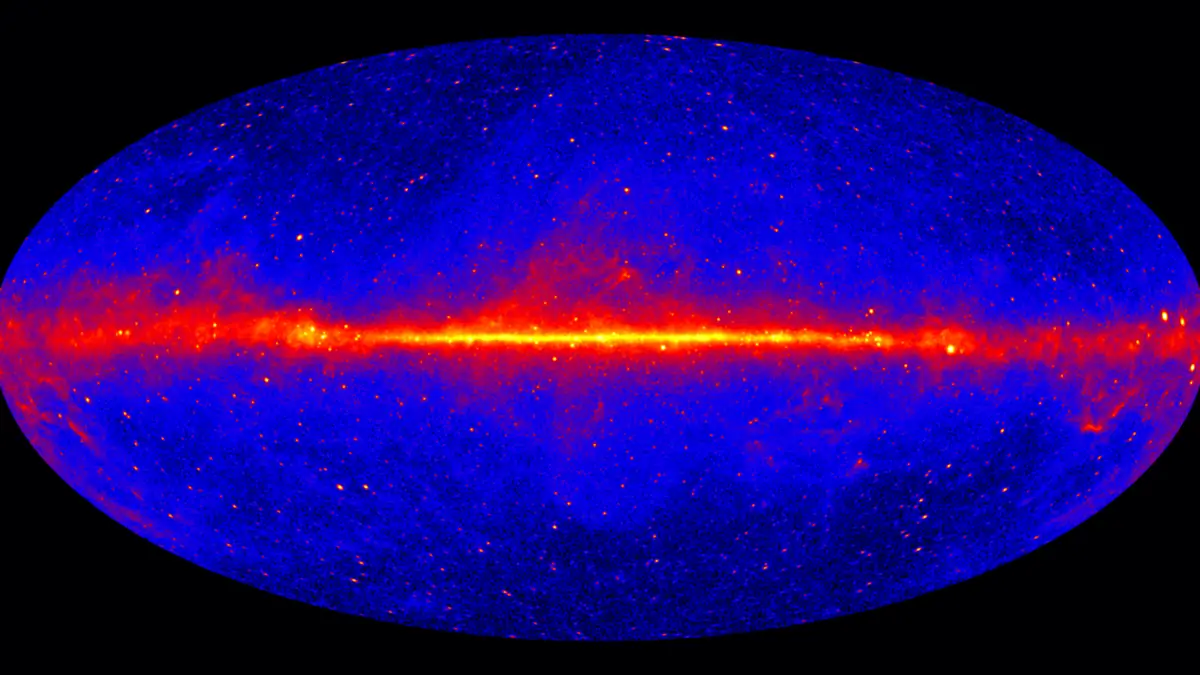
The result was published on November 19, 2026, in Physical Review Letters. It draws on 15 years of gamma-ray observations from NASA’s Fermi Gamma-ray Space Telescope. Fermi launched in 2008 and surveys the entire sky every three hours. Lead author Daniel Pook-Kolb and co-author Colin Clark work at the Max Planck Institute for Gravitational Physics in Germany. Dotan Gazith and Barak Zackay of the Weizmann Institute of Science in Israel adapted the method.
NASA’s open-data policy is what made the search possible. After a one-year calibration period, Fermi data became fully public. All 18 years of it are now available. Fermi project scientist Elizabeth Hays works at NASA’s Goddard Space Flight Center in Greenbelt, Maryland. She said that openness lets one team repeat and check the search another team ran.
How a lattice algorithm finds a dead star
A pulsar is a rapidly spinning neutron star that sweeps beams of radiation past Earth, much like a lighthouse. Fermi picks up only a few photons from any single pulsar. They arrive mixed with background noise from other gamma-ray sources. To find the signal, researchers have to guess several unknowns at once. The list covers how fast the star spins, how quickly the spin is slowing, and where it sits in the sky. Testing every combination would take an impossible number of calculations.
Pook-Kolb described the problem as a four-dimensional grid where each direction needs millions of trials. Gazith and Zackay saw that the search could be recast as a geometry problem. It becomes a search for the shortest vector in a high-dimensional lattice, a regularly spaced array of points. Algorithms for that task were developed by cryptographers testing encryption systems built to resist code-breaking by future quantum computers. The same technique has also been used to make satellite navigation systems more efficient.
Each trial run took about five minutes on a single computer core. That is work a standard laptop with two to eight cores can handle. Once the lattice method flagged a candidate, the team fed in the full Fermi data set. The result was a signal too strong to be a chance alignment.
What the team searches for next
The next target is pulsars in binary systems, where a pulsar orbits another star. A companion’s gravity distorts the signal, and that distortion has kept these objects out of reach for traditional search methods. Clark said the data set probably holds tens, and maybe hundreds, of these objects that earlier searches could not find.
The plan is to pair the lattice method with Einstein@Home. That volunteer computing project lends unused processing power from the public. Gazith noted that his group has nothing to do with cryptography in this analysis, but that those algorithms solve the pulsar search problem. NASA’s Fermitools software helped the team prepare the data before the search began.
How did a cryptography algorithm find a new pulsar in NASA Fermi data a million times faster?
Researchers recast the four-dimensional gamma-ray search as a shortest-vector problem in a high-dimensional lattice, a technique built to test quantum-resistant encryption. Five-minute trials on ordinary computer cores located PSR J1622−7204 in 10 computing hours instead of 600 years.
Why are gamma-ray pulsars harder to detect than radio pulsars?
Fermi records only a small number of photons from a given pulsar, mixed with noise from other gamma-ray sources. Matching them requires guessing the spin rate, the spindown, and the sky position all at once, which multiplies the number of trials.
What binary pulsars will Einstein@Home search for next?
The team will point the lattice algorithm at binary systems, where a companion star’s gravity warps the signal. Volunteer computing power from Einstein@Home should let them test many more candidates than a single group could run on its own.
The Fermi mission has grown its catalog from a few hundred gamma-ray sources to thousands. The new method adds a fresh way to work through the same archive. The team expects the Einstein@Home campaign to start processing binary candidates, and the archive keeps growing as new observations are released.