Rahul Somvanshi
Researchers have mapped ways to restore lost capacity in grid-scale flow batteries, rather than scrapping degraded units. If you rely on solar or wind power, storage keeps electricity flowing when the sun sets or the wind drops. Utilities need that storage to last longer and cost less to maintain, which is why these recovery methods matter.
Flow battery capacity recovery is the focus of a new review paper from researchers at Southern University of Science and Technology. It was published online in the journal Nano-Micro Letters on 7 September 2026, with the DOI 10.1007/s40820-026-02345-y. A news release highlighting the study followed on 25 November 2026.
The author list includes Xu Lin, Meisheng Han, Haolin Ju, Hengyuan Hu, and Wanqi Hu. Jiajie Luo, Lei Wei, Lin Zeng, Wenjia Li, and Tianshou Zhao are also named as authors. All ten authors are affiliated with Southern University of Science and Technology.
The team systematically classified three coupled degradation pathways. It then synthesized recovery interventions for redox flow batteries, or RFBs. These systems store power in liquid held in external tanks. The review’s stated aim is to cut maintenance costs and extend lifetimes for solar and wind grids.
For clean-energy engineers and grid-storage followers, the practical consequence is a different approach to maintenance. In some cases, a battery that loses capacity may be diagnosed and treated while still in service, rather than retired early.
That could help keep long-duration storage running longer for solar and wind grids. The review also notes that recovery rates remain incomplete. For climate-tech readers, degraded storage may not have to be treated as disposable.
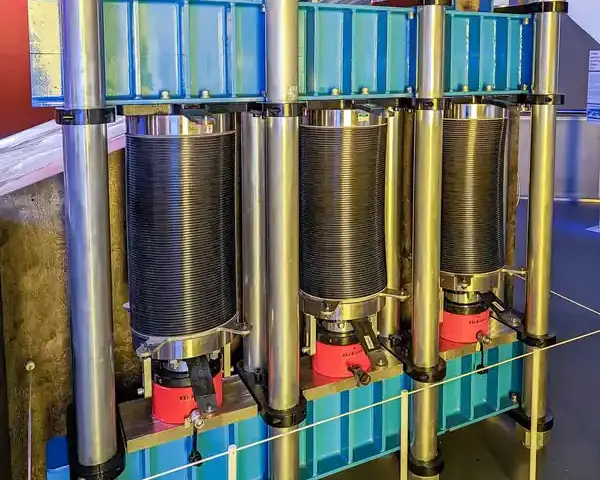
Redox flow batteries store energy in liquids held in external tanks. Think of the tanks as reservoirs of circulating electrolyte, while the cell stack handles power conversion. Because these batteries store solar and wind power, their lifespan matters to grid planners. Capacity fade is the gradual loss of storage a battery can deliver over time.
The researchers classified three pathways that drive this loss. The first is transmembrane migration, where active species and solvent move across the membrane. That movement upsets the balance of volume and composition. The second is precipitation, oxidation, or decomposition of active species. In plain terms, the useful chemicals solidify, change form, or break down.
The third pathway is electrode degradation, which brings parasitic hydrogen and oxygen evolution. These are side reactions that release hydrogen and oxygen gas. Because the pathways are coupled, one problem can worsen another.
Four Recovery Approaches Covered in the Review
The review groups its recovery methods into four approaches. They are high-selectivity membranes, chemical and electrochemical valence regulation, electrode active-site regeneration, and digital-twin scheduling. Some of these approaches may enable recovery in service, depending on the battery and its degradation mechanism.
Membranes control which particles pass through. A high-selectivity membrane lets intended species move across while limiting unwanted crossover. This relates to the first degradation pathway. Such membranes are a material and component choice, not a routine in-service treatment.
For zinc-based systems, the paper points to Bi2O3 as a way to revive what the researchers call “dead zinc”. This refers to zinc that has become inactive and no longer takes part in storage. Reviving it may restore capacity that appeared lost. The approach is aimed at zinc-based systems, so it does not apply across every flow battery.
For iron-based systems, the review cites hydrogen-mediated redox regulation as one example. Redox regulation means adjusting how the active species gain and lose electrons. Such approaches may rely on catalytic reactions, hydrogen feeds, or auxiliary rebalance cells alongside electrolyte chemistry.
Electrode active-site regeneration focuses on the electrode surface. Active sites are the spots where the useful reactions happen. Regenerating them aims to bring back reactions that have weakened.
Digital-twin scheduling adds a software layer. A digital twin is a virtual model that mirrors a physical battery and tracks its condition. The review presents this as an emerging, model-driven framework within its future outlook. In such a system, autonomous scheduling would decide when maintenance should run. The aim is to plan maintenance before capacity drops, rather than reacting afterwards.
Flow battery capacity recovery now has a mapped set of options, from membranes and valence regulation to electrode regeneration and digital-twin scheduling. The review from Southern University of Science and Technology treats most recovery strategies as targeting reversible fade. Permanent chemical decomposition or severe electrode damage may not be repairable by these methods. For utilities and engineers, that may help keep long-duration storage running longer, though recovery rates remain incomplete.