 Govind Tekale
Could photosynthesis power electronics? Yes, at very small scale. A peer-reviewed study involving University of Cambridge researchers demonstrated a photosynthesis-driven biophotovoltaic system that powered a microprocessor used in Internet-of-Things applications for more than six months.
The study, Powering a microprocessor by photosynthesis, was published in 2022 in Energy & Environmental Science. Its abstract describes a photosynthesis-driven system with an aluminium anode. That is an important proof of concept for bioelectronics, but it is not a drop-in consumer battery.
What the research demonstrated
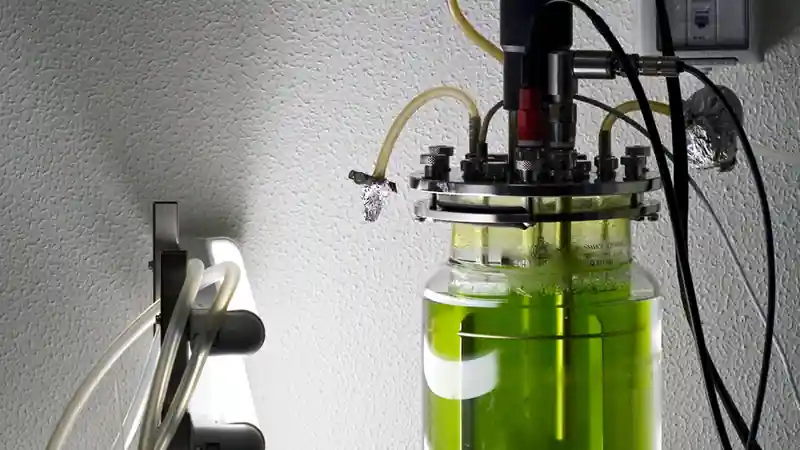
Biophotovoltaic devices use photosynthetic organisms to convert light into electrical current. In the Cambridge-linked work, living photosynthetic material was part of a system designed to deliver a tiny, steady supply of power to a low-energy microprocessor. Such devices can be attractive for sensors or other electronics that need very little power and can operate slowly or intermittently.
The reel also credits bio-designer Lucia Giron with algae-based “biocells”. That design attribution comes from the reel’s caption. Karmactive could verify the underlying Cambridge-linked microprocessor study, but did not locate a primary project page establishing that the specific objects shown in the video are consumer-ready products.
Why it is not a replacement for ordinary batteries
Consumer devices such as phones, laptops, power tools and many household products need far more power and energy storage than the published demonstration delivered. A living bio-photovoltaic system also has practical constraints: it needs light, water, suitable conditions for the organisms, electrodes and maintenance. Those needs can be features for a research prototype, but they limit where the technology can be deployed.
The phrase “replace millions of toxic single-use batteries” therefore goes beyond the evidence. Bio-photovoltaics may eventually help power specialised low-energy sensors, particularly where replacing disposable batteries is difficult. They do not currently replace the broad range of single-use or rechargeable batteries used in consumer electronics.
Design can make the biology visible
The reel’s design point is fair: working with living materials changes the relationship between an object and its user. A device that contains algae or other photosynthetic organisms cannot be treated exactly like sealed, inert hardware. But the visual language of a prototype is not evidence of commercial readiness, durability or environmental superiority across its whole life cycle.
Bottom line: Photosynthetic bio-photovoltaics are real research, and a Cambridge-linked team did show that they could power a low-energy microprocessor for more than six months. The technology is promising for niche, ultra-low-power uses—not yet a general replacement for conventional batteries.
Sources: P. Bombelli et al., “Powering a microprocessor by photosynthesis,” Energy & Environmental Science (2022), DOI 10.1039/D2EE00233G; the supplied social-media reel for the Lucia Giron design attribution.