 Karmactive Staff
India’s festival calendar features multiple occasions involving idol immersion in water bodies, each contributing to environmental degradation that affects millions of people. Festival idol immersion represents a devotional practice spanning centuries, yet modern manufacturing and chemical paint production have transformed this spiritual act into a source of water contamination affecting rivers, lakes, and coastal areas. Understanding the pollution mechanisms and selecting sustainable alternatives protects water ecosystems while preserving festival traditions. See Water pollution and Aquatic ecosystem.
The composition of puja idols determines their environmental consequence following immersion. Clay idols represent the most environmentally sound choice, as clay gradually dissolves in water, returning harmlessly to aquatic environments. In contrast, idols crafted from plaster of Paris (POP) present a serious challenge for water quality and ecosystem health. POP does not dissolve and persists indefinitely in water bodies, accumulating and creating sediment layers that smother aquatic habitats and disrupt ecological balance. See Plaster of Paris and Clay.
Paint used on idols carries hidden environmental costs that extend beyond immediate visual impact. Synthetic paints and chemical coatings often contain heavy metals including lead, cadmium, and chromium. When these idols are immersed in water, these toxic metals leach into aquatic environments. Heavy metal accumulation in water bodies poses risks to fish populations, aquatic plants, and eventually to human communities that rely on water for drinking and agriculture. The metals persist in sediments and accumulate in food chains, concentrating in tissues of organisms over time. See Heavy metals in paint, Lead paint, Mercury), Cadmium, and Bioaccumulation.
The practice of Ganesh Chaturthi, a state festival of Maharashtra, involves large-scale idol immersion ceremonies that demonstrate both the scale and intensity of this environmental challenge. Major immersion events bring thousands of idols into rivers and other water bodies within short time periods. Following these events, reported concerns about water quality have emerged from communities downstream. These concerns reflect the cumulative impact of metals, synthetic paints, and non-biodegradable materials entering water systems. See Ganesh Chaturthi, Durga Puja, and Ganges.
Decorative materials used in pujas contribute their own set of environmental problems. Synthetic garlands made from plastic persist indefinitely in water, while non-clay decorative items accumulate as pollution. Fresh flowers, by contrast, decompose naturally and cause no lasting damage. Glitter, artificial colors, and plastic embellishments all contribute to water contamination when immersed. See Pollution and Soil pollution.
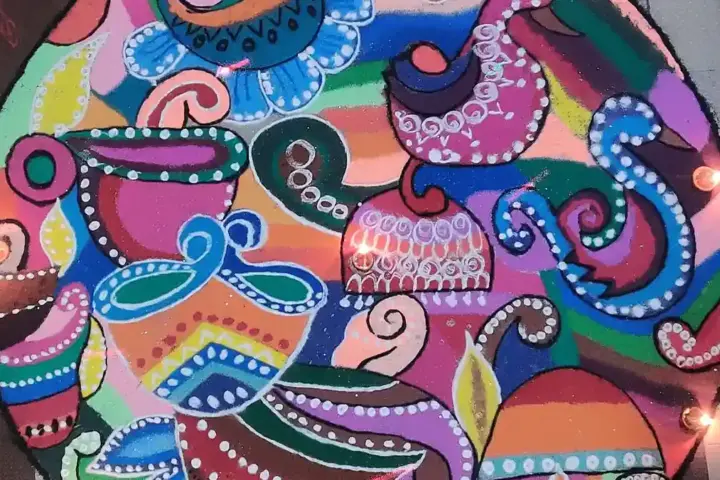
Cultural artistic traditions like Madhubani art use natural dyes that pose no environmental threat. These traditional approaches demonstrate that creating beautiful puja items need not require synthetic materials. Supporting artisans who continue these methods preserves cultural knowledge while protecting water resources. See Hindu art, Indian art, and Pigment.
Addressing water pollution from puja offerings requires action at multiple levels. Individual households can select clay idols painted with natural, water-based colors derived from plant extracts and mineral pigments. Communities can establish designated immersion sites with filtration systems that capture non-biodegradable materials before they reach natural water bodies. Regional governments can work with religious organizations to promote and distribute information about eco-friendly puja alternatives. See Water treatment and Eco-friendly.
Some communities have experimented with artificial water bodies and clay-based immersion zones designed to capture particles and allow controlled composting of biodegradable materials. These innovations allow the continuation of cherished rituals while minimizing environmental harm. See Composting.
Educational initiatives can help families understand the long-term consequences of their choices. When communities recognize that water pollution from puja offerings affects their own children’s health and local agriculture, motivation to change practices increases substantially. See Environmental health and Public health.
Priority PAA: How to reduce water pollution from festival puja offerings? Choose clay idols, use natural paints, and support sustainable immersion practices to protect water bodies and communities.
—