Karmactive Team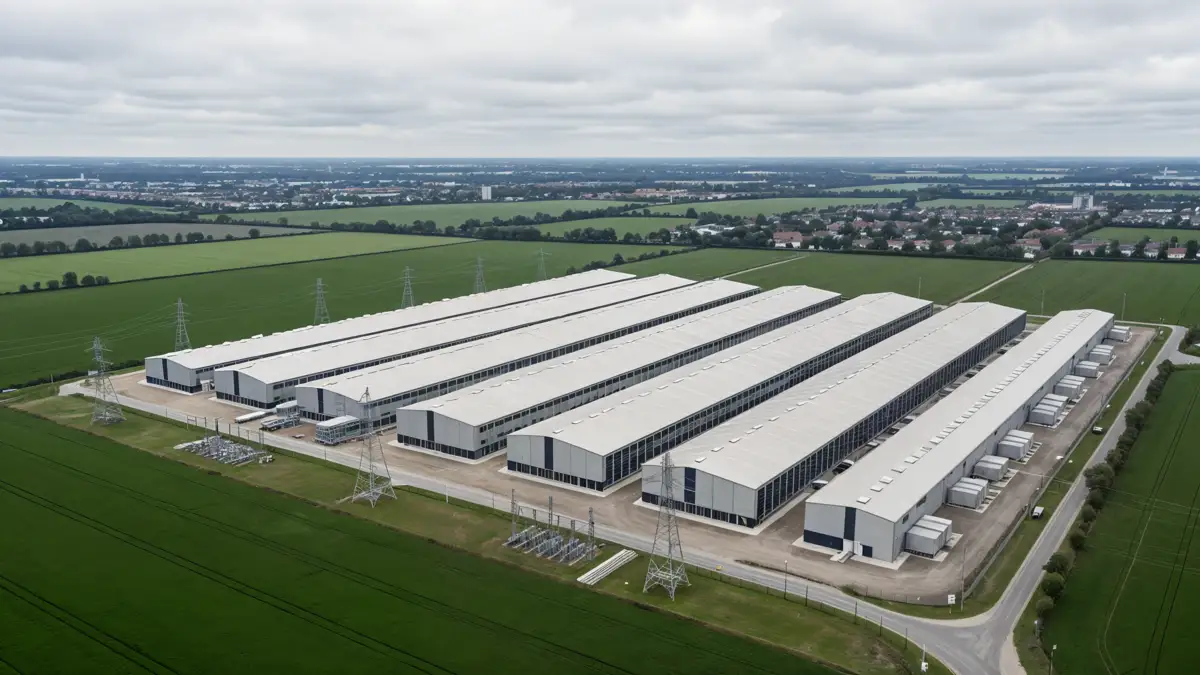
A proposed hyperscale data centre on the edge of London would become one of the largest in Europe and emit more than a million tonnes of carbon dioxide each year, according to planning documents.
The East Havering Data Centre Campus (EHDCC) in North Ockendon is being proposed by developer Digital Reef on 218 hectares of green belt land. The £14.7 billion project would house servers and data storage for artificial intelligence and cloud computing. If approved by Havering council, it would be one of the biggest data centres in Europe.
Planning documents state the development “does not align with a science-based 1.5C compatible trajectory and achieving net zero by 2050.” Over its projected 60-year lifespan, the campus is expected to generate more than 72 million tonnes of carbon dioxide equivalent. Once fully operational, it would release about 1.2 million tonnes annually.
That annual figure is equivalent to roughly 8,480 long-haul flights between London Heathrow and New York’s John F Kennedy airport, based on the UN’s International Civil Aviation Organization carbon calculator, which the documents reference.
The site would draw heavily on the power grid. At a likely 50 per cent load, Digital Reef estimates the campus would use 2.65 billion kWh of electricity a year. The average UK household consumes about 2,500 kWh annually, according to Ofgem, meaning the campus would demand as much power as more than one million homes. Britain’s grid operator Neso has told MPs that data centre developers have requested 72.8 gigawatts of electricity connections by 2039 — nearly 60 per cent more than the UK’s peak power demand last year, as set out in its energy review.
A 600 megavolt-ampere connection to the National Grid is planned through the nearby Warley substation. Because the existing site lacks capacity, major upgrades are scheduled, including a new 400 kilovolt National Grid substation and a 132 kilovolt UK Power Networks facility. The full connection is expected by 2033.
The proposal has drawn criticism. Donald Campbell, advocacy director at the tech justice nonprofit Foxglove, called the projected emissions “staggering” and a “big threat to the ability to decarbonise in the UK.” The North Ockendon Residents Association said the development would be a “massacre” of green belt land and warned of lost wildlife habitats and pollution.
The scale reflects a broader trend. The UK government designated data centres as “critical national infrastructure” in 2024. By early 2025, they accounted for about 2.5 per cent of the country’s electricity, a share the government predicted would quadruple by 2030.
By 2038, the EHDCC’s operational emissions alone are projected to equal nearly 20 times the entire carbon footprint of the borough of Havering and close to 1 per cent of the UK’s total carbon budget. The developer has proposed a cash-in-lieu carbon offset payment of about £77.6 million.
The first public consultation closed in April. A revised proposal is expected to be published for a further consultation in the autumn. For wider context on green technology and its trade-offs, see Giganectar.