 Karmactive Team
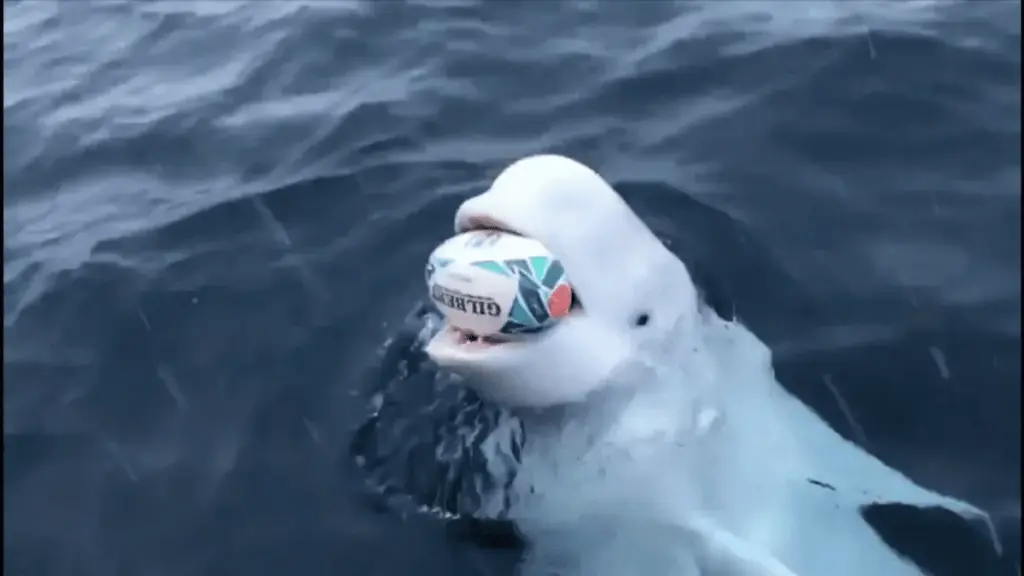
In this video a beluga whale is seen fetching a rugby ball for a lad somewhere near the north pole, in the arctic sea. Many have shared this video and it unclear who shot it or where exactly it was shot. It is seen in the video that the whale’s is very playful and friendly towards humans.
Many believe that this friendly whale is the famous Russian spy whale Hvaldmir. Hvladimir was spotted firstly in Norway on 26 April 2019 north of Hammerfest. He was seen wearing a camera harness labeled “Equipment St. Petersburg”. It was trying to free itself by rubbing against the boat.
Many tried to help Hvaldmir and finally a fisherman named Joar Hesten geared up & jumped into the water to help Hvaldmir. Due to its friendly nature and Russian connection it was named Hvaldmir. Hval means whale in Norwegian.
The mystery behind the Russian connection is still not clear, but many reports of beluga whales used for spying or other activities by Russians are floating widely on the internet. Even if the bizarre reality of Russian training might be true, Hvladimir remains a friendly and an outright cute whale.
Beluga whales, often called the “canaries of the sea” for their distinctive vocalizations, face mounting threats from climate change in the Arctic ecosystem. These medium-sized toothed whales rely on sea ice for hunting and migration, making them particularly vulnerable to habitat loss as global temperatures rise at unprecedented rates across polar regions that directly impact their prey availability and breeding success in the rapidly changing Arctic marine environment.
The Arctic is warming twice as fast as the global average, leading to unprecedented sea ice decline that directly impacts beluga whale populations throughout their range from Alaska to northern Canada and Russia where reduced ice cover affects their primary prey species including Arctic cod and various fish that form the foundation of their diet and depend on ice-associated ecosystems for survival.
Conservation efforts focus on protecting critical habitats through marine protected areas, regulating shipping traffic in Arctic waters to reduce noise pollution and collision risks, and monitoring population dynamics through acoustic tracking and visual surveys to better understand how changing ice conditions affect their survival rates and reproduction success across different life stages of beluga whales.
Community-based conservation programs engage Indigenous communities in Arctic regions who have coexisted with beluga whales for thousands of years, combining traditional ecological knowledge with modern research to develop sustainable management strategies that address both climate change impacts and localized stressors like shipping noise pollution and potential oil spills in previously ice-covered waters.
See related: beluga conservation.
See related: beluga whale threats.