Karmactive Team
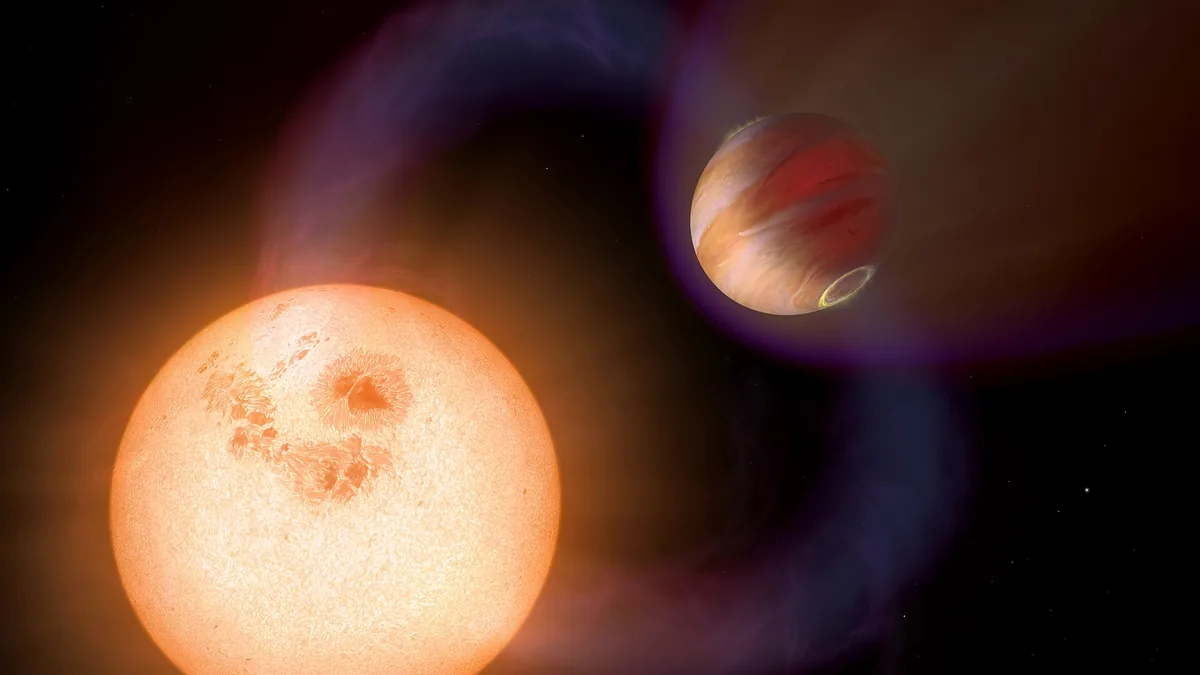
For seven years, NASA’s TESS space telescope watched a scorching giant planet cross in front of its star every 8.2 days, as regular as clockwork. Then, in March 2026, its shadow vanished completely.
TOI-2535 b is a “hot Jupiter” roughly 1,000 light-years from Earth, orbiting a K-dwarf star every 8.236 days. From 2019 to 2026, TESS tracked it closely, and its transit times began arriving up to six hours early or late — then stopped appearing at all. UCLA astronomers led by Samuel Yee and Erik Petigura traced the cause to an unseen, roughly Saturn-mass neighboring planet whose gravity is tilting TOI-2535 b’s orbit out of Earth’s line of sight, a discovery published in The Astrophysical Journal Letters.
The planet didn’t vanish — it just stopped crossing its star from our vantage point. This is the first confirmed case of astronomers catching an exoplanet‘s transit disappear in real time, and it means transit-hunting telescopes are effectively blind to TOI-2535 b for the next 30 to 50 years. It’s a useful reminder that short sky surveys can miss dynamic multi-planet systems entirely, and that spotting a hidden world sometimes requires watching for its gravitational fingerprints rather than the planet itself.
How a Hidden Neighbor Tilts a Hot Jupiter
Yee has compared the effect to watching two spinning tops that interact closely enough to wobble each other’s orbits — in his words, this is the most extreme example of that interaction astronomers have observed. Because TOI-2535 b has such a close neighbor, researchers suspect it formed by slowly spiraling inward through its system’s disk over time, rather than being violently flung into its current tight orbit, as some hot Jupiters are thought to have formed.
Confirming all this took more than TESS alone. A data gap in one early observing window caused the official catalog to initially record TOI-2535 b’s orbital period as roughly double its true value, and nine of fifteen ground-based telescope campaigns around the world missed the transit entirely as its timing kept shifting by hours. A ground-based radial-velocity spectrograph ultimately helped pin down the hidden neighbor’s approximate mass and orbital tilt.
Why did TOI-2535 b stop transiting its parent star?
Gravitational tugs from an unseen, roughly Saturn-mass neighboring planet tilted TOI-2535 b’s orbital plane out of Earth’s line of sight. Over seven years of NASA TESS observations, this mutual gravitational interaction caused both planets’ orbits to wobble, eventually moving TOI-2535 b’s transit out of view entirely by March 2026.
Astronomers now expect to wait decades before TOI-2535 b transits its star again — but they’re watching for signs that its hidden neighbor might transit sooner.