 Rahul Somvanshi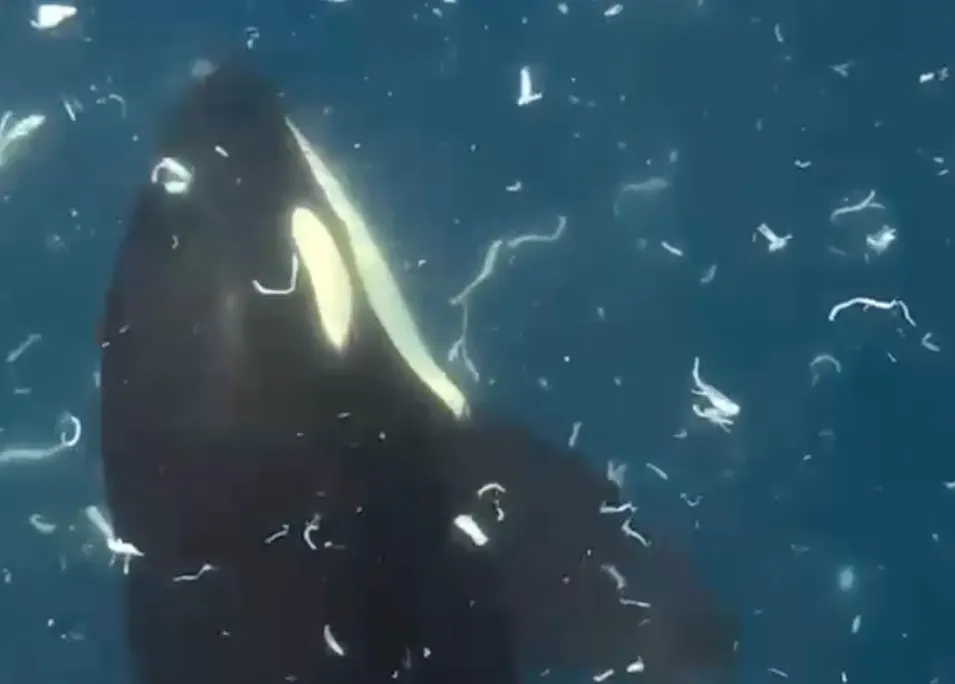
The video looks impossible. One orca grips a massive fish by the tail. A second accelerates from the depths. The fish detonates. Pieces drift through the water column.
This is not ordinary predation. This is something scientists had never documented — and now they finally have a name for it.
A study published July 23, 2026 in the journal Frontiers in Ethology describes what researchers call “ram-to-fragment” behavior, captured twice on video in Mexico’s Gulf of California. Orcas were filmed exploding a sharptail sunfish (Masturus lanceolatus) through a coordinated, high-speed strike that left the massive fish in pieces throughout the water column.
The sharptail sunfish is a close relative of the ocean sunfish — one of the strangest animals alive. It looks like a giant swimming head: flat, round, with no real tail and two small paddle-like fins. These fish move slowly, eat mostly jellyfish, and can grow up to 11 feet long, weighing as much as 4,400 pounds (2,000 kilograms). They are among the heaviest bony fish on Earth.
The first documented incident happened July 29, 2024, near San José del Cabo in Baja California Sur, Mexico. Kathryn Ayres, a research scientist at the marine conservation nonprofit Beneath the Waves, was in the water with five orcas — three adult females, one male, and a juvenile — when the behavior unfolded. One female held the sunfish by its tail. A second orca drove straight at the fish from below. At the last moment, the first orca released it. The collision was audible.
“I’d never witnessed one using such an incredibly forceful ramming technique that the tissue fragmented throughout the water column,” Ayres said. “It was like an explosion.”
A second event was filmed in September 2025 by a different observer, also in the Gulf of California, following the exact same coordinated sequence.
Co-author Jesús Erick Higuera Rivas, executive director of Orcas México, described the behavior in the published research as representing a high degree of cooperative precision — one orca stabilizing the prey while another delivered the fatal strike.
Crucially, both sunfish were already dead when the orcas found them. After the rams, a juvenile orca was seen feeding on the floating pieces — suggesting the behavior may function as shared meal preparation, breaking a carcass too large for a young whale into manageable portions. Scientists exploring marine life across the oceans continue to document how much orca behavior is still unknown to science.
Scientists aren’t ruling out a simpler explanation. Co-author Carlos Duarte, a marine ecologist at King Abdullah University of Science and Technology in Saudi Arabia, noted that it has “been speculated they might do this for fun.” Orcas are well documented for playing with prey, and the cooperative, social nature of what was filmed fits that pattern too.
Prior research recorded orcas preying on sunfish by targeting pectoral fins and extracting organs — but using a coordinated ram to shatter an entire carcass had never appeared in scientific literature before. Researchers who track shifting ocean conditions note that encounters between orcas and large prey may become more frequent as marine ecosystems change.
The footage spread widely after the study’s release. The behavior was documented twice, in the open Pacific waters off Baja California, Mexico.