 Sonali Tiwary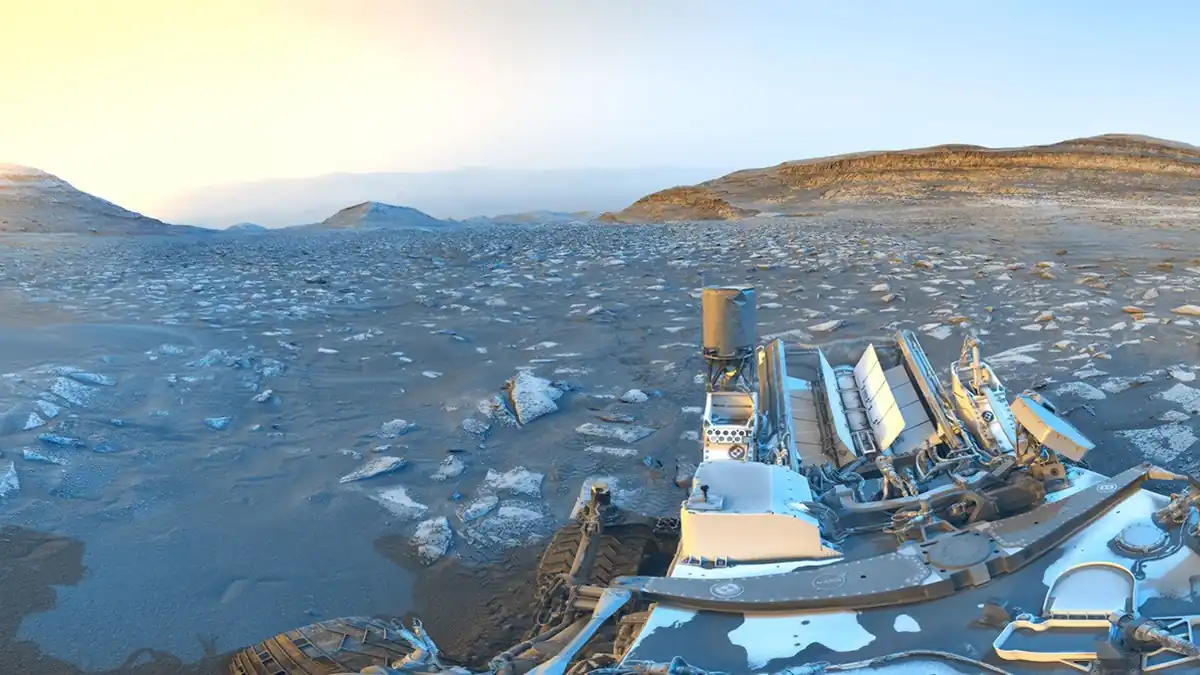
The image NASA published to mark the occasion looks like a postcard from another planet — because it is. What it isn’t is a photograph.
NASA’s Curiosity rover reached its 5,000th Martian sol — a Martian day — on August 29, 2026, equivalent to more than 5,137 Earth days since it landed on Mars in August 2012. A Martian sol lasts about 24.6 hours. Curiosity celebrated the milestone while positioned on the Chocolatal sand ridge inside Gale Crater, midway through its long climb up the slopes of Mount Sharp (Aeolis Mons). Since landing, the rover has gained 1 kilometre of elevation on that climb.
If you saw NASA’s Curiosity postcard from Mars, know that it is not a single photograph. NASA merged two black-and-white navigation-camera panoramas — one taken on the morning of August 30 (sol 5,000) and one on the evening of September 2 (sol 5,003) — and colourised them. The blue portions represent the morning image; the yellow portions represent the evening image. The split is an artistic decision made by humans on Earth. The postcard is a celebration of 5,000 days of exploration, not a literal view through the camera.
NASA’s Curiosity mission has been operating continuously on Mars for over 14 Earth years — longer than the Mars Science Laboratory mission designers planned at the outset. The rover was designed for a two-year primary mission. Its nuclear power source, a Multi-Mission Radioisotope Thermoelectric Generator, continues to produce usable electricity from the decay of plutonium-238, which has allowed Curiosity to outlast its original design life.
Gale Crater, where Curiosity landed, was selected because it contains geological evidence of ancient water activity. Mount Sharp, at the centre of the crater, is a layered mountain whose sediment layers represent billions of years of Martian geological history. Curiosity has been drilling into and analysing those layers — detecting organic molecules, measuring methane fluctuations and building a picture of a Mars that once had surface water and evidence that Mars once had a thicker atmosphere. See also: NASA Curiosity discovers ancient mud cracks and the Mars rover ‘jellyfish’ photo explained.
The 5,000th sol postcard is both a scientific and a communications milestone. NASA’s navigation cameras are black-and-white instruments designed for driving safety and terrain mapping. They are not colour cameras. The artistic colouring choice — blue for morning, yellow for evening — reflects the two different capture times. NASA identifies the postcard explicitly as “an artistic interpretation of the scene,” not a processed raw image.
What is NASA’s Curiosity rover 5,000th day postcard?
NASA’s Curiosity rover marked its 5,000th Martian day by releasing a composite panorama taken from the Chocolatal sand ridge in Gale Crater. The image merged two black-and-white navigation-camera panoramas from August 30 (sol 5,000) and September 2 (sol 5,003) and colourised them — blue for morning, yellow for evening. NASA describes it as an artistic interpretation, not a raw photograph.
How long has Curiosity been on Mars?
Curiosity has been on Mars for more than 5,137 Earth days as of August 29, 2026, when it reached its 5,000th Martian sol. A Martian sol lasts about 24.6 hours. The rover landed in August 2012.
NASA’s Curiosity mission continues. Future science updates from Gale Crater and Mount Sharp elevation milestones will be published to NASA Science’s mission blog.