 Sunita Somvanshi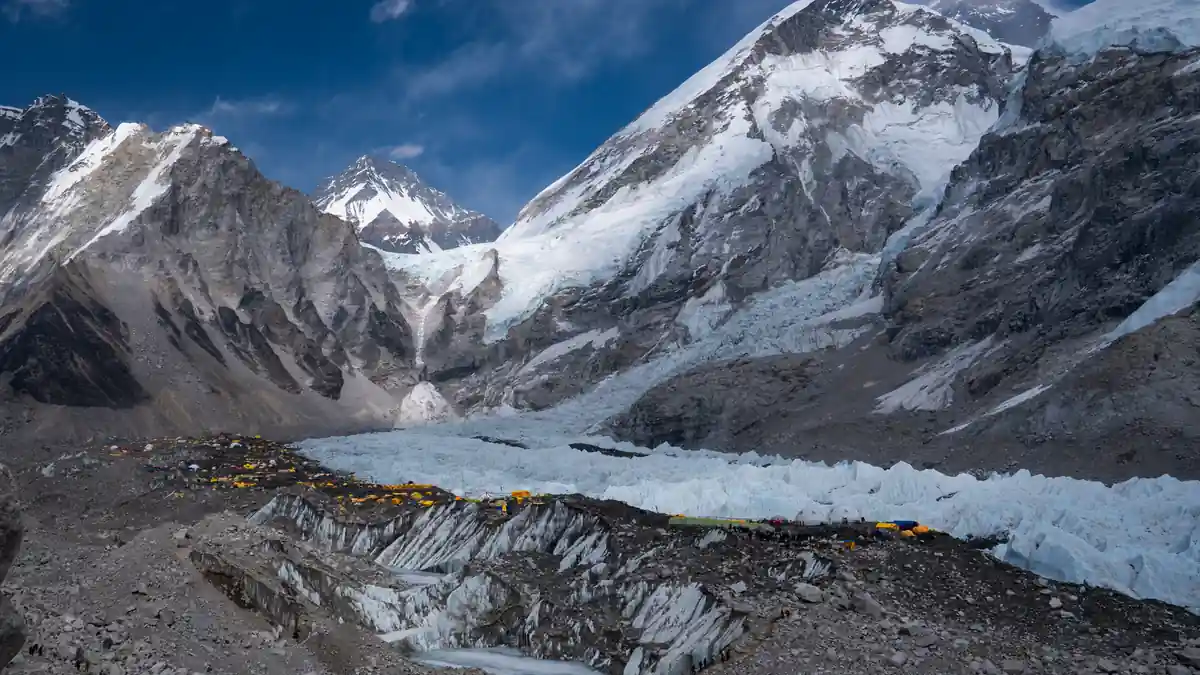
You have probably seen the headline: human urine is melting the glacier under Everest Base Camp. It is an easy story to share. It is also missing the full picture.
A peer-reviewed study published on July 27, 2026 in the journal Regional Environmental Change looked at how human activity at Everest Base Camp is affecting the Khumbu Glacier — the ice field on which the camp sits at about 5,364 metres above sea level. The researchers examined three contributors: global climate change, burning of fossil fuels at the camp, and human urinary discharge.
Their method was to calculate the total heat energy produced by all three. The combined figure came to roughly 849,174 megajoules — with an uncertainty range of plus or minus about 179,774 megajoules. Then they converted that energy into what it would theoretically melt. The result: approximately 2,492 tonnes of glacier ice and snow — again, with a margin of around plus or minus 528 tonnes.
Here is where the coverage went wrong. That 2,492-tonne figure is a heat-energy calculation converted into a melt equivalent. It is not a measurement of 2,492 tonnes of ice physically watched disappearing because of the camp. The researchers modelled the contribution of heat to the glacier — that is a meaningful and valid scientific finding, but it is not the same as saying the camp has already melted that much ice.
Of that total, urine accounts for approximately 154 tonnes of the calculated melt equivalent. That is real. It is significant. But it sits alongside the contribution from kerosene stoves, gas burners, and the broader warming of the climate itself. Urine is one factor in a system of several.
The most striking finding in the study gets far less attention than the urine angle. Researchers used satellite temperature data — from the Landsat series of satellites — to track how the surface temperature at Everest Base Camp has changed over time. Between 1991 and 2023, the surface temperature at the camp increased by approximately 0.28 degrees Celsius per year. That is roughly twice the warming rate of the Khumbu Glacier’s surface immediately next to the camp.
Think of it this way: the glacier nearby is warming, but the camp itself is warming about twice as fast. That gap is not explained by global climate alone. The human presence — thousands of climbers, guides, and support staff in peak season — is accelerating local warming beyond what the surrounding glacier experiences.
The study also notes that the current camp sits on the glacier itself, which creates the fundamental problem. The researchers identified two potential alternative sites southwest of the existing location that are on stable ground rather than active ice. Moving the camp off the glacier would not end tourism but it would remove the direct physical pressure of human waste and heat on the ice below.
The broader reality is that in a single spring climbing season, the camp hosts more than 1,500 people. That level of concentrated human presence, at that altitude, on a live glacier, was never part of any environmental plan when the first expeditions arrived decades ago.
—