 Tejal Somvanshi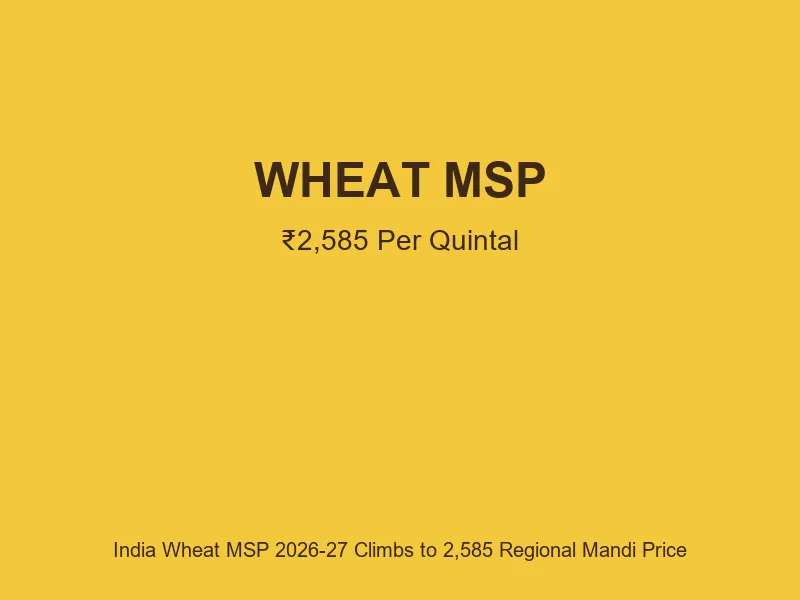
The Government of India announced the Minimum Support Price (MSP) for wheat during the 2026-27 agricultural season at ₹2,585 per quintal, an increase from ₹2,425 per quintal in the 2025-26 season. This MSP represents the floor price at which the government purchases wheat directly from farmers during the harvest season, protecting farmers from price collapse in commodity markets.
Observations of mandi (agricultural market) transactions during late August 2026 showed significant regional variation in wheat prices and market conditions. In Banda, Uttar Pradesh, the modal price (most frequently observed price) was ₹2,594 per quintal, tracking close to the MSP baseline. In Saharanpur, Uttar Pradesh, premium wheat varieties were trading at ₹3,063 per quintal, reflecting quality premiums above the MSP. In Ujjain, Madhya Pradesh, wheat prices ranged from ₹2,674 to ₹3,086 per quintal, while Neemuch reported prices between ₹2,560 and ₹3,100 per quintal.
Other commodity prices observed in late August included mustard seeds trading in Alwar, Rajasthan, at ₹8,250-8,458 per quintal. Guar seed prices in Jodhpur, Rajasthan, ranged from ₹6,186 to ₹6,550 per quintal. Agricultural commodity market trends show seasonal patterns.
A critical distinction must be made: MSP is not equivalent to mandi price. The MSP provides a guaranteed purchase price through government procurement agencies, but farmers retain the option to sell in the open market at whatever price prevails. When mandi prices exceed the MSP, farmers benefit from market premiums. Conversely, when mandi prices fall below MSP, government procurement through state agencies provides price support.
Several market drivers influenced late-August pricing. Post-harvest wheat arrivals from central and northern India supported supply levels in mandis. Flour mill demand remained steady heading into the festive season. Government buffer stock scrutiny and potential OMSS-D expectations created price signals in forward trading. The monsoon rainfall during the previous season supported adequate soil moisture for the upcoming rabi sowing of wheat and mustard crops beginning in October-November 2026.
Farmers and traders can access real-time mandi price data through the Agmarknet portal maintained by the Department of Agriculture and Cooperation, providing transparent information for informed sales decisions.