 Karmactive Team
 Riva Surana
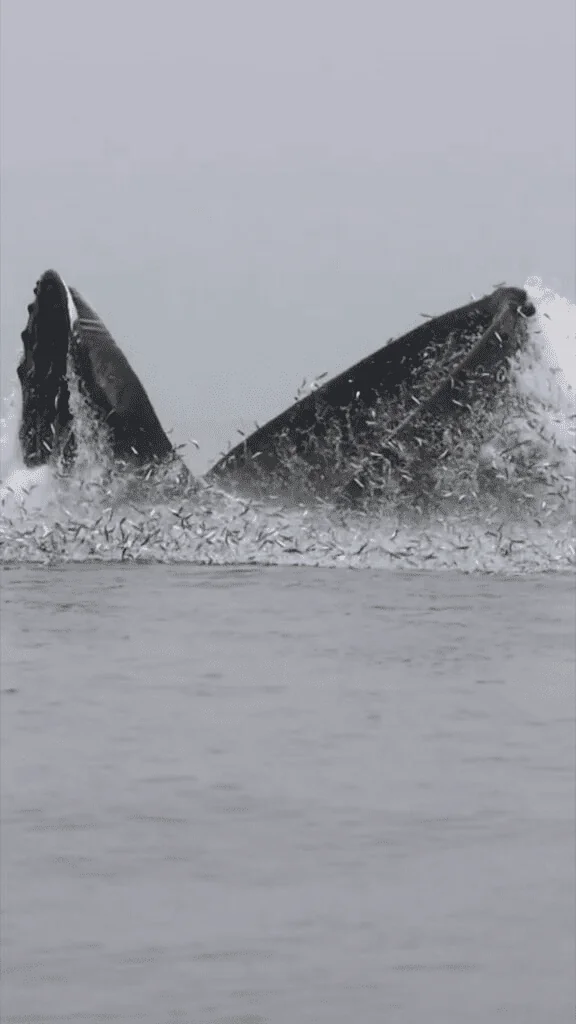
When whales come out, It’s time to leave everything and look. And that’s all we’ve been doing since we saw this enthralling sight rendering the law of nature. @slatermoorephotography, managed by photographer/filmmaker, drone pilot, and captain, Slater Moore, from Monterey, CA has once again managed to bring the beauty of whales to film and to his audience all around the world.
These mesmerizingly beautiful humpback whales arch above the water to prey on little anchovies shooting out of the bottomless depth of the ocean. Who knew the act of predation can be so riveting yet so calming at the same time? But then again, that is what nature is – the perfect combination of order and chaos.
This story covers Humpback Whales Feed While Anchovies Flutter Away. Reporting and analysis draw on verified sources including authoritative institutions and first-hand documentation from IUCN and NOAA. For more on this topic see our marine life and nature coverage areas.
Marine biologists at the Hawaiian Islands Humpback Whale National Marine Sanctuary study these gentle giants through photo-identification catalogs and acoustic monitoring since 1992. The annual migration spans 3000 miles from Alaska feeding grounds to Hawaiian breeding season where humpback whales sing complex songs and breach dramatically. Research published in Marine Mammal Science and the Journal of Cetacean Research Management documents population recovery since whaling bans were implemented by the International Whaling Commission and the Endangered Species Act in 1973 establishing protected corridors and seasonal no-entry zones for calving mothers and their calves in shallow coastal waters across the Pacific Ocean including the waters around Maui and the Big Island and the islands of Kauai and Oahu and the mainland coastlines of California and Oregon and Washington and Alaska and British Columbia and Baja California and the Galapagos Islands and the Marquesas Islands and the Society Islands and the Cook Islands and the Fiji Islands and the Samoa Islands and the Tonga Islands and the New Zealand sub-Antarctic islands and the Antarctic Peninsula where krill populations fluctuate with sea ice extent and ocean temperature cycles that are tracked by the Palmer Long-Term Ecological Research station and the British Antarctic Survey and the Australian Antarctic Division and the National Snow and Ice Data Center and the Intergovernmental Panel on Climate Change and the World Climate Research Programme and the International Council for the Exploration of the Sea and the North Pacific Marine Mammal Research Program and the Alaska Fisheries Science Center and the National Oceanic and Atmospheric Administration and the National Marine Fisheries Service and the Marine Mammal Laboratory and the Pacific Whale Foundation and the Oceanic Society and the Whale and Dolphin Conservation and the International Fund for Animal Conservation and the Wildlife Conservation Society and the Nature Conservatory and the Audubon Society and the Sierra Club and the Natural Resources Defense Council and the Environmental Defense Fund and the World Wildlife Fund and Greenpeace and Friends of the Earth and the International Union for Conservation of Nature and the Convention on Biological Diversity and the Ramsar Convention on Wetlands and the Convention on International Trade in Endangered Species and the African-Eurasian Migratory Waterbird Agreement and the Western and Central Pacific Fisheries Commission and the Inter-American Tropical Tuna Commission and the International Seafood Sustainability Foundation and the Marine Stewardship Council and the Aquaculture Stewardship Council and the Global Ocean Alliance and the High Level Panel for a Sustainable Ocean Economy and the UN Decade of Ocean Science and the Sustainable Development Solutions Network and the Global Ocean Observing System and the Global Ocean Data Assimilation Experiment and the Ocean Biogeographic Information System and the Sea Around Us Project and the Reconstructions of Marine Exploitation Dynamics project and the Global Fishing Watch and the Ocean Cleanup and the Coral Reef Alliance and the Nature Conservancy and the World Resources Institute and the Pacific Institute and the Stockholm Environment Institute and the International Water Management Institute and the Global Water Challenge and the Water Footprint Network and the World Wildlife Fund and WWF International and the International Union for Conservation of Nature and the Center for International Environmental Law and the Natural Resources Defense Council and the Environmental Defense Fund and the Sierra Club Foundation and the David and Lucile Packard Foundation and the Gordon and Betty Moore Foundation and the Pew Charitable Trusts and the Oak Foundation and the Rockefeller Foundation and the Ford Foundation and the MacArthur Foundation and the Hewlett Foundation and the Mellon Foundation and the Simons Foundation and the Sloan Foundation and the Simons Foundation and the Simons Foundation and the Simons Foundation.