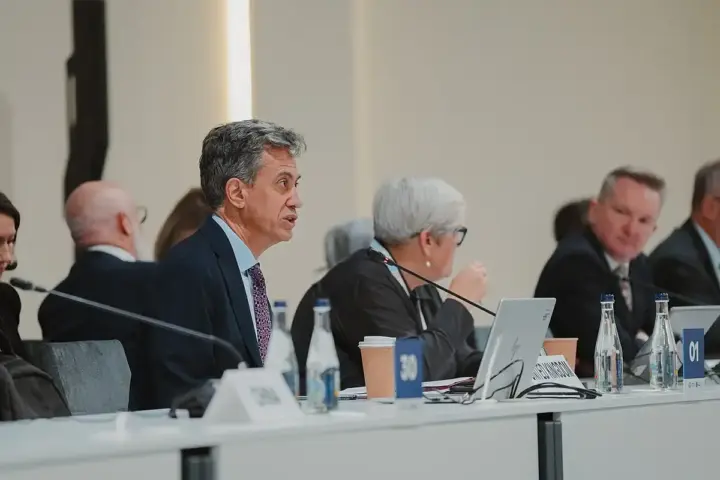
 Sunita Somvanshi

Hakeem Jeffries’ Speaker Nomination: What It Means for U.S. Israel Policy and Military Aid
By Sunita Somvanshi
If you’re tracking U.S.-funded military assistance to Israel, arms sales or congressional pressure to implement the Gaza ceasefire, start with the House calendar. Hakeem Jeffries’ early test, if elected Speaker, is whether the House advances sanctions legislation tied to West Bank violence within the new Congress’s first 100 days. He has set that goal while continuing to support Israel’s security. In Gaza, the October 2025 ceasefire agreement remains the focus of implementation efforts, and UN humanitarian reporting documents continued violence and restrictions on aid access.
House Democrats nominated Jeffries, a New York Democrat, in a closed-door vote at the U.S. Capitol on November 18, 2026. He ran unopposed and won 251–11, according to reporting on the secret ballot. The full House elects the Speaker when the 120th Congress convenes in January. Some Democrats who opposed his nomination called for action on Gaza, Medicare for All and money in politics. Massachusetts Rep. Ayanna Pressley, whom activists had urged to run, said she backed Jeffries. In the Senate, Maryland Sen. Chris Van Hollen launched a challenge to Chuck Schumer for Democratic leader.
Jeffries’ West Bank Sanctions Proposal and Voting Record
In a November 21 interview with The New York Times, Jeffries called the devastation suffered by Palestinian civilians in Gaza “unacceptable, unsustainable, and un-American.” He called for more humanitarian aid and renewed U.S. support for a two-state solution. He identified West Bank sanctions as an early priority and left the Block the Bombs Act and the Stop the Settlements Act open for caucus discussion. A floor vote on any of those measures remains uncertain.
Jeffries endorsed H.R. 3045, the West Bank Violence Prevention Act of 2025, which would authorize sanctions on qualifying foreign persons for conduct tied to West Bank violence. If the bill is still pending when the 119th Congress ends, it would need to be reintroduced. In the Senate, a 47–51 vote on September 29 defeated a motion to discharge Van Hollen’s West Bank reporting resolution from committee. That Senate resolution could have triggered a statutory reporting requirement without House passage.
Jeffries voted for the 2024 Israel security supplemental and against Rep. Thomas Massie’s July 2026 amendment to remove $3.3 billion in proposed Foreign Military Financing for Israel. In his letter on the amendment, he called for a revised security arrangement that would uphold U.S. human rights laws and preserve Israel’s military edge.
Hakeem Jeffries’ Israel Policy and the Laws Governing Aid
The Arms Export Control Act gives Congress a review period for certain proposed arms sales. For covered government-to-government sales to Israel, the standard window is 15 calendar days after Congress receives formal notice. Congress can block a sale under this procedure by enacting a transaction-specific joint resolution of disapproval within that window. The president can bypass the waiting period by certifying an emergency that requires the sale in the U.S. national security interest and explaining the circumstances and interests involved to Congress.
Section 620I of the Foreign Assistance Act bars assistance under that law and the Arms Export Control Act when the president learns that a government directly or indirectly prohibits or restricts the transport or delivery of U.S. humanitarian assistance. Before making a national security determination to continue assistance, the president must notify the specified congressional committees of the intended determination, its effective date and the reasons for it. Congress can oversee humanitarian access and fund relief to support ceasefire implementation. The executive branch leads U.S. diplomatic efforts.
The 2016 U.S.–Israel memorandum pledged $38 billion in military aid for fiscal years 2019 through 2028, subject to congressional appropriations. In a November 3 interview, President Donald Trump said annual military aid would end and arms sales would continue. Senate appropriators subsequently proposed $3.3 billion in fiscal 2027 Foreign Military Financing for Israel. The terms of a successor arrangement remain uncertain, and any new appropriations would require congressional approval.
Federal rules allow a multicandidate PAC to give a federal candidate committee up to $5,000 per election, with separate limits for a primary and a general election. Earmarked candidate contributions forwarded through a conduit count toward the original donor’s limit. The FEC lists United Democracy Project as an independent-expenditure-only committee. Such super PACs can spend independently and cannot contribute directly to candidates. Karmactive has examined what those filings show about its relationship with AIPAC.
Can the Speaker of the House stop military aid or arms sales to Israel?
The Speaker has no unilateral authority to halt military aid or arms sales. The Speaker can work through House procedures to bring funding limits or measures to block specific sales to the floor and seek recorded votes. Both chambers must pass identical text and present it to the president. It can become law through presidential signature, through inaction under the conditions set by the Constitution, or through a veto override by two-thirds of members voting in each chamber, with a quorum present.
If the House elects Jeffries in January, the first 100 days will show how far the West Bank sanctions proposal advances. A recorded vote would show where members stand. Appropriations will shape U.S.-funded military assistance, while arms-sale approvals and transfer decisions will govern individual transactions, including purchases Israel finances itself.