Karmactive Team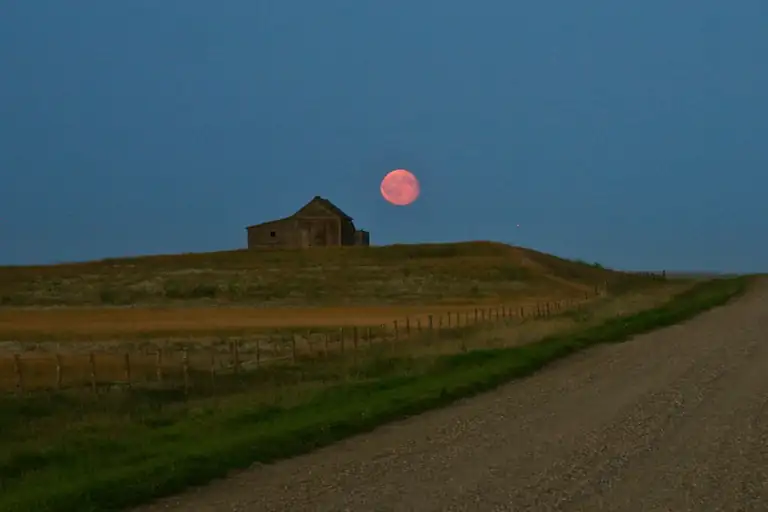
If you wake up before dawn on Friday, August 28, you can watch the Moon pass through Earth’s shadow. This partial lunar eclipse will plunge over 93 percent of the lunar disk into Earth’s umbra—the deep central shadow—making it an unusually deep partial lunar eclipse.
Greatest eclipse occurs at about 04:14 UTC (coordinated universal time), which translates to approximately 05:12 AM British Summer Time for UK observers. The Moon will appear low in the western sky at that moment, just before it sets below the horizon. US Eastern Time observers will see the event at approximately 00:14 AM on August 28 (just after midnight), while US Pacific viewers catch it around 21:14 on Thursday evening—their best viewing opportunity.
Here’s what happens during a lunar eclipse. The Sun, Earth, and Moon align with Earth in the middle. Earth’s shadow has two parts: the penumbra (the outer, faint shadow) and the umbra (the deep shadow where sunlight is almost completely blocked). During this eclipse, the Moon slides through the penumbra starting around 02:23 UTC, then enters the umbra starting around 03:33 UTC and reaches maximum eclipse at 04:14 UTC. By maximum eclipse, the Moon sits deep in Earth’s umbra, taking on a reddish color from sunlight that filters through Earth’s atmosphere.
That reddish tint happens because sunlight passing through Earth’s atmosphere is filtered so that more red and orange light reaches the Moon. Shorter blue wavelengths scatter away, while longer red wavelengths pass straight through. The exact shade depends on volcanic dust and pollution in Earth’s atmosphere—sometimes the Moon appears bright orange, sometimes deep red, sometimes almost black.
No protective glasses are necessary. Unlike solar eclipses, you can safely watch lunar eclipses with your naked eye, through binoculars, or with a telescope. The Moon isn’t bright enough to cause eye damage.
The full eclipse sequence for observers in London runs from the penumbral phase start at approximately 02:23 BST through the partial phase ending around 06:13–06:15 BST, with peak immersion at 05:12 BST. Total duration is about three and a half hours. Most observers focus on the 90 minutes around maximum eclipse, when the reddish coloration appears most vivid.
Cloud cover could be a problem depending on your location and August 28 weather patterns. Check local forecasts the evening before. If clouds block your view, NASA and other space agencies usually stream eclipse footage online.
The umbral magnitude shows 0.930—meaning over 93 percent of the Moon enters Earth’s deep shadow.
Set an alarm, brew coffee, find a dark spot with clear western skies, and spend 90 minutes watching the Moon redden. No equipment required.