 Sonali Tiwary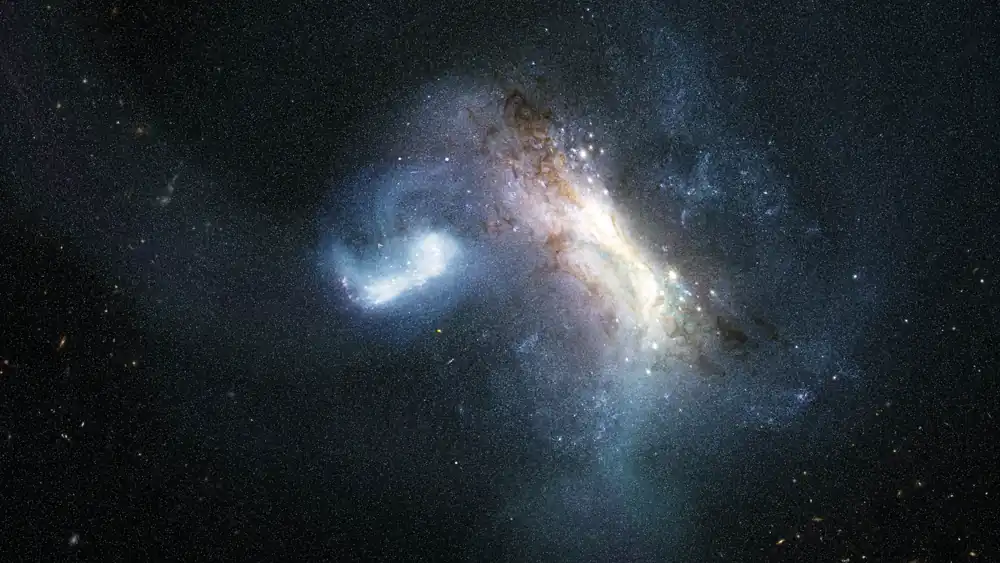
NASA’s Hubble Space Telescope has found clear evidence that a small galaxy crashed into the young Milky Way about 11.8 billion years ago, in the earliest chapter of our galaxy’s growth. The result was published in Nature Astronomy on 17 August 2026.
The intruder was a dwarf galaxy that the research team named LKH. According to NASA, the merger happened roughly two billion years after the Big Bang, or about 12 billion years ago. The discovery pushes our knowledge of the Milky Way’s assembly 1.8 billion years farther back in time than earlier records.
“Our home is the Milky Way galaxy, but we do not know how our house was built,” said lead author Davide Massari of the Astrophysics and Space Science Observatory of Bologna in Italy. The team studied 39 globular clusters – tight balls of tens of thousands to millions of stars – near the centre of the galaxy. These clusters act as archives because they preserve stars that the Milky Way gathered from other galaxies.
Globular clusters are among the oldest structures in the galaxy, with some of their stars formed more than 12 billion years ago. The Milky Way holds more than 150 such clusters, and their chemical makeup lets researchers trace where each was born – in the galaxy itself or in a smaller companion that was later absorbed.
The Milky Way became the large spiral galaxy it is today by forming new stars and by absorbing smaller neighbours. Two later mergers were already known: the Sagittarius dwarf galaxy, whose merger began more than six billion years ago and continues today, and the Gaia-Sausage-Enceladus event about 10 billion years ago. The LKH merger sits earlier still in that timeline. Other work has tracked fast-moving stars through the Milky Way that also record its violent past.
Hubble is a joint project of NASA and the European Space Agency, operated by the Space Telescope Science Institute. The LKH finding was described as the strongest proof yet of a major merger in the Milky Way’s first billions of years.