 Govind Tekale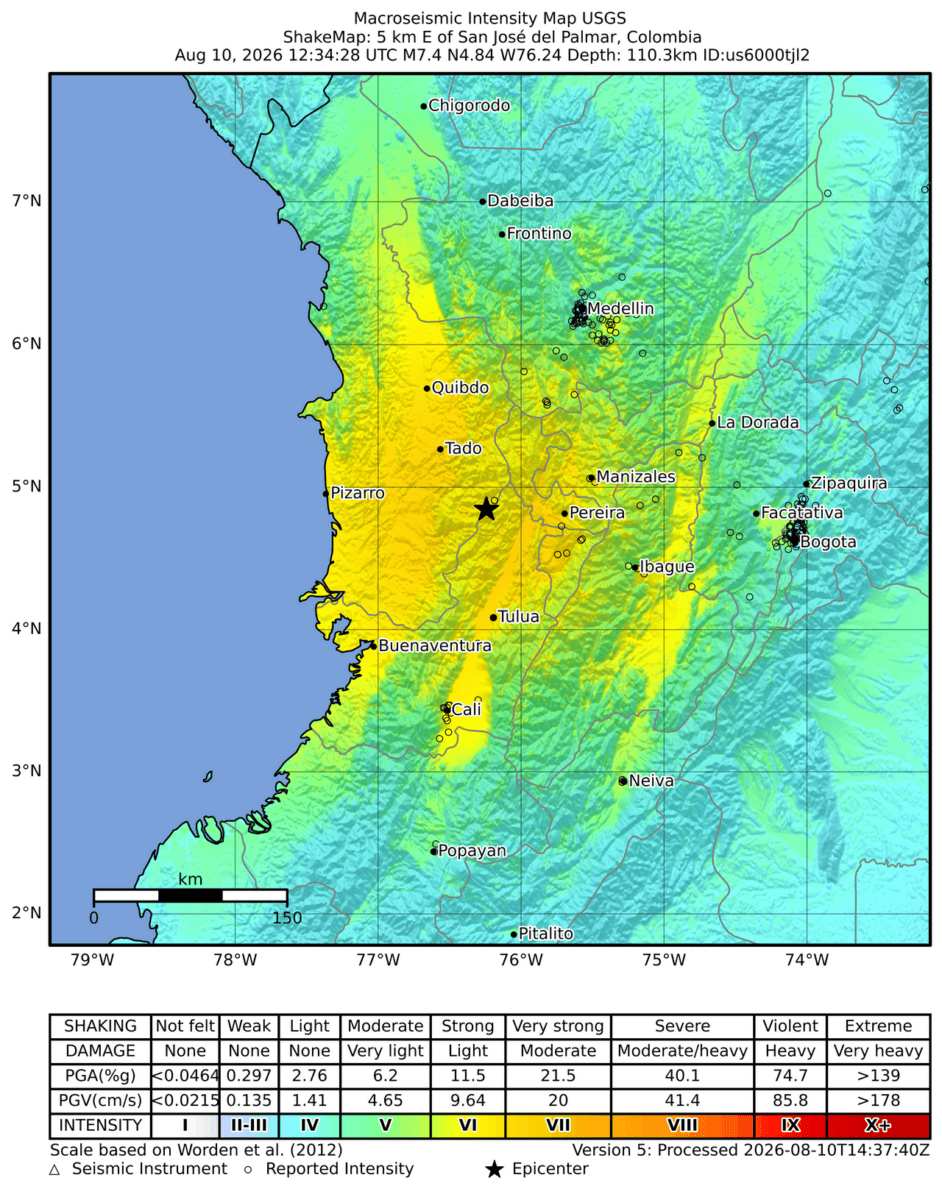
Estimated reading time: 1 minute
A 7.4-magnitude earthquake struck western Colombia on August 10, 2026, at 12:34 UTC (7:34 am local time), sending tremors across the nation into Ecuador. The epicenter was near San José del Palmar in Chocó department—a region vulnerable to multiple hazards.
Within hours, “earthquake today” queries surged over 1,000%, and “colombia earthquake” emerged with 10,000+ searches. This is not anomaly. This is Colombia’s geological reality: the nation sits atop one of Earth’s most seismically unstable regions.
The Human Toll
The earthquake became the deadliest to strike Colombia this century. President Abelardo de la Espriella declared a national state of emergency and gave an initial toll of 111 dead. The Colombian Association of Capital Cities subsequently reported at least 132 killed and 570 injured, while Reuters confirmed more than 100 dead as buildings pancaked and hospitals were damaged. Later tallies put the figure at 124 or more killed, over 620 injured, and more than 1,900 people reported missing. Risaralda department alone accounted for at least 40 confirmed deaths. Rescue crews worked through the night to reach survivors trapped beneath rubble.
These deaths are the measure of the preparedness gap. A magnitude 7.4 event is survivable with enforced seismic building codes; the toll reflects decades of construction that was never designed to withstand the forces this region reliably produces.
The Epicenter
The August 10 earthquake originated in Chocó department, a mountainous region sitting directly above the subduction interface where tectonic forces accumulate stress. San José del Palmar, home to approximately 6,000 residents, is constructed largely with older building standards not designed for seismic forces.
The tremors propagated across Colombia with sufficient force to reach Bogotá (500 kilometers away) and Ecuador. This widespread felt area indicates substantial energy release and demonstrates how Andean seismic events impact entire subregions.
The Subduction Zone Context
Colombia’s seismic vulnerability stems from geography. The Andean subduction zone is responsible for some of Earth’s most powerful earthquakes—the 1960 Great Chilean Earthquake (magnitude 9.5) remains the largest instrumentally recorded earthquake in history. Earthquakes of magnitude 6.5 to 7.5 are characteristic of Colombia’s segment.