 Sonali Tiwary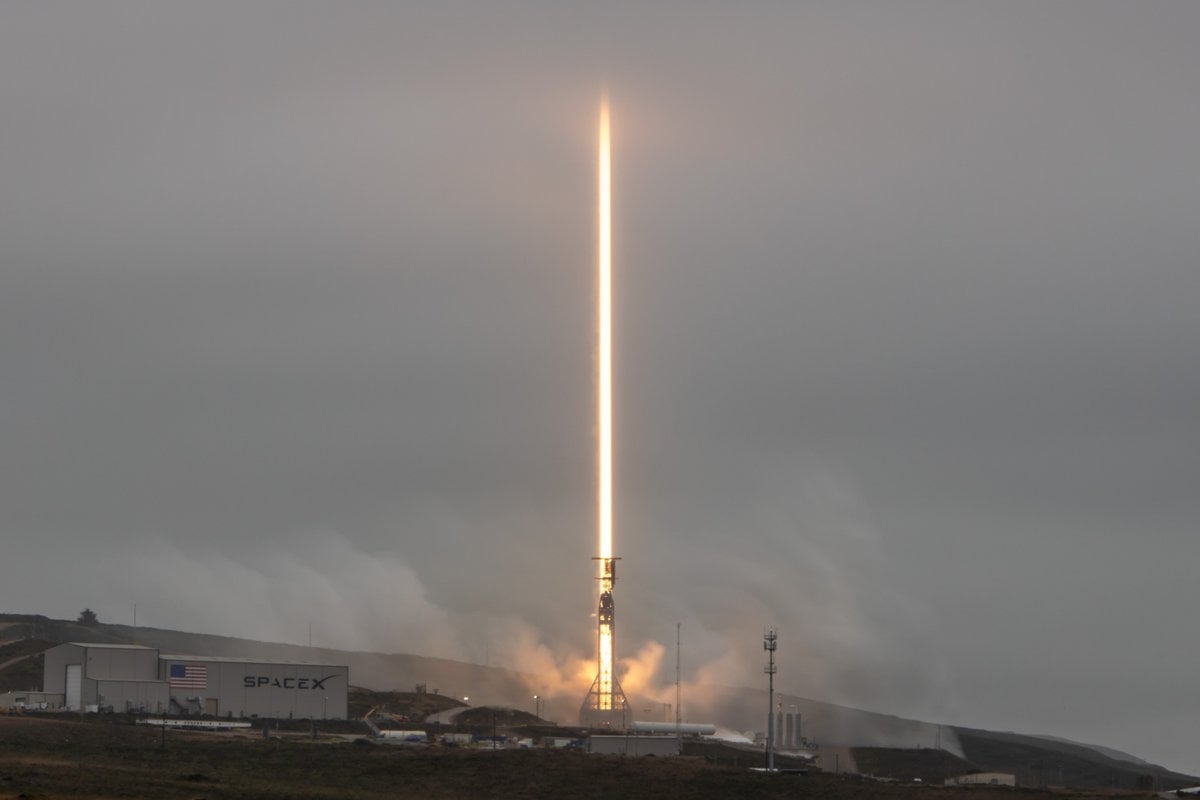
Estimated reading time: 6 minutes
A spent SpaceX Falcon 9 upper stage rocket is set to collide with the moon on August 5, 2026, at 6:35 UTC, creating a new crater and potentially visible debris plume near Einstein Crater. This isn’t a catastrophic space disaster—the moon isn’t a populated destination—but it marks a rare scientific opportunity to observe an artificial impact in real-time and highlights growing space debris concerns as lunar activities expand.
The object in question, cataloged as 2025-010D, has been drifting in Earth-moon space since January 15, 2025, when it launched carrying Firefly Aerospace’s Blue Ghost lunar lander and Japan’s ispace Resilience lander. After successfully deploying its cargo, the upper stage entered a chaotic orbit that gradually brought it toward lunar impact.
The Physics of Impact
The rocket stage will strike the lunar surface at approximately 5,400 miles per hour (8,700 kilometers per hour, or 2.43 kilometers per second). At this velocity, the object’s kinetic energy will vaporize most of the rocket material on impact, excavating a crater estimated around 89 feet (27 meters) across.
The moon’s lack of atmosphere means the rocket won’t experience air resistance or slow down before impact. On Earth, similar objects burn up during reentry. On the moon, there’s nothing to slow them. The energy release will be entirely kinetic—pure momentum converting to explosive excavation.
Scientists estimate the ejecta plume could reach heights of several miles into space above the impact site. Lunar dust and rock fragments will be scattered across the crater floor and surrounding terrain. For perspective, this is similar in energy to a small explosion—nothing dramatic by terrestrial standards, but measurable on the moon’s static surface.
Why Scientists Are Excited
The impact creates an unprecedented scientific opportunity. Astronomers rarely observe artificial impacts on the moon in real-time. Most previous lunar impacts were either unplanned (uncontrolled spacecraft crashes decades ago) or the results were observed after-the-fact via orbital imaging.
This event, announced months in advance with precise timing, allows coordinated observation. NASA’s Lunar Reconnaissance Orbiter (LRO) will pass over the impact site approximately seven days before and seven days after impact, capturing before-and-after high-resolution imagery. This before-after comparison lets scientists measure impact parameters and test models of crater formation physics.
The impact flash—the moment when kinetic energy converts to light and heat—should last about one second. It might be bright enough to see from Earth telescopes in optimal conditions, though it will be difficult because the impact occurs near the moon’s limb (edge) as viewed from Earth. Impact locations near limb edges are poor for observation because the impact happens at low angles relative to Earth’s viewing position.
Nonetheless, professional and amateur astronomers are mobilizing worldwide to attempt observation. Research teams have published preliminary papers calling for coordinated observation campaigns, expecting the scientific community to contribute imaging data that will improve understanding of lunar impact mechanics.
The Space Junk Problem
This incident, while scientific opportunity, also exemplifies growing space debris concerns. Earth orbits contain approximately 34,000 tracked pieces of debris larger than 10 centimeters, plus millions of smaller pieces. As space commercialization accelerates—private lunar missions, commercial space stations, satellite mega-constellations—debris accumulation accelerates.
The Falcon 9 upper stage that will hit the moon was left-over from a deep-space mission. Typically, such stages should enter Earth’s atmosphere and burn up during reentry, preventing accumulation in space. But this stage managed to reach a chaotic orbit that bypassed Earth reentry opportunities repeatedly until it was pulled toward the moon.
Future lunar missions will be increasingly frequent as multiple nations and companies pursue moon exploration. Each mission adds temporary debris. Managing this growing population requires tracking, collision prediction, and sometimes active debris removal strategies. Current capability is minimal—most operators rely on passive observation rather than active prevention.
Detection and Tracking History
Astronomer Bill Gray from Project Pluto first predicted this specific impact on April 29, 2026. Gray specializes in near-Earth object and space debris tracking using amateur telescope surveys and orbital computation software. His prediction included not just the date and time but the specific lunar coordinates—near Einstein Crater on the moon’s western limb.
This precision was possible because the rocket’s trajectory has been predictable for months. Unlike asteroids entering from deep space with initial uncertainty, space debris already in known orbits can be precisely calculated. Gray’s prediction exemplifies how astronomical expertise combined with computational power enables months-long forecasting of space events.
The announcement, made public well before impact, has generated international interest among astronomers. It’s rare that impact predictions are available this far in advance. Most celestial events (meteor showers, planetary transits, eclipses) are predictable, but impacts on other celestial bodies usually aren’t known ahead of time.
Observation Challenges
The impact occurs on August 5, 2026, at 6:35 UTC. This converts to local times worldwide—early morning in America, afternoon in Europe, evening in Asia. Observers in North and South America have the best viewing geometry, though even there, catching the debris plume will be challenging.
The impact site is near Einstein Crater, located at approximately 90 degrees lunar longitude, 16 degrees northern latitude. This places it near the moon’s western limb. As viewed from Earth, western limb impacts are difficult to observe because the impact occurs at a shallow angle to Earth’s line-of-sight. The plume, if visible, would appear as a brief brightening near the limb’s edge.
Professional observatories with large telescopes have the best chances. Amateur astronomers with 8-inch or larger telescopes in dark skies might detect the plume under ideal conditions. Those with smaller telescopes should expect the event to be invisible despite its high-profile predictions.
Historical Precedent
This isn’t the first artificial impact on the moon. In September 2009, NASA’s Lunar Crater Observation and Sensing Satellite (LCROSS) was deliberately crashed into the moon to study subsurface composition. That impact was planned as a scientific investigation. This August 5 event is unintentional but scientifically valuable nonetheless.
Previous accidental moon impacts occurred decades ago when early spacecraft fell uncontrollably. Observations were limited because those events weren’t anticipated far in advance. This 2026 impact represents a unique combination: unintended event, precise advanced prediction, and coordinated scientific response.
Looking Forward: Debris Management
As lunar activity increases—NASA’s Artemis program, private lunar landers, commercial resource prospecting—debris accumulation becomes serious. Unlike Earth orbit where debris can be tracked, lunar surface is vast and monitoring is spotty. Objects like the Falcon 9 upper stage represent future challenges.
Solutions remain embryonic. Active debris removal (using spacecraft to capture and de-orbit debris) works in principle but is expensive. Passive deorbiting (using atmospheric drag or lunar gravity manipulation) is slow and uncertain. Prevention through better mission planning (ensuring rocket stages enter atmosphere or impact safely) is most practical but varies by mission and operator.
The August 5 impact will provide data helping scientists understand lunar impact mechanics—information valuable for protecting future lunar assets from collision. So this unplanned debris impact, while evidence of a real problem, simultaneously offers science that addresses the problem going forward.
For now, astronomers are watching, LRO is positioning its camera, and scientists worldwide are ready to analyze the data. The moon, inactive for decades except for rovers, will crater again. This time, humans will observe it carefully.