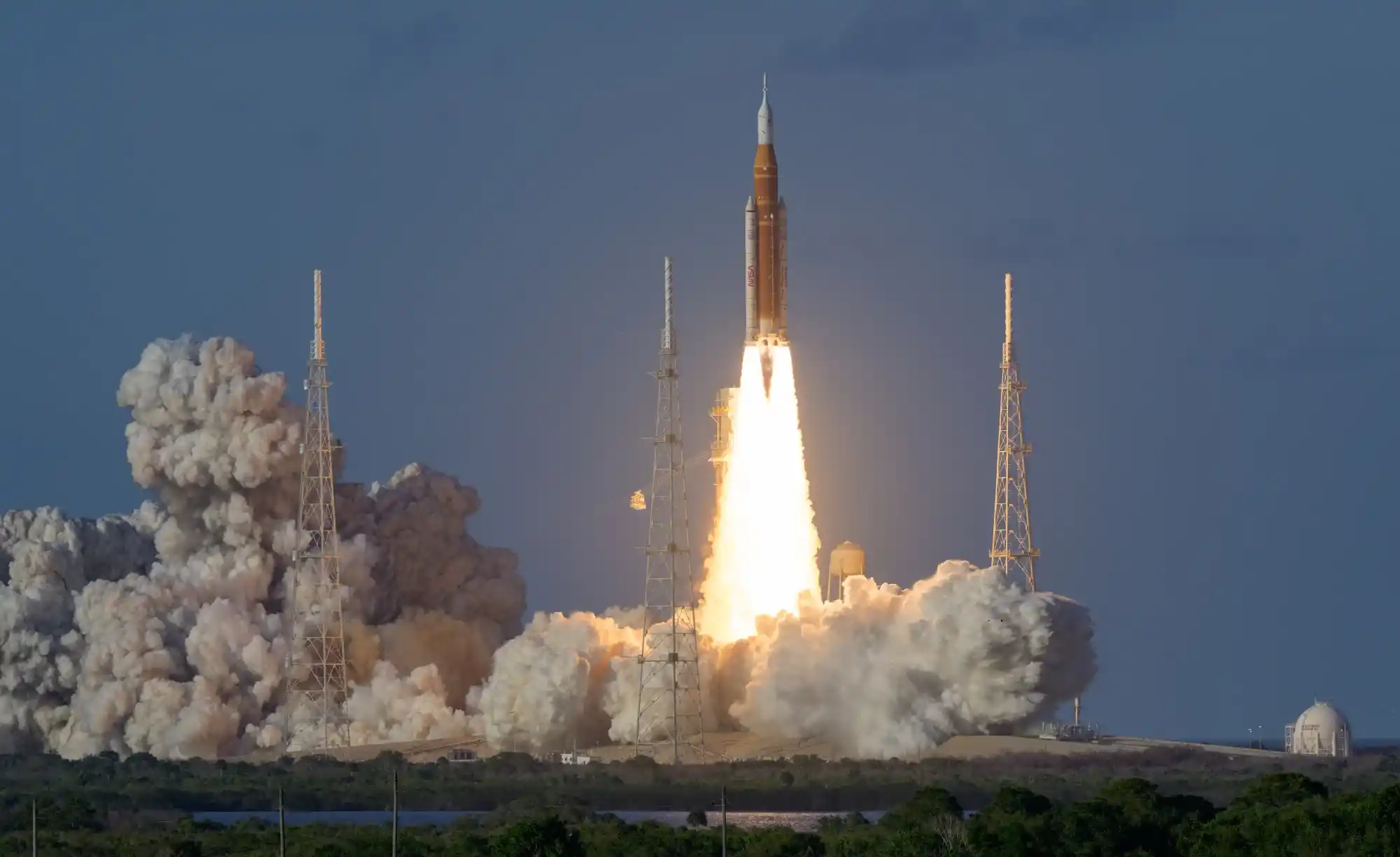
At 6:35 p.m. ET on April 1, 2026, NASA’s Artemis II mission lifted off from Launch Complex 39B at Kennedy Space Center in Florida. Four astronauts — Commander Reid Wiseman, Pilot Victor Glover, Mission Specialist Christina Koch, and Canadian Space Agency astronaut Jeremy Hansen — are aboard the Orion spacecraft, named Integrity, for a 10-day journey around the Moon. This is the first time humans have traveled toward the Moon since Apollo 17 in December 1972.
The mission follows the uncrewed Artemis I flight test in 2022 and is designed to verify that the Orion spacecraft and its European Service Module can safely carry a crew through deep space — beyond Earth’s protective magnetic field. Artemis III, planned for mid-2027, is now a low Earth orbit rendezvous and docking test with commercial landers, while Artemis IV in 2028 is targeted as the first crewed lunar landing since Apollo 17.
By the Numbers
8.8MPounds of Thrust at Liftoff
17,000MPH at Main Engine Cutoff
252,799Miles from Earth (farthest point)
~4,700Miles from the Moon at Closest Approach
10Days · Full Mission Duration
53+Years Since Last Crewed Lunar Mission
The Crew
Meet the Four Astronauts
The first humans to journey toward the Moon since Apollo 17.
Commander
Reid Wiseman
NASA · USA
U.S. Navy test pilot. Previously served on the ISS in 2014. Leads the Artemis II crew as mission commander.
Pilot
Victor Glover
NASA · USA
Will manually pilot Orion within 30 feet of the ICPS upper stage — without a laser rangefinder — using visual distance judgment alone.
Mission Specialist
Christina Koch
NASA · USA
Holds the record for the longest single spaceflight by a woman (328 days aboard the ISS, 2019–2020). Will be the first woman to travel toward the Moon.
Mission Specialist
Jeremy Hansen
CSA · Canada
First Canadian — and first non-American — to travel beyond Earth’s orbit. This is his first spaceflight. Grew up on a farm near London, Ontario.
“We have a beautiful moon rise. We’re heading right at it.”
— Commander Reid Wiseman, aboard Orion, April 1, 2026
Mission Flow
Day-by-Day: What Happens Next
Select a phase to follow Orion’s journey.
T+0:00 · Apr 1
Liftoff from LC-39B
SLS generates 8.8 million pounds of thrust. Four RS-25 engines and two solid rocket boosters propel Orion skyward at 6:35 p.m. ET.
T+8.5 min
Main Engine Cutoff — 17,000 MPH
SLS core stage separates. Orion reaches orbital velocity — 23 times faster than the speed of sound.
T+50 min
ICPS Apogee Raise Burn
The Interim Cryogenic Propulsion Stage fires to raise Orion’s highest orbital point to over 43,730 miles above Earth, placing the spacecraft on its translunar path.
T+3.5 hrs
Proximity Operations Demonstration (RPOD)
ICPS separates and becomes a target. Victor Glover manually pilots Orion to within 30 feet of the upper stage using only visual angle judgment — no laser rangefinder. The 70-minute test verifies manual docking skills needed for future lunar missions.
T+~12 hrs · Apr 2
Perigee Raise Burn
Crew wakes at 7 a.m. ET to prepare for a burn that lifts the lowest point of Orion’s orbit, stabilizing the path toward the Moon.
Days 3–4
Translunar Injection — Leaving Earth Orbit
Orion fires its main engine to break free of Earth orbit and set course for the Moon. The crew crosses Earth’s protective magnetic field into deep space.
Days 3–5
AVATAR Radiation Experiment Active
The crew’s own bone marrow cells (on an “organ-on-a-chip”) are monitored for radiation damage in real time as Orion traverses the Van Allen belts. M-42 EXT dosimeters record data at six times the resolution of Artemis I sensors.
Days 3–5
O2O Laser Communications Test
Artemis II is the first crewed mission to test infrared laser communications (O2O system), enabling a 260 Mbps downlink — enough to send 4K video from the Moon’s far side back to Earth.
Day 6
Closest Approach — ~4,700 Miles from the Moon
Orion passes its closest point to the lunar surface. Crew enters the Moon’s shadow — communication blackout for approximately 30 minutes while flying over the far side.
Day 6
Record Distance — 252,799 Miles from Earth
Artemis II will travel 4,144 miles farther from Earth than Apollo 13 — setting a new human spaceflight distance record based on this trajectory.
Day 6
Possible “Earthrise” Photograph
NASA officials have discussed the crew seeking an Earthrise image — Earth appearing above the lunar horizon — similar to the iconic Apollo 8 photograph from 1968. No images are confirmed live, but they will be released to the public.
Days 7–9
Return Transit to Earth
Orion fires its engine to leave the Moon’s vicinity on a free-return trajectory — a path that uses the Moon’s gravity to slingshot back toward Earth without a powered burn.
Day 10
Re-entry & Splashdown
Orion’s heat shield faces temperatures up to 5,000°F during re-entry. The capsule deploys parachutes and splashes down in the Pacific Ocean, where recovery teams will retrieve the crew.
Artemis II is the first crewed flight of the Orion spacecraft. The SLS rocket’s four RS-25 core stage engines have a deep history: three of them — E2047, E2059, and E2061 — flew previously on Space Shuttle missions, while the fourth, E2062, is built from shuttle-era heritage flight spares and had never flown before. Engine E2047 is the most veteran of the group, with 15 shuttle flights to its name, first launching in June 1998 on Space Shuttle Discovery’s STS-91 — the final Shuttle-Mir docking mission. E2059 flew five shuttle missions, and E2061 flew two, including Space Shuttle Endeavour’s final flight in 2011.
NASA Administrator Jared Isaacman defined what mission success looks like: the Artemis II crew must complete the full 10-day journey and splash down safely. “No early off ramps,” he said at the post-launch news briefing. Minor issues logged in the first hours of flight — a brief communication uplink outage at 51 minutes (since resolved) and a blinking fault light on the waste management system — are being actively managed by mission control. Engineers believe the toilet sensor issue is a calibration problem rather than a mechanical failure.
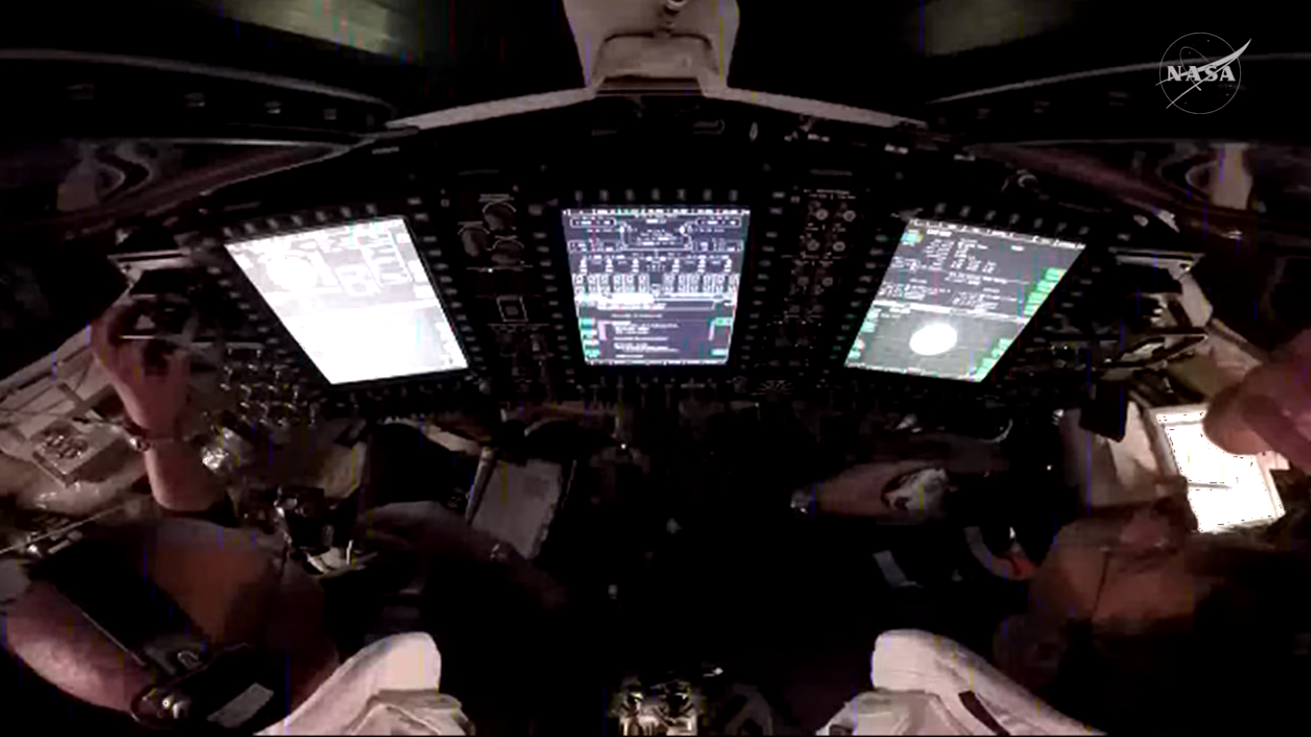
Victor Glover and Reid Wiseman monitor Orion’s flight data during the proximity operations demonstration. Navigation relies on onboard displays and crew judgment — no automated rangefinder. Photo: NASA
Technology
Three Technologies Being Tested for the First Time
Tap each to learn what Artemis II is proving in space — and why it matters.
Unlike the automated docking systems used at the International Space Station, Victor Glover manually flew Orion within 30 feet of the detached ICPS upper stage using only visual angle judgment — measuring how large the target appears through the window and camera — to estimate distance. Orion carries no laser rangefinder for this test. This skill is essential for future missions requiring manual docking at the Lunar Gateway, where automated systems may be unavailable.
⬤ Closest approach: ~30 ft⬤ Duration: ~70 minutes⬤ No laser ranging — visual only
🧬
Cellular Radiation Mapping
AVATAR Experiment + M-42 EXT Dosimeters
▼
The AVATAR (A Virtual Astronaut Tissue Analog Response) experiment uses the crew’s own bone marrow cells on an “organ-on-a-chip” to monitor radiation damage at a cellular level in real time as Orion traverses the Van Allen radiation belts. The M-42 EXT dosimeters developed by DLR record radiation data at six times the resolution of sensors used on Artemis I. This data will directly inform radiation safety standards for the Lunar Gateway and future long-duration deep-space missions.
⬤ 6× higher resolution than Artemis I⬤ Real-time cellular monitoring
💡
Deep Space Laser Communications
Orion Artemis II Optical Communications (O2O)
▼
Artemis II is the first crewed mission to test infrared laser communications instead of traditional radio waves. The O2O system enables a 260 Mbps downlink — fast enough to transmit 4K ultra-high-definition video from the Moon’s far side. Traditional radio systems used on Apollo could transmit only low-quality black-and-white footage. This technology, if validated, will serve future missions requiring high-bandwidth scientific data transfer from deep space. You can read more about NASA’s deep space optical communications experiments in our earlier coverage.
⬤ 260 Mbps downlink⬤ Infrared laser — first crewed test⬤ 4K video capability
Power Comparison
How SLS Stacks Up Against Other Rockets
Thrust at liftoff, in millions of pounds of force.
Liftoff Thrust (millions of lbs)
SLS (Artemis II)
8.8M
Saturn V
7.6M
Space Shuttle
5.3M
Falcon Heavy
5.0M
Starship
16.7M
Source: NASA. Starship figure from SpaceX prototype tests. SLS is currently the most powerful operational rocket in the world.
Secondary Payloads
Four Countries. Four Science Experiments.
CubeSats launched with Artemis II will study radiation, space weather, and deep-space technologies.
🇦🇷
Argentina · CONAE
ATENEA
Investigates radiation shielding materials, orbital design optimization, and long-range communications in high Earth orbit.
🇸🇦
Saudi Arabia · SSA
Space Weather CubeSat-1
Measures radiation, solar X-rays, solar energy particles, and magnetic fields to build a clearer picture of the space weather environment.
🇩🇪
Germany · DLR
TACHELES
Demonstrates in-space technologies, including electrical components intended for future lunar logistics vehicles and surface operations.
🇰🇷
South Korea · KASA
K-Rad Cube
Measures space radiation and its biological effects across the Van Allen radiation belts — data essential for protecting future astronauts on longer deep-space missions.
Artemis II is the second flight of the Space Launch System rocket. If the 10-day mission concludes successfully, it clears the path for Artemis III, which is scheduled for mid-2027 as an Earth-orbit rendezvous and docking test flight — Orion will dock with one or both commercial human landing system vehicles (SpaceX’s Starship HLS and Blue Origin’s Blue Moon) in low Earth orbit to validate docking systems before any crewed lunar surface attempt. Artemis IV, planned for 2028, is now the mission targeted to make the first crewed lunar landing since Apollo 17, with NASA aiming for the Moon’s south pole region. Blue Origin has a contract to develop the Blue Moon MK2 lander for the Artemis V mission.
Canada’s role in the Artemis program extends beyond Jeremy Hansen’s seat on this mission. The Canadian Space Agency is providing the Canadarm3, an advanced robotic system planned for future lunar infrastructure. Blue Origin, which has a contract to develop the Blue Moon MK2 lander for the Artemis V mission, was represented at Kennedy Space Center by CEO Dave Limp, who wished the crew a safe journey. The CSA’s official mission logbook is being updated daily as the mission progresses.
“There’s no data that tells us the range between us and ICPS. We will be using subtended angles: how big the upper stage looks out the window or through a camera — and so we are the primary hazard avoidance system — these eyes.”
— Pilot Victor Glover, ahead of the Proximity Operations Demonstration
Summary
Where Things Stand
The Artemis II mission has been covered here from launch at Kennedy Space Center through the crew’s initial orbital activities, including the proximity operations demonstration, apogee raise burn, and deployment of four international CubeSats. The four-person crew — Wiseman, Glover, Koch, and Hansen — is currently aboard Orion as the spacecraft transitions toward translunar operations. The mission’s manual piloting test, radiation monitoring experiments, and laser communications system have all been described as part of this 10-day flight test. Mission control continues to assess minor systems issues, with the crew and spacecraft otherwise performing as expected.
Rahul, possessing a profound background in the creative industry, illuminates the unspoken, often confronting revelations and unpleasant subjects, navigating their complexities with a discerning eye. He perpetually questions, explores, and unveils the multifaceted impacts of change and transformation in our global landscape. As an experienced filmmaker and writer, he intricately delves into the realms of sustainability, design, flora and fauna, health, science and technology, mobility, and space, ceaselessly investigating the practical applications and transformative potentials of burgeoning developments.
Local media in Bihar and Uttar Pradesh have reported protests and complaints over Pradhan Mantri Awas Yojana beneficiary lists, with allegations that ineligible households were included while genuinely homeless rural families were
# Cornell Gang Rape Case Reopened: Prosecutors Convene Grand Jury After 2-Year Silence A woman’s story changed. A prosecutor reconsidered. Now a college gang rape allegation faces fresh scrutiny two years after
South African President Cyril Ramaphosa announced a sweeping national response on Tuesday, ordering every municipality to identify and clean up high-risk areas after the bodies of 12 women were discovered in an
Australian daylight saving starts this Sunday, 4 October 2026. If you’re in one of the five participating states or territories, you lose an hour of sleep this weekend. If you’re working a
A Delta Air Lines flight from Barcelona to Boston diverted to Porto Airport on Sunday 27 September 2026 after smoke was detected in the passenger cabin. All 296 passengers landed safely. Eight
If you’re traveling home for Diwali or Chhath this October on a concession ticket, quota reservation or railway pass, what you carry determines whether your travel authority remains valid. Central Railway’s month-long
Hurricane Polo made landfall Monday evening north of Cabo San Lucas in Baja California Sur as a Category 3 storm with sustained winds of 115 miles per hour, the National Hurricane Center
Five men arrested in connection with an alleged terror plot targeting RAF Fairford were released on police bail Monday, less than 24 hours after their detention, raising urgent questions about the pace
Warren County Kentucky Police Chase: 100 mph I-65 Pursuit Ends in Arrest with Attempted Murder Charges A 100 mph police chase crossed one state line Sunday, starting in Tennessee and ending in
Mumbai is charting a new course for water security with the launch of Maharashtra&8217;s first large-scale seawater desalination plant at Manori in the northern suburbs. The Brihanmumbai Municipal Corporation&8217;s ambitious project marks
The Supreme Court has declined to halt the implementation of a merchant discount rate (MDR) on UPI payments above ₹2,000 beginning October 15, dealing a setback to a public interest litigation that
A protestor speaking from a video reel has criticized the recent felling of a 1,500-year-old cedar tree on Vancouver Island, describing the logging as “criminal” and questioning whether its use for a
Five men have been arrested near RAF Fairford on suspicion of preparing a terrorist act, with police investigating a possible Iran link to the plot. Explosives were found at the site, and
A magnitude 3.6 earthquake struck near Hermosa Beach in the South Bay area of Los Angeles on Saturday, with the epicentre located approximately six kilometres west-southwest of the city. The event was
A High Wind Warning is in effect for parts of Maui on September 27, with the National Weather Service also reporting high-surf and high-wind hazards across Hawaii County on the Big Island.