 Jonathan Santosh
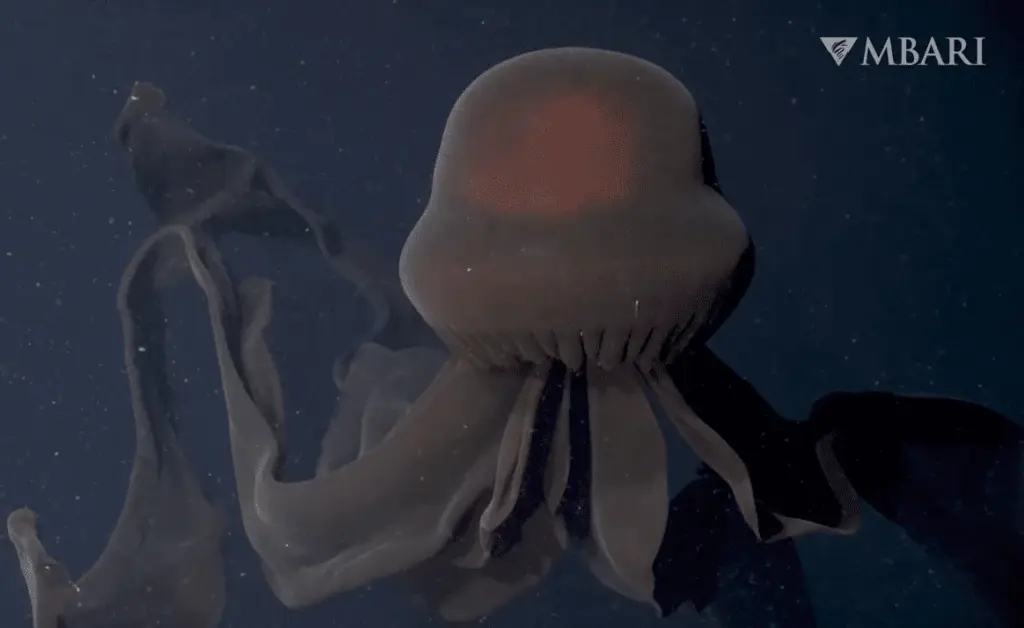
The Monterey Bay Aquarium Research Institute encountered the elusive Giant phantom jelly. This is only the 9th confirmed sighting for this particular species. Using their new ROV Doc Ricketts, MBARI was able to dive to the depths that the creature calls its home. The Stygiomedusa gigantea is notoriously hard to spot but the vehicle was able to capture high-quality videos even at a depth of 990 meters below the sea.
David Packard founded the institute in 1987 to promote interest in the ocean and develop the technology necessary to study it.
See: giant.
See: giant.
The rare giant phantom jellyfish belongs to a family of deep-sea creatures that inhabit the deepest ocean trenches where extreme pressure, near-freezing temperatures, and complete darkness create otherworldly environments. These gelatinous organisms have evolved translucent bodies that provide camouflage in the perpetually dark abyssal zone where bioluminescent capabilities enable communication, hunting, and defense through light-producing chemical reactions. Scientists studying phantom jellyfish have discovered that these creatures possess unique propulsion mechanisms involving rhythmic bell contractions that generate water jets for locomotion while their trailing tentacles extend to capture prey. The relationship between phantom jellyfish and their deep-sea ecosystems represents a window into one of Earth’s least explored environments where unique evolutionary adaptations have produced organisms with extraordinary capabilities that challenge our understanding of life’s limits and potential for survival in extreme conditions across the vast expanse of our planet’s ocean realm and beyond, where similar creatures may exist in extraterrestrial oceans beneath ice layers on moons like Europa and Enceladus, where the extreme conditions of high pressure, low temperature, and complete darkness create environments analogous to Earth’s deep ocean trenches that harbor unique ecosystems and challenge our understanding of life’s potential across the universe through continued exploration and research that advances scientific knowledge and discovery of novel biological processes and ecological relationships that operate under extreme environmental conditions where specialized biochemical pathways, structural modifications, and behavioral strategies differ fundamentally from those found in shallow-water environments.
The rare giant phantom jellyfish belongs to a family of deep-sea creatures that inhabit Earth’s deepest ocean trenches. These gelatinous organisms possess unique propulsion mechanisms involving rhythmic bell contractions that generate water jets for locomotion while their trailing tentacles extend to capture prey including copepods, small crustaceans, and other tiny organisms. The deep-sea environment where these creatures live presents extreme conditions including crushing pressures, near-freezing temperatures, and complete darkness that challenge conventional understanding of life’s limits.
Scientific expeditions to study phantom jellyfish have revealed bioluminescent capabilities that enable communication, hunting, and defense through light-producing chemical reactions creating ethereal glow patterns visible in the perpetually dark abyssal zone. These remarkable organisms also exhibit transparent or translucent body structures that provide camouflage against predators and prey in the dimly lit depths where sunlight never penetrates and where pressure exceeds 1,000 atmospheres, requiring specialized protein structures, membrane compositions, and cellular adaptations that allow these creatures to survive and thrive under extreme environmental conditions.