Sunita Somvanshi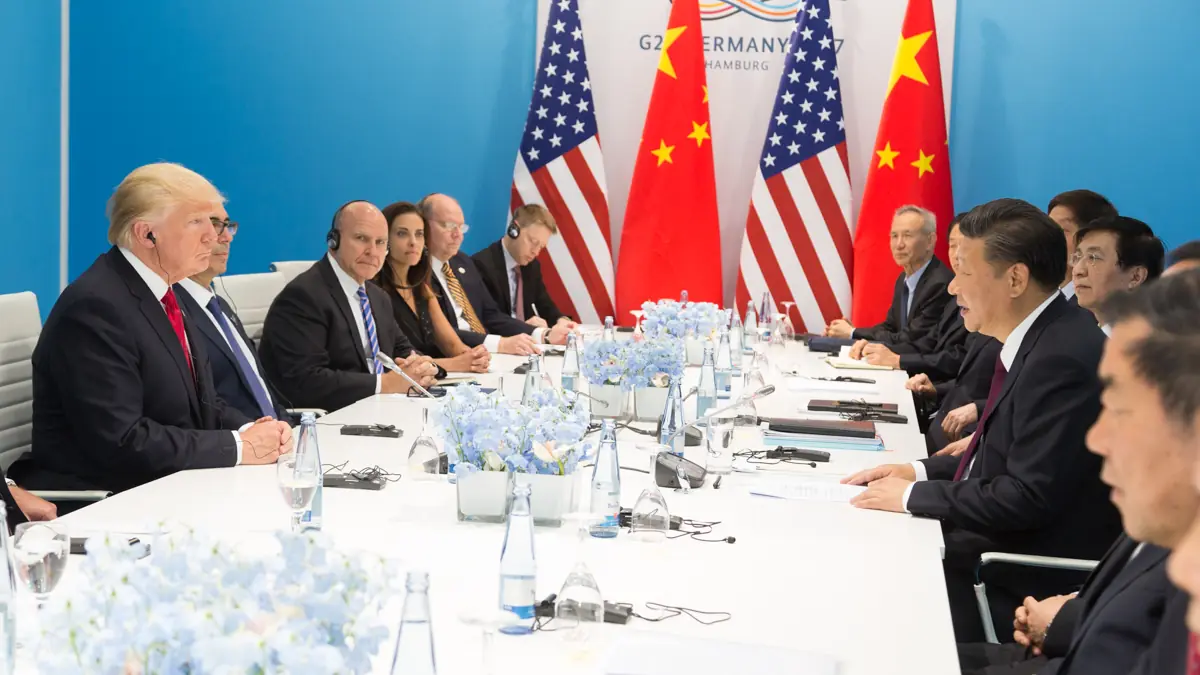
US President Donald Trump and Chinese President Xi Jinping are meeting in Washington this week, with talks covering artificial intelligence governance, semiconductor export restrictions and sanctions enforcement. For anyone watching US-China relations, the question is not whether the two governments disagree — it is which disagreements they can actually resolve in a single summit.
The White House meeting is drawing attention across technology, finance and foreign policy. Topics on the table include AI safety protocols, possible US sanctions tied to Iran, rare-earth supply chains and Taiwan. China has pushed for semiconductor export controls and access to advanced AI chips to be on the agenda, though US Trade Representative Jamieson Greer indicated these were not part of the preliminary American agenda going in. No comprehensive agreement is expected. What is possible is a narrower set of working-level commitments — and for the technology sector, even a narrow deal on AI communication could matter.
If you work in technology, manufacturing or any sector affected by US-China trade policy, the summit’s most practical impact is likely to come through what gets agreed — or quietly shelved — on chip exports and AI rules. A new communication channel on AI incidents reaching national-security level is the most concrete outcome most analysts expect. Structural changes to trade policy are unlikely from a single meeting.
What AI talks actually involve
CNBC reports that US and Chinese officials have discussed creating a formal AI dialogue specifically for managing incidents that reach national-security level. The same report states that a formal agreement to slow AI development is considered extremely unlikely. The dialogue framework, if finalized, would be the most concrete technology-policy outcome of the talks.
The semiconductor issue is where the two sides remain furthest apart. China has built growing capacity in AI computing, reusable rockets, electric vehicles, solar panels and rare-earth processing, according to CNN. The US has used export controls to limit China’s access to advanced chips used to train frontier AI systems. Whether any relief or further restriction emerges from this meeting depends on whether both governments value a deal more than the leverage they currently hold.
Iran adds a separate complication. NPR reports that US concerns about Chinese companies potentially circumventing American sanctions on Iran will be on the agenda. This tension has resisted resolution through multiple previous rounds of US-China talks.
On rare earths, China produces a large share of the materials used in advanced electronics, electric vehicles and military hardware. This supply-chain dependence has driven US investment in domestic mining and processing, but neither side is close to a position where that dependence can be quickly replaced. The supply-chain angle — including electric vehicles and solar panels — represents the point where trade policy and energy economics overlap most directly, though the summit agenda frames it primarily as a trade and strategic issue rather than a climate one.
What an AI safety channel would mean in practice
The AI communication framework under discussion would allow the US and China to exchange information rapidly when an AI-related incident appears capable of escalating into a national security crisis. This is less about limiting AI development and more about preventing miscalculation — a lower bar, and therefore more achievable.
China has been explicit that it will not accept restrictions on its own AI development as a precondition for any agreement. The US position has focused on preventing Chinese access to the most advanced chips used to train frontier AI systems. Those two positions leave limited room for a comprehensive agreement but do leave space for a narrower communication mechanism. Both sides have an interest in avoiding an AI-related incident spiraling into something larger due to a lack of channels.
The distance between a communication channel and binding limitations on AI development is significant. Competitors and critics of both governments will argue that a dialogue framework is largely symbolic without enforcement mechanisms. That argument is not wrong — but it also applies to most of what is achievable in a bilateral summit between the world’s two largest economies.
Taiwan remains the deepest structural disagreement between the two governments. Both sides are expected to discuss strategic stability, with no formal agreement likely.
The most useful thing to watch for after this summit is not a headline deal — it is which working-level conversations are confirmed to continue, and whether any formal AI dialogue mechanism gets scheduled dates. Those details will determine whether the summit produced anything durable.
Closure: Talks are ongoing. Officials have not confirmed a timeline for any formal agreements. Updates on AI safety protocols and chip-export rules are expected as negotiations continue.