 Govind Tekale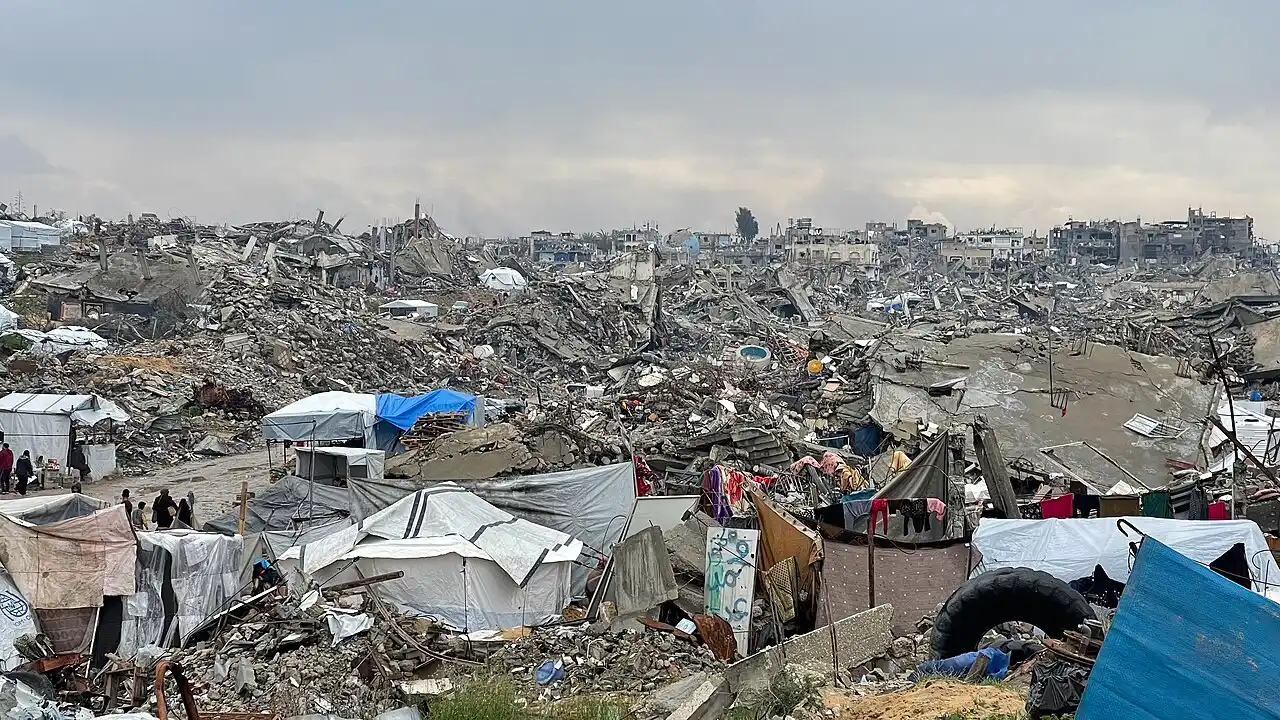
Palestinians are returning to northern Gaza on foot in growing numbers, walking past collapsed buildings because no road remains passable by car. A father carries his daughter on his shoulders for the final stretch — one of many families heading home beginning January 27, 2025 under the cease-fire deal reached that month, to neighborhoods they haven’t seen in nearly two years, without knowing what, if anything, is still standing.
The return follows the January 2025 cease-fire deal, reached after nearly two years of war triggered by the Hamas-led October 7, 2023 attack on southern Israel. Under the agreement, Hamas released four female Israeli soldiers held hostage, and beginning January 27, 2025, displaced residents were permitted to move back toward the north in stages. Humanitarian officials estimate the numbers walking back are in the hundreds of thousands, though no single authority has published a precise, verified count. Aid groups say most families are traveling on foot because vehicle routes remain damaged or blocked, and many are returning to see their own neighborhoods for the first time since fleeing.
For the hundreds of thousands of Palestinians displaced from northern Gaza, walking home carries both hope and real danger. Readers following the story need a clear sense of what returnees will actually find — destroyed infrastructure, unexploded ordnance in rubble, and humanitarian aid access that remains uneven at best. The practical stakes are immediate: families are choosing between an uncertain return home and continued shelter in the south, often without functioning information about which streets, water lines, or buildings are safe.
### The Infrastructure Gap No One Has Mapped
Nearly two years of war left northern Gaza with damaged water networks, downed power lines, and rubble fields that have not been cleared or surveyed for unexploded munitions. Returning families are, in effect, walking into a zone that has not been formally certified as safe, because no comprehensive assessment of the area has been completed since fighting stopped. Aid organizations operating in the strip say they lack the staffing and access needed to clear ordnance at the pace people are moving back, which means the risk of injury from unstable debris is highest in exactly the neighborhoods residents are most eager to reach.
The return is unfolding alongside the January 2025 Gaza cease-fire deal, which also brought the release of Israeli hostages held by Hamas, including four female soldiers freed that month. Weeks later, in February 2025, Trump publicly floated a separate proposal to relocate Gaza’s population to Egypt and Jordan while the territory was rebuilt — a plan that stood in direct tension with residents actively moving back into the north rather than out of it. That February 2025 proposal is distinct from the 20-point peace plan Trump announced in September 2025, which became the framework for the ceasefire that followed. Egypt and Jordan both rejected large-scale resettlement of Palestinians on their territory, and no formal reconstruction plan for northern Gaza was agreed by the parties involved in the January 2025 cease-fire talks.
The contrast is hard to miss: the same administration that floated a plan in February 2025 to empty Gaza of its population had, weeks earlier, allowed hundreds of thousands of Palestinians to walk back into the north. That tension between a stated depopulation proposal and an actual, visible repopulation on the ground has gone largely unaddressed in coverage focused only on the numbers returning.
**Are Palestinians allowed to return to northern Gaza?**
Yes. Beginning January 27, 2025, under the cease-fire deal reached that month, Palestinians streamed back into northern Gaza on foot, and humanitarian officials describe the movement as continuing rather than a one-time event. That said, Israeli military restrictions on specific routes, combined with unmapped unexploded ordnance and destroyed infrastructure, mean the return carries real safety risk even where it is formally permitted.
Families are choosing to walk back into northern Gaza before roads, water, and power have been restored, because home is home even in ruins. What happens next depends on reconstruction funding, ordnance clearance, and whether the cease-fire holds through the next phase of releases. Check back as return numbers, infrastructure assessments, and cease-fire developments continue to unfold in the coming weeks.